He sought no personal glory, no riches, and no fame,
For service to the Motherland remained his life’s true aim.
He lit the lamp of wisdom and built organizations strong,
Inspiring workers and farmers to unite for a cause lifelong.
He never chased a position, nor sought applause or praise,
His dedication to the nation illuminated all his days.
From the shakha came a message of duty, courage, and pride,
That service, sacrifice, and unity must always be our guide.
Time may change its seasons, and generations come and go,
But the seeds of selfless service continue to bloom and grow.
Dattopant Ji’s life reminds us, through every trial and test,
That placing the nation first brings purpose to our quest.
Dattopant Thengadi: A Visionary Who Made National Service His Life’s Mission
In India’s national life, certain personalities are remembered not merely for their positions, public recognition, or personal achievements, but for the institutions they build, the ideas they advance, and the direction they give to society. Dattopant Thengadi was one such remarkable personality.
He dedicated his entire life to national service, organizational development, the protection of workers’ rights, and the promotion of a socioeconomic system rooted in Indian thought and traditions.
His death anniversary on October 14 is not merely an occasion to remember an outstanding organizer. It is also an opportunity for introspection—to reflect on our responsibilities toward the nation and consider how we can make our lives more meaningful through service to society.
Dattopant Thengadi’s life embodied the spirit of selfless service cultivated through the Rashtriya Swayamsevak Sangh (RSS). His journey demonstrated that a person’s true worth is not determined by position or prestige, but by their actions, character, commitment to their ideals, and contribution to society.
He believed that India’s challenges could be addressed more effectively by understanding the country’s social realities, cultural traditions, historical experiences, and developmental needs.
This conviction shaped his contributions to the labour movement, farmers’ organisations, and the promotion of Swadeshi and indigenous economic thought.
From RSS Sanskars to a Wider National Mission
Dattopant Thengadi was born on November 10, 1920, in Maharashtra. From his youth, he demonstrated an interest in national consciousness and social activities. His association with the Rashtriya Swayamsevak Sangh eventually led him to dedicate his life to organizational work as an RSS pracharak.
The life of a pracharak represents a commitment to placing society and the nation above personal ambitions. It involves living among people, understanding their concerns, connecting communities, spreading ideas, and strengthening organizations through consistent effort.
Dattopant Thengadi carried this spirit beyond his personal life and sought to translate it into practical initiatives across different sectors of society.
He asked important questions about the dignity and status of workers. Why should a worker be regarded merely as an instrument of economic production? Why should workers’ cultural identity, social dignity, and contribution to nation-building not receive equal recognition?
Similarly, he believed that farmers should not be viewed merely as producers of agricultural commodities, but as an essential foundation of India’s economy and social structure.
These questions shaped his approach to social and economic organization. Through his work among workers and farmers, he sought to communicate nationalist ideas to wider sections of society.
Bharatiya Mazdoor Sangh: A New Direction for the Labour Movement
One of Dattopant Thengadi’s most significant contributions was the establishment of the Bharatiya Mazdoor Sangh (BMS), founded on July 23, 1955. The date also marks the birth anniversary of the great freedom fighter Lokmanya Bal Gangadhar Tilak.
Through the BMS, Thengadi sought to organize workers, protect their rights, and strengthen respect for labour.
In his vision, workers were not merely components of the production process. They were citizens playing an essential role in building the nation.
Consequently, the purpose of the labour movement could not be restricted to wage increases or immediate economic benefits. It also needed to address workers’ dignity, social security, workplace respect, and participation in the country’s economic development.
The BMS placed national interests alongside workers’ interests. Thengadi emphasized dialogue, cooperation, and balance among workers, industries, and society rather than viewing them exclusively through the framework of class conflict.
This approach did not mean neglecting workers’ grievances. Rather, it emphasized protecting workers’ rights while seeking to make the economic system more equitable and socially responsible.
At a time when employment patterns are changing, the informal sector remains significant, and technological transformation is reshaping the labour market, his emphasis on workers’ dignity, social protection, and economic justice deserves renewed examination.
Farmers, Workers, and Swadeshi: An Integrated Social Vision
Dattopant Thengadi’s contribution extended beyond the labour movement. He also played an important role in the development of farmers’ organizations and the promotion of Swadeshi thought.
The Bharatiya Kisan Sangh was established in 1979, with its work focused on agricultural concerns, farmers’ interests, and the importance of India’s rural economy.
Thengadi understood that the economic system of a country like India could not be evaluated solely through figures relating to production, profits, and consumption.
Agriculture, village life, family structures, social responsibility, and harmony with nature also needed to be considered when assessing development.
Swadeshi occupied a special place in his economic philosophy. It meant more than purchasing goods manufactured within the country. It also involved shaping economic policies and development models according to Indian society’s actual needs and circumstances.
He advocated an approach in which economic growth would be accompanied by social justice, employment opportunities, local production, and respect for human dignity.
His ideas raise an important question: Should economic progress be measured only through gross domestic product and market expansion, or should we also examine how far its benefits reach the last person in society?
In contemporary discussions about self-reliance, domestic manufacturing, rural development, and employment, studying Thengadi’s Swadeshi philosophy can provide valuable perspectives.
The Power of Ideas and the Discipline of Institution-Building
One of Dattopant Thengadi’s distinctive qualities was his ability to transform ideas into organized social initiatives.
Building an organization requires patience, consistency, dialogue, and genuine relationships with workers and supporters. An organization does not become strong merely through slogans. Its real strength lies in people who remain committed to its objectives even under difficult circumstances.
Through his work across different sectors, Thengadi demonstrated that every section of society has distinct needs and concerns.
The methods required to organize industrial workers may differ from those needed among farmers. Economic debates may also demand approaches different from those used in political activities.
Therefore, while remaining committed to core principles, an organization must adapt its methods to changing circumstances.
His life teaches organizers that speeches alone are insufficient to build lasting relationships. Listening to people’s problems, spending time among them, earning their trust, and leading through personal example are equally important.
For these reasons, Dattopant Thengadi is remembered not only as a labour leader but also as a thinker, author, and institution-builder.
Indian Economic Thought and the Search for Alternatives
Dattopant Thengadi’s philosophy was rooted in Indian traditions, but he also engaged with contemporary economic and political ideologies.
He questioned the limitations of both capitalism and communism and emphasized the need to develop an economic perspective suited to Indian conditions.
In his view, no ideology should be adopted uncritically. Its usefulness, social consequences, and compatibility with Indian realities must be examined carefully.
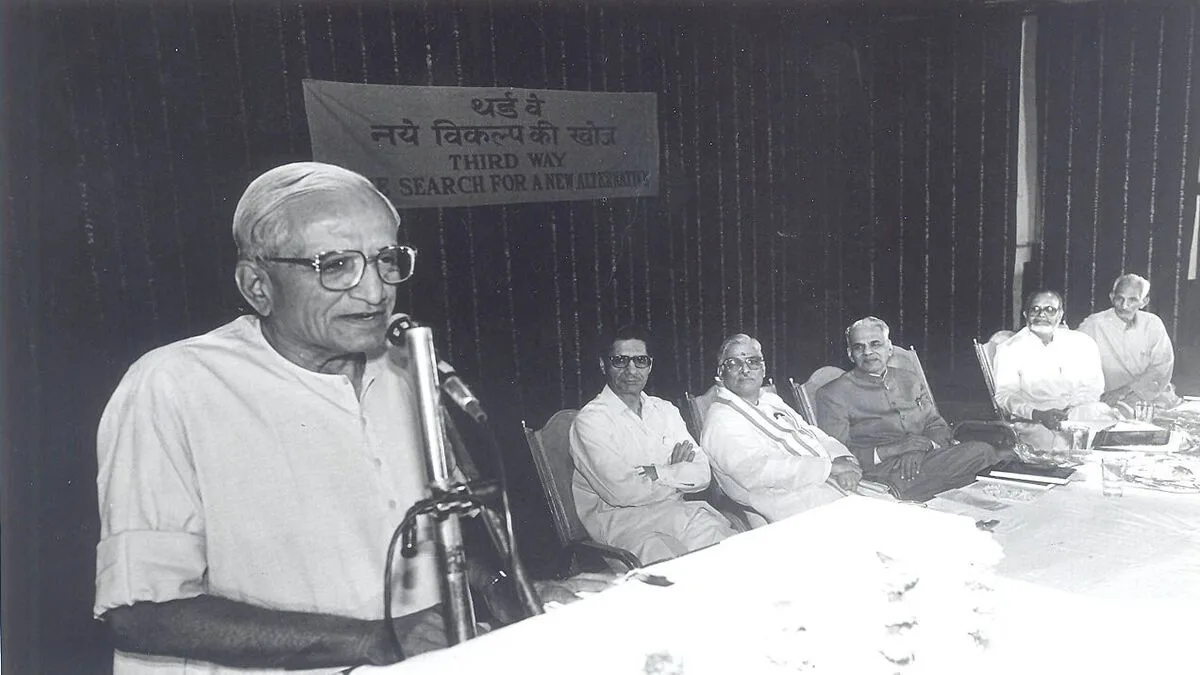
His influential work The Third Way is particularly significant in this context. Through this work, he attempted to articulate an alternative perspective grounded in Indian thought rather than simply accepting the established frameworks of capitalism and communism.
Readers may agree or disagree with his conclusions. Nevertheless, studying his work offers an important perspective on India’s economic and intellectual debates.
Thengadi believed that the economy should serve human beings rather than reduce human beings to instruments of the economy.
Economic development, in his view, should not come at the cost of social relationships, cultural values, or human dignity.
His philosophy raises a question that remains relevant today: Does modernization require distancing ourselves from our traditions, or can India advance through science, technology, and economic development while retaining its cultural confidence?
Dattopant Thengadi’s Message to the Younger Generation of Volunteers
Dattopant Thengadi’s life offers several important lessons for young people and RSS volunteers. His example encourages a thoughtful understanding of national service, organisational discipline, and social responsibility.
1. Place National Service Above Personal Ambition
Life should not be confined to personal success, comfort, and recognition.
Education, employment, family responsibilities, and individual development are important, but so is our responsibility toward society.
National service means fulfilling our duties sincerely while making our abilities useful to others and to the country.
2. Strengthen Your Ideas Through Study and Reason
Merely associating with an ideology is not enough. A committed volunteer must understand its history, principles, achievements, and limitations.
Thengadi’s life encourages young people to become serious students of society. They should develop a sound understanding of Indian history, the Constitution, economics, labour issues, and contemporary social challenges.
An informed volunteer can contribute more meaningfully than one who relies only on slogans.
3. Give Greater Importance to Work Than to Position
Holding a position in an organization is not an achievement in itself. Its real value depends on the contribution made to society through that responsibility.
Organisational strength requires collective effort, accountability, discipline, and humility rather than personal ego.
Young volunteers should remember that leadership is demonstrated through responsibility and action, not merely through titles.
4. Reach the Last Person in Society
The value of national service cannot be measured only through large events, public speeches, or visible activities.
Understanding the concerns of workers, farmers, underprivileged communities, and people in need—and working sincerely toward their welfare—is equally important.
Service becomes meaningful when it improves people’s lives.
5. Understand Swadeshi as Self-Confidence and Self-Reliance
The younger generation should pursue excellence in science, technology, research, and innovation.
At the same time, it should understand India’s social needs and cultural heritage.
Swadeshi, in its constructive sense, means developing domestic capabilities, encouraging innovation, strengthening local production, and making India more cpable in knowledge, manufacturing, and technology.
Self-reliance should inspire confidence, creativity, and a willingness to solve India’s challenges.
6. Promote Dialogue Even When Differences Exist
Differences of opinion are natural in a diverse society.
Commitment to an ideology should not mean refusing to understand alternative perspectives. Constructive change requires reasoned discussion, study, dialogue, and respect for constitutional principles.
Young volunteers can learn from Thengadi’s organizational approach by combining ideological clarity with the ability to engage with people holding different views.
The True Measure of Dedication: What Did We Give to Society?
We live in an age often associated with the display of achievements, personal recognition, and the pursuit of rapid success.
In public life, too, positions, honours, and popularity can sometimes become the principal measures of achievement.
Dattopant Thengadi’s life encourages us to reconsider these assumptions.
The true significance of a life lies not only in what a person acquires for themselves, but also in what they contribute to society.
How many people did they inspire? How many problems did they help address? What institutions and ideas did they leave behind for future generations?
The life of an RSS pracharak illustrates the choice to prioritize social responsibility over personal comfort.
This does not mean that everyone must follow the same path. Rather, it means that people can contribute to national development while pursuing their respective professions and responsibilities.
A teacher contributes by educating responsible citizens. A journalist serves society through truthful and responsible reporting. A scientist advances knowledge through innovation. A worker contributes through honest labour. A young professional serves the nation by using their abilities for constructive purposes.
This is the broader meaning of national service.
A Tribute on His Death Anniversary
Dattopant Thengadi passed away on October 14, 2004. Yet the organizations he helped build, the ideas he articulated, and the methods of social organization he promoted continue to keep his legacy alive.
A genuine tribute to him cannot be limited to offering flowers or praising his personality. It must also involve studying his ideas, evaluating his work objectively, and examining their relevance to the challenges confronting contemporary society.
His life leaves an important question for the younger generation of volunteers:
Will we confine our ideals to speeches, or will we translate them into our conduct and our service to society?
If we respect labour, understand the problems of farmers, encourage indigenous production and innovation, maintain discipline within organizations, and give due importance to social justice and human dignity alongside national development, we will be putting the lessons of his life into practice.
Dattopant Thengadi’s journey reminds us that an individual’s lifetime may be limited, but their ideas and contributions can guide generations to come.
On his death anniversary, let us resolve that dedication to the nation will be reflected not merely in our words but also in our actions.
Clarity in thought, integrity in conduct, commitment to the organization, and sensitivity toward society—these are among the enduring lessons that Dattopant Thengadi’s life offers to the nation.
Humble tributes to Dattopant Thengadi Ji on his death anniversary!