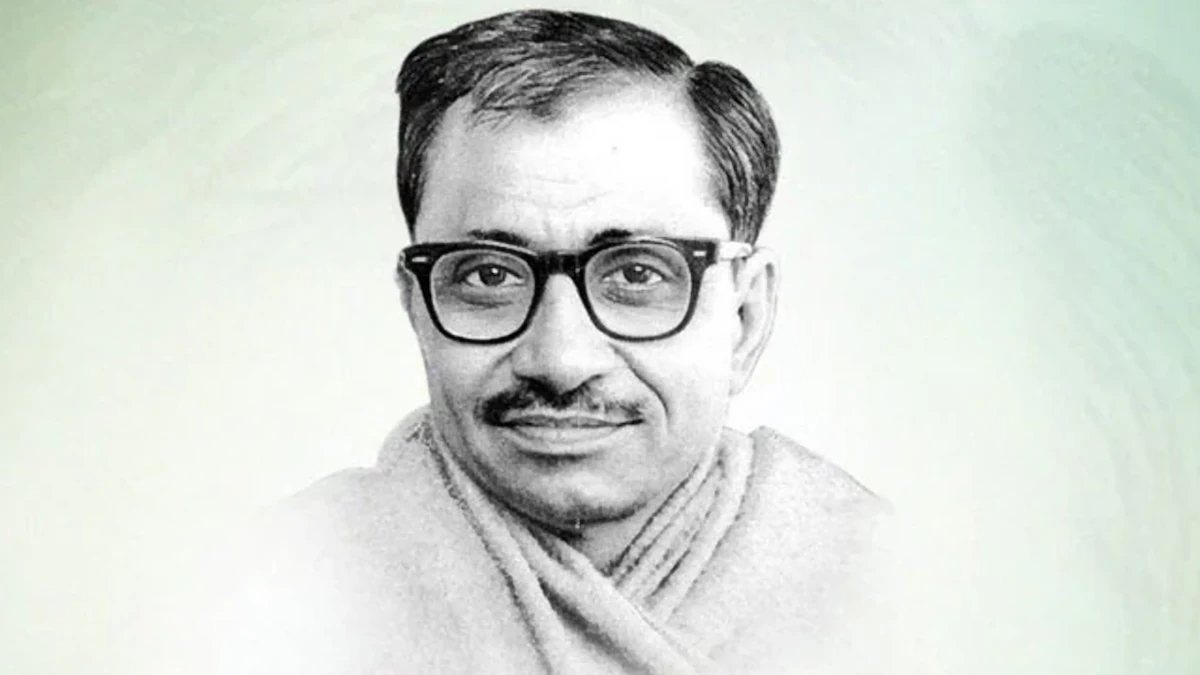
On a chilly late-winter evening, millions of devout pilgrims assembled on the vast grounds of the Ardha Kumbh Mela along the banks of Triveni Sangam in Prayagraj. The air resounded with conch shells, Vedic incantations, and the devotional chanting of sadhus and ascetics. Ordinary Indians from every corner of the country had journeyed on foot to bathe at the sacred confluence, driven by the supreme yearning for spiritual purification and liberation. Yet, amidst that grand congregation, eschewing all pomp and VIP privileges, stood a solitary pracharak dressed in a dusty khadi dhoti and kurta, quietly attending to his duties at the service camp of the Rashtriya Swayamsevak Sangh (RSS) Pandit Deendayal Upadhyaya.
As the most auspicious hour for the holy dip drew near, a young organiser from the service camp approached Deendayalji with an anxious face. “Panditji,” he pleaded, “the hour for the Shahi Snan is slipping away. Covered in dust since dawn, you have been standing here serving thousands of ordinary pilgrims managing their food, medical care, and shelter. Will you not take a sacred bath at the Sangam today?”
Deendayalji smiled softly. Wiping the dust from his weary forehead, he replied in a calm, soothing voice: “For the common man, immersing oneself in the waters of the Sangam constitutes the bath and spiritual purification. But look at the faces of these millions of ordinary, poor, and marginalized Indians who have walked from distant lands. My Supreme Lord resides within them. Serving them, ensuring that the last person standing in the very back row of this crowd receives a safe shelter and a meal—that is my worship. This service unto humanity is my true Kumbh bath, the ultimate practice of my life’s Antyodaya.”
Integral Humanism: An indigenous anti-Marxist manifesto
In April 1965, during the Gyan Mandal Lecture Series in Bombay (now Mumbai), Pandit Deendayal Upadhyaya delivered four historic discourses. These lectures were later compiled as Integral Humanism (Ekatma Manavdarshan) and formally adopted that same year as the official guiding ideology of the Bharatiya Jana Sangh. Grounded firmly in Indian ethos and philosophy, this doctrine served as a powerful indigenous manifesto challenging Western socialist and Marxist frameworks.
The core thrust of Deendayal Upadhyaya’s political philosophy struck directly at Marxist dialectical materialism and the doctrine of class struggle. Marxism reduces the human being to a mere ‘economic animal’ (Homo Economicus) or an insignificant cog in the machinery of production. Deendayalji argued that a human being is neither a mechanical component nor an isolated gear in a factory; rather, humanity represents an integrated and indivisible entity composed of body, mind, intellect, and soul. True human well-being can be attained only through the harmonious pursuit of Indian civilisation’s four fundamental goals of life (Purusharthas) Dharma (moral righteousness), Artha (material wealth), Kama (desire/pleasure), and Moksha (spiritual liberation).
Capitalism vs Communism: Insights from Ramashray Roy
Renowned sociologist Ramashray Roy, in his seminal research paper titled “Integral Humanism: An Analysis” (Indian Journal of Political Science, Vol. 40, No. 2, 1979), observed that Deendayal Upadhyaya incisively demonstrated how both capitalism and communism deny the spiritual and psychological existence of humanity by placing excessive emphasis solely on material needs and financial accumulation. Under capitalism, wealth becomes concentrated in the hands of an affluent few; under communism, that same power is monopolised by an all-pervasive state bureaucracy. Consequently, under communist rule, the individual loses personal freedom and is reduced to a mere serf serving a colossal state engine.
Contemporary Sociological and Academic Appraisals
Distinguished sociologist and historian Christophe Jaffrelot, in his research work The Hindu Nationalist Movement in India (Columbia University Press, 1996) and his edited sourcebook Hindu Nationalism: A Reader (Princeton University Press, 2007), analysed how Deendayal Upadhyaya constructed a robust indigenous alternative to Western-imported Marxist and Nehruvian socialism through Integral Humanism. According to Jaffrelot, communist intellectuals were so alarmed by the theoretical depth of this philosophy that, rather than engaging in genuine philosophical debate, they adopted a strategic political tactic of dismissing it outright as a “disguised social version of communal politics.”
Similarly, scholar Chetan Bhatt, in his book Hindu Nationalism: Origins, Ideologies and Modern Myths (Berg Publishers, 2001), analysed how Upadhyaya’s synthesis of the four Purusharthas and the concept of an Organic Society struck at the very roots of the communist worldview. While communists viewed society as a perpetual battlefield between oppressors and the oppressed, Deendayalji conceptualised society as a living organism possessing its own inherent, supreme consciousness—which he termed Chiti—and the sustaining vitality that preserves this consciousness, which he designated as Prana.
Communist Propaganda, Media Hegemony, and Intellectual Warfare
The Official Counter-Offensive: CPI’s 1969 Pamphlet
In January 1969, the Communist Party of India’s official publishing house, New Age Printing Press (Rani Jhansi Road, New Delhi), released a famous propaganda pamphlet written by K. Vyas titled Incendiary Hand of the RSS and Jana Sangh Behind Communal Riots (Communist Party Publication No. 3, January 1969). Published just weeks after the mysterious death of Pandit Deendayal Upadhyaya, this party document saw communist leaders allege that the Jana Sangh and its top thinkers were acting as catalysts in destroying the nation’s communal harmony. The underlying objective of the communists was to exploit the political vacuum created by Deendayalji’s premature demise and smear his inclusive philosophy in the public domain.
Media Hegemony and Strategies of the Propaganda Machinery
In post-independence India, leftist ideology established widespread hegemony over mainstream English and regional journalism, literary journals, and the broader media ecosystem. Influential periodicals such as Seminar (established in 1959), Mainstream Weekly, Yojana, and the Economic and Political Weekly (EPW) heavily controlled by leftist sociologists at the time consistently published articles that distorted Deendayal Upadhyaya’s principles and ideas.
For instance, multiple issues of Seminar labelled Integral Humanism as “extremist Hindutva clad in philosophical garb.” Various articles in EPW characterised Deendayalji’s principles of economic decentralisation and Antyodaya as “pre-capitalist reactionism opposed to modern industrialisation.”
Countering Propaganda: Alternative Media Infrastructure
To counter this orchestrated propaganda, Deendayal Upadhyaya personally took the initiative to build an alternative media infrastructure. He served as a key founder and editor of prominent publications based in Lucknow, including the monthly journal Rashtradharma, the weekly Panchjanya, and the daily newspaper Swadesh. A review of the 15-volume Complete Works of Pandit Deendayal Upadhyaya (Pandit Deendayal Upadhyaya Sampoorna Vangmaya), published by Prabhat Prakashan and edited by former Rajya Sabha MP Dr Mahesh Chandra Sharma, shows how Deendayalji used his sharp pen in these periodicals to demolish leftist falsehoods and systematically expose anti-national stances.
Eminent political leader L.K. Advani recalled in his autobiography, My Country My Life (Rupa & Co., 2008), that Deendayal Upadhyaya’s regular column, titled Political Diary, in the Organiser weekly served as the primary intellectual weapon against contemporary leftist propaganda. Particularly during the 1962 Sino-Indian War, when a major faction of the CPI adopted an anti-national stance by supporting Chinese aggression, Deendayal Upadhyaya unmasked the communists’ anti-national stratagems while standing firmly for national security.
Academic Hegemony and the History Crisis in University Campuses
Colonial and Marxist Dominance in Higher Education
In Indian higher education, especially in history, political science, and sociology, communist historians and sociologists established near-monopolistic authority. Renowned researcher and journalist Arun Shourie, in his heavily documented book Eminent Historians: Their Technology, Their Line, Their Fraud (ASA Publications, 1998), provided extensive evidence demonstrating how the Indian History Congress (IHC), the Progressive Writers’ Association, and leftist research institutes systematically marginalised nationalist and independent thinkers from academia.
According to statements by former Dhaka University professors and eminent historians, “progressive” and Marxist scholars in post-independence India in charge of framing NCERT and university curricula deliberately devalued the philosophies of independent nationalist thinkers such as Deendayal Upadhyaya, Bankim Chandra Chattopadhyay, and Dr Syama Prasad Mookerjee. Their primary objective was to condition students into believing that India possessed no indigenous statecraft or socio-economic model outside of Western Marxism.
Manthan and the Inception of Intellectual Resistance
In response to this academic boycott and leftist hegemony, Nanaji Deshmukh established the Deendayal Research Institute (DRI) in 1972. The institute’s flagship academic journal, Manthan (published from 1979 under the editorship of D.P. Thengadi), first re-established Integral Humanism within university and institutional circles. Through a succession of rigorous papers, Manthan demonstrated how the Marxist theory of class conflict fractured Indian social cohesion, and how Deendayal Upadhyaya’s Antyodaya was not merely an economic development model, but a revolutionary mechanism for restoring social dignity to every individual.
From Kerala to Naxalbari: The Spectrum of Political Violence
Bloody Beginnings: Communist Violence in Kerala
The hostility of communists toward Deendayal Upadhyaya was not confined to ideological or academic spheres; on the ground, they resorted to bloody violence to decimate his movement and cadres. In Kerala, where the communist movement had established its strongest foothold in India, physical assaults against nationalist organisers began as early as the 1940s.
Journalist N.P. Ullekh, in his investigative work Kannur: Inside India’s Bleediest Revenge Politics (Penguin Random House, 2018), cited documents penned by senior RSS pracharaks Ranga Hari and P. Parameswaran, recording how armed CPI youth cadres stormed public meetings addressed by RSS chief Madhav Sadashiv ‘Guruji’ Golwalkar in Thiruvananthapuram’s Thaicaud Stadium and Calicut in December 1947 and January 1948.
Professor A.K.M. Das, in his book RSS in Kerala: A Saga of Struggle (Keshari Prakashan, 2020), documented that during the 1960s, as the Jana Sangh began gaining political support in Kerala under Deendayal Upadhyaya’s general secretaryship, leftist unions turned to social boycotts, denial of shelter, and physical violence against Jana Sangh organisers. In December 1967, the Jana Sangh held its historic All-India Annual Session in Calicut, Kerala, where Deendayal Upadhyaya was unanimously elected as Party President. This political triumph in the heart of the strongest communist citadel deeply alarmed the leftists. Just a few months later, on April 28, 1969, in Thalassery, communist cadres hacked to death 34-year-old tailor and RSS instructor Vadikkal Ramakrishnan—an event widely recognised as the first institutional political murder in Kerala’s history of Left-RSS violence.
Naxalbari’s ‘Khatam Line’
In May 1967, an armed Naxalite movement erupted in Naxalbari, Darjeeling district, North Bengal, led by Charu Majumdar and Kanu Sanyal. Between 1967 and 1969, Charu Majumdar authored his famous Eight Documents, circulated through the Naxalite periodical Deshabrati and later in Liberation (1968). These documents declared the Bharatiya Jana Sangh and the RSS to be “saffron-clad reactionary class enemies of the bourgeois-feudal state.”
Charu Majumdar’s notorious Khatam Line, the policy of physical liquidation of political enemies, explicitly targeted Jana Sangh and RSS workers. Kanu Sanyal later acknowledged in his memoir, The History of CPI(ML) (1972), that Naxalites saw those who opposed Marxist class struggle and advocated indigenous Indian reforms as the primary obstacles to revolution. As a consequence, numerous Jana Sangh workers were murdered by Naxal squads across West Bengal, Bihar, and Andhra Pradesh.
The Cursed Night of Mughalsarai: Conspiracy, Cover-up, and Unanswered Questions
The Web of Mystery
Just two months after being elected Party President at the Calicut Session in December 1967, Pandit Deendayal Upadhyaya met a tragic and mysterious end on February 11, 1968. On the evening of February 10, he boarded First Class Compartment No. 1 of the Sealdah Express from Lucknow bound for Patna. Co-passengers and railway staff last saw him alive near Jaunpur Junction around 12:30 AM.
At 1:40 AM, the train departed Varanasi and arrived at Mughalsarai Junction (now Pandit Deendayal Upadhyaya Junction) at 2:10 AM. However, he was no longer inside his compartment. Just ten minutes later, at 2:20 AM, Deendayal Upadhyaya’s lifeless, blood-stained body was discovered lying near high-traction Pole No. 1276, located 748 feet from the far end of the Mughalsarai station platform.
Intriguingly, police found a five-rupee currency note tightly clutched between the fingers of his right hand. His clothing, wristwatch, spectacles, and bag were entirely intact, yet crucial political papers were missing from his pocket. Furthermore, the nature of his bodily injuries did not match the severe trauma typical of a fall from a fast-moving train.
CBI Investigation and the Verdict of the Varanasi Sessions Court
Amid nationwide outrage, the contemporary Congress government handed the investigation to the Central Bureau of Investigation (CBI), led by DIG John Lobo. The CBI swiftly concluded its inquiry with a simplistic narrative, claiming that two petty thieves, Bharat Lal and Ram Avadh, had boarded the train to steal; when Deendayal Upadhyaya caught them and threatened police action, they pushed him out of the moving train.
However, when the CBI presented its case before the Special Sessions Court in Varanasi, the presiding judge examined all evidence and completely rejected the CBI’s theft theory. On June 9, 1969, the judge delivered a historic verdict, acquitting the accused of murder charges and making a sharp observation: “The prosecution has utterly failed to prove the murder charge against the accused. Consequently, the real truth behind this murder remains to be revealed.”
Justice Y.V. Chandrachud Commission of Inquiry and the Sabotage of Evidence
After the CBI’s fabricated narrative collapsed in court, Parliament witnessed heated debates. After a written demand from over 70 Members of Parliament, the Central Government appointed a one-person Commission of Inquiry in 1969, headed by Justice Y.V. Chandrachud of the Bombay High Court (later Chief Justice of India).
A review of the Proceedings of the Justice Chandrachud Commission (Government of Uttar Pradesh, 1969) and the Commission of Inquiry Report paints a chilling picture. Justice Chandrachud himself wrote in his report: “What happened at Mughalsarai is in parts stranger than fiction. Multiple individuals behaved in an extraordinarily abnormal manner, raising deep suspicion… All these abnormal behaviors shroud the entire incident in a dense cloud of mystery.”
The Commission’s proceedings established that primary case records, including the original FIR and Case Diary, had mysteriously vanished from Uttar Pradesh Police records (a fact later confirmed in investigative reports by TFI Post and Operation India).
The CBI failed to provide any satisfactory explanation for Deendayal Upadhyaya’s compartment change during the journey or the suspicious identity and contradictory statements of his co-passenger, military officer Major S.L. Sharma.
The body was positioned neatly and orderly, contradicting the physical impact expected from falling off a moving train.
Explosive Allegations by Balraj Madhok and the Political Imperative
Balraj Madhok, a co-founder of the Jana Sangh and predecessor to Upadhyaya as Party President, explicitly asserted in his autobiography Zindagi Ka Safar (Vol. 3, B.R. Publishing Corporation, Delhi, 1986) that Deendayal Upadhyaya’s death was a meticulously planned political assassination.
Madhok wrote: “The murder of Deendayal Upadhyaya was neither an ordinary accident nor the work of two petty thieves. It was a deep political conspiracy aimed at stifling the rising power of the Bharatiya Jana Sangh.”
The contemporary political context was crucial: in the 1967 general elections, the Congress failed to form governments in several states, and the Jana Sangh emerged as a formidable opposition force. As Deendayal Upadhyaya demonstrated political acumen in uniting non-Congress parties under a common platform, he posed the greatest political threat to the Indira Gandhi government and its Left allies. To ensure parliamentary survival, Indira Gandhi relied on CPI support. Consequently, researchers contend that the contemporary government sought to cover up the political conspiracy behind the assassination by relying on the CBI’s perfunctory report.
Posthumous Left Propaganda vs The Heart-Touching Reality of ‘Antyodaya’
Continuing Defamation: Centenary Attacks
Even after his tragic death, the propaganda campaign against Deendayal Upadhyaya’s thought by leftist intellectuals did not cease. During his birth centenary celebrations in 2016–2017, portals such as The Wire and Scroll. in, as well as Caravan Magazine and Frontline, in, as well as Caravan Magazine and Frontline, in, Caravan Magazine, and Frontline published numerous articles attempting to brand him as a “proto-fascist” or a “merchant of hate.”
These portals presented his statements out of context, claiming that Integral Humanism was “merely a subtle stratagem to preserve upper-caste hegemony.” However, renowned political scientist and researcher Dr Sudesh Verma, in his book Deendayal Upadhyaya: A Profile (Prabhat Prakashan, 2016), refuted these allegations, demonstrating how Deendayalji actively spoke out against the caste system, untouchability, and economic inequality throughout his life.
The Saga of an Antyodaya Practitioner Facing Humiliation
In the late 1960s, as the Naxalbari movement in North Bengal spread like wildfire, Naxal and communist cadres intensified their activities across the villages of the Hindi belt. On a freezing winter afternoon, Pandit Deendayal Upadhyaya visited a remote, impoverished village near the Bihar-Uttar Pradesh border for party work. The village was suffering from extreme poverty and exploitation, where local communist and Naxalite cadres were sowing seeds of ‘class struggle’ and violence among the villagers.
As soon as Deendayalji arrived, a group of communist union cadres and armed Naxal supporters surrounded him. Raising their fists, they shouted harsh slogans: “Beware, minion of the bourgeoisie!” “Down with Deendayal, agent of feudal lords!” Not content with slogans alone, they threw mud and dust upon him and subjected him to abusive character assassination. As local Jana Sangh organisers prepared to react in anger, Deendayalji calmly raised his hand to stop them. His face showed neither anger nor a trace of political vengeance.
A short distance away, sitting on the porch of a dilapidated hut, was an elderly, landless, exploited daily-wage labourer. Huddled in the biting cold, the older man’s eyes reflected deep hunger and uncertainty. Ignoring the ridicule and humiliation hurled at him, Deendayalji walked straight up to the elderly labourer. He knelt beside him on the dusty ground. Without any pretence of political posturing, he gently removed his own thick woollen shawl and wrapped it around the shivering older man.
Taking out his own simple dry roti and jaggery from his bag, he shared the meal with the old man, speaking in a quiet, emotional voice: “Father, bloody revolution or political slogans of hatred will never put a handful of rice on your empty plate. The communist class struggle teaches you to fight your neighbour, but my Antyodaya seeks to wipe the tears and bring a smile to the face of the very last man standing in the line, a man like you. You are neither an oppressor nor the oppressed; you are a child of Mother India.”
Watching this scene, the protesting communist cadres fell silent instantly. The man they had been denouncing as a “class enemy” showed astonishing humility, boundless love, and the living spirit of Antyodaya; touched by his humanity, the eyes of local villagers and cadres filled with tears, and the toxic wall of leftist provocation and propaganda dissolved in a single moment.
The Realisation of ‘Antyodaya’ in Modern Governance
The policy that leftist sociologists had dismissed as an “unrealistic pre-industrial fairy tale” has proven to be the most effective and historic model in independent India’s welfare state framework:
Antyodaya Anna Yojana (AAY): Launched by the Government of India in 2000, this scheme ensures highly subsidised foodgrains to the poorest and most marginalised families, giving concrete form to Deendayalji’s theory of “feeding the last person in society.”
Deendayal Antyodaya Yojana: National Rural Livelihoods Mission (DAY-NRLM): According to NITI Aayog evaluation reports, this initiative has empowered over 100 million rural poor households across India economically and socially through Self-Help Groups (SHGs).
History’s Inevitable Judgment
An analysis reveals that during the mid-20th century, the communist and Naxalite ecosystem—benefiting from a monopoly over India’s media, academia, and administrative apparatus—employed a four-fold strategy to suppress the significance of Deendayal Upadhyaya:
- Ideological Labelling: Branding his philosophical creation as “religious fundamentalism.”
- Academic Boycott: Completely purging his name and works from university and research curricula.
- Political and Physical Attacks: Unleashing bloody terror through cadres in Kerala and Naxal-infested regions.
- Investigative Cover-up: Institutional and legal reluctance to uncover the truth behind his mysterious death
Yet, over time, history has delivered its unappealable verdict. The ideology rooted in violence, class conflict, and misleading propaganda that once held intellectual hegemony in India has grown politically, administratively, and intellectually obsolete. Conversely, standing in stark contrast to communist humiliation and violence, Pandit Deendayal Upadhyaya’s philosophy of Integral Humanism and his compassionate vision of Antyodaya now serve as a guiding beacon of liberation for millions of marginalised Indians and form the bedrock of national public policy.