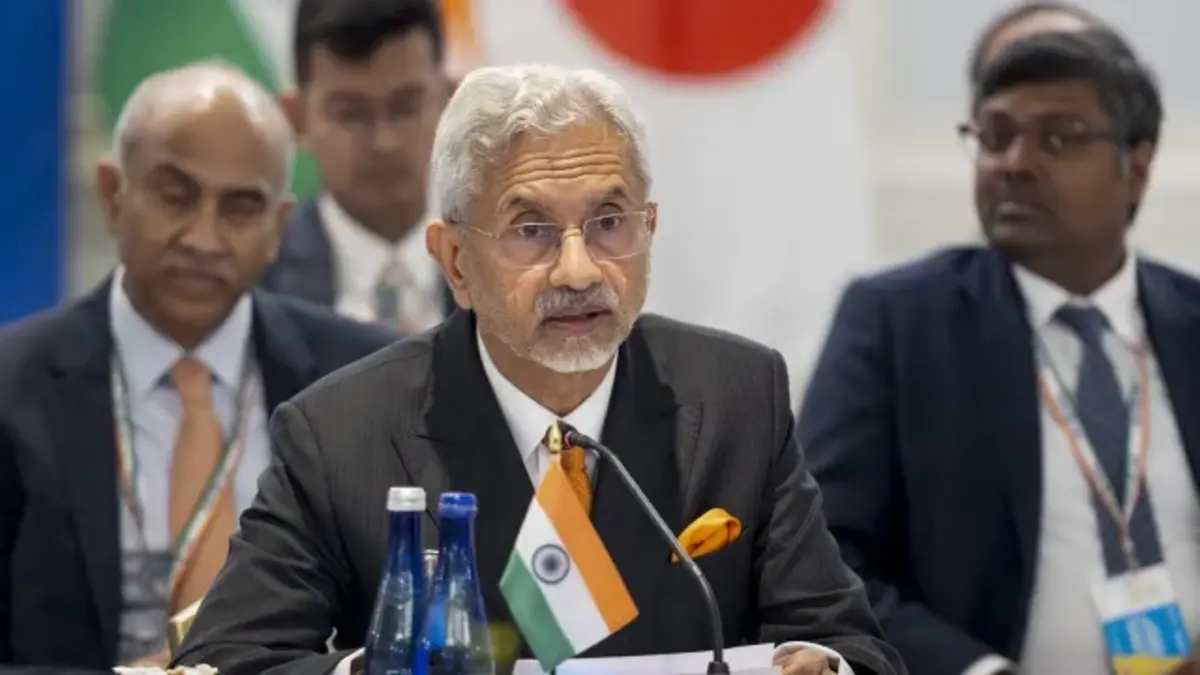
NEW YORK: India’s intensive diplomatic outreach to articulate an inclusive, multilateral world-order, specifically to secure national interests and for the prosperity of Global South amid soaring geopolitical upheavals is under full swing under the leadership of External Affairs Minister Dr. S. Jaishankar’s on the sidelines of the 81st United Nations General Assembly. New Delhi is swiftly advocating a wide range of India’s foreign-policy priorities — from trade with European partners, to technology partnership and security cooperation. EAM Jaishnakar also sealed development discussions and assistance with the Caribbean and Pacific Island nations, with climate action and UNSC reforms on the agenda.
With the high-level UNGA week underway, EAM Jaishankar also held bilateral meetings with the foreign ministers of the Netherlands, Finland, Slovenia and Andorra, while also chairing ministerial engagements with CARICOM and the Forum for India-Pacific Islands Cooperation (FIPIC). He also co-chaired consultations on UNSC reform, underlining India’s continuing push for a more representative multilateral system.
Accelerating India-EU ties, Ukraine conflict & technology ties
EAM Jaishankar’s meetings with the European counterparts covered both immediate geopolitical challenges and the expanding India-Europe economic relationship. In his meeting with Dutch Foreign Minister Tom Berendsen, EAM Jaishankar exchanged views on the Ukraine conflict and followed up on the outcomes and deliverables of Prime Minister Narendra Modi’s visit to the Netherlands earlier this year.
Appreciate the meeting with @ministerBZ Tom Berendsen of Netherlands #UNGA81
Exchanged views on the Ukraine conflict. Also followed up on the deliverables from PM @narendramodi’s visit to the Netherlands earlier this year.
🇮🇳🇳🇱 pic.twitter.com/MiP8ZgEsww
— Dr. S. Jaishankar (@DrSJaishankar) September 24, 2026
With Finnish Foreign Minister Elina Valtonen, the discussions focused on current geopolitical and technological challenges. EAM Jaishankar said that the bilateral relations and cooperation between India and Finland within the European Union remained strong.
Pleased to meet FM @elinavaltonen of Finland today #UNGA81. Exchanged notes on current geopolitical and technology challenges.
Our bilateral relations and cooperation in the European Union remain strong.
🇮🇳🇫🇮 pic.twitter.com/ijdVu1UomL
— Dr. S. Jaishankar (@DrSJaishankar) September 24, 2026
Trade and investment opportunities linked to the India-EU Free Trade Agreement were central to his discussion with Slovenia’s Foreign Minister Tone Kajzer. The two sides also discussed energy, manufacturing, digital cooperation, connectivity, defence and multilateral issues.
Great meeting with FM Tone Kajzer @TKajzer of Slovenia.
Spoke about the emerging trade & investment opportunities as we move towards the actualisation of the India-EU FTA.
Also discussed energy, manufacturing , digital, connectivity, defence and multilateral dimensions of our… pic.twitter.com/ko1ypM4W2b
— Dr. S. Jaishankar (@DrSJaishankar) September 24, 2026
EAM Jaishankar also met Andorra’s Foreign Minister Imma Tor Faus. Their discussions covered trade and investment, climate change, Artificial Intelligence and multilateral cooperation. India and Andorra established diplomatic relations in 1994 and have maintained cooperation, including at international organisations.
A pleasure to meet FM @ImmaTorFaus of Andorra on the sidelines of #UNGA81
We discussed issues pertaining to trade & investment, climate change and Artificial Intelligence. Also talked about our multilateral cooperation.
🇮🇳🇦🇩 pic.twitter.com/R58WWPnI7X
— Dr. S. Jaishankar (@DrSJaishankar) September 23, 2026
Taken together, the European engagements highlighted the breadth of India’s current agenda with European partners — spanning economic integration, emerging technologies, energy and defence cooperation alongside major geopolitical questions.
India-CARICOM ties get fresh push; Bloc backs India’s UNSC bid
EAM Jaishankar also co-chaired the India-CARICOM Foreign Ministers’ Meeting with Suriname’s Foreign Minister Melvin WJ Bouva. The meeting reviewed progress in India-CARICOM cooperation and discussed ways to expand political engagement, trade and investment, agriculture and food security, digital governance, climate resilience and energy cooperation.
A significant outcome was CARICOM’s decision to support India’s candidature for the United Nations Security Council for the 2028-29 term. The decision was conveyed by the CARICOM co-chair, with EAM Jaishankar thanking the grouping for its “trust and support” and saying India would remain a strong voice of the Global South.
Glad to join colleagues from the Caribbean, in New York today for the India-CARICOM Foreign Ministers’ Meeting. Special appreciation for @SG_CARICOM Dr. Carla Barnett and FM MelvinBouva #Suriname for conducting the proceedings. In my remarks:
➡️ Highlighted our solidarity… pic.twitter.com/q24cttuWUB
— Dr. S. Jaishankar (@DrSJaishankar) September 24, 2026
India’s extensive developmental assistance to Caribbean countries
EAM Jaishankar also highlighted India’s development partnership with Caribbean countries, including Small and Medium Enterprise projects and Quick Impact Projects. He pointed to the healthcare assistance such as limb-fitment camps, haemodialysis units and BHISHM Cube medical facilities.
Capacity-building was another focus, with India urging CARICOM countries to utilise training slots offered by New Delhi and offering customised programmes in areas identified by partner countries. Climate and renewable energy cooperation also featured prominently. EAM Jaishankar encouraged CARICOM members to consider joining the International Solar Alliance and the Global Biofuels Alliance, while calling for deeper cooperation in economic, digital and mobility-related sectors.
Aid to Pacific Islands by India: 20 sea ambulances by March 2027
Healthcare, climate resilience and capacity building were at the centre of EAM Jaishankar’s engagement with Pacific Island countries at the second FIPIC Foreign Ministers’ Meeting. He reviewed progress since the third FIPIC Summit in 2023 and highlighted two major frameworks through which India’s development partnership with Pacific Island nations has expanded: the FIPIC framework and the India-UN Development Partnership Fund.
Pleased to chair the India-FIPIC Foreign Ministers’ Meeting today in New York #UNGA81. Underlined the following:
✅ Our approach to the Pacific has consistently been demand-driven, development-oriented and people-centric.
✅ India fully respects and supports the priorities… pic.twitter.com/hSFhG3gaKj
— Dr. S. Jaishankar (@DrSJaishankar) September 23, 2026
One of the most concrete initiatives is India’s planned supply of 20 sea ambulances to Pacific Island countries. Jaishankar said that the12 member states had requested the vessels and that India expected to be in a position to deliver them by March 2027. The initiative addresses a practical challenge confronting geographically dispersed island nations, where maritime connectivity will be critical for emergency healthcare and medical evacuation.
India is also developing a 100-bed super-speciality hospital in Fiji, while wider cooperation covers renewable energy, connectivity, digital technology, healthcare and capacity building. Fiji has described the hospital as a significant outcome of the 2023 FIPIC process.
EAM Jaishankar proposed customised capacity-building modules for the Pacific countries based on their individual priorities. Under the proposed approach, professionals from the region could travel to India for specialised training in areas identified by Pacific partners.
India has also encouraged Pacific countries to join the International Solar Alliance and the Coalition for Disaster Resilient Infrastructure.
India advances climate resilience & sustainable development
Climate change emerged as a common theme across India’s engagements with both the Caribbean and Pacific regions. At the FIPIC meeting, EAM Jaishankar highlighted the challenges posed by El Niño and said India was ready to assist Pacific Island countries in mitigating its adverse effects. He also pointed to cooperation in space, sustainable coastal management and ocean research.
India reaffirmed its support for the Pacific Islands Forum’s 2050 Strategy for the Blue Pacific Continent, while stressing that its own approach to the region remains demand-driven, development-oriented and people-centric.
Separately, MEA Secretary (Economic Relations) Sudhakar Dalela highlighted India’s climate priorities at UN meetings on adaptation and climate finance. He stressed the need for predictable financing for country-led adaptation and said that climate finance should protect vulnerable communities without adding to their debt burdens.
Dalela also highlighted India’s progress on its Nationally Determined Contribution targets. As of June 30, 2026, non-fossil sources accounted for 54.18 per cent of India’s installed electricity capacity, according to government data.
India steps up push for UNSC reform
The question of reforming the global multilateral architecture remained another major component of India’s UNGA diplomacy. EAM Jaishankar co-chaired the L.69 Consultative Ministerial Interaction on UNSC reform with Saint Lucia’s Foreign Minister Alva Baptiste. He argued that the inability of the Security Council to address ongoing conflicts and threats to international peace and security underlined the urgency of reform.
Co-chaired the L.69 Consultative Ministerial Interaction on UNSC reform, along with FM Alva Baptiste of Saint Lucia. Thank C-10 coordinator @SwarayRahman of Sierra Leone for his presence. Made the following points:
➡️ Global South is at the receiving end of the unprecedented… pic.twitter.com/Vl9Fj5O6Tb
— Dr. S. Jaishankar (@DrSJaishankar) September 23, 2026
EAM Jaishankar said that the Global South was at the receiving end of unprecedented changes while the existing UN system was falling short of expectations. He also argued that continued delays in reform perpetuated historical injustice. Members of the L.69 and the C-10 African grouping, he said, would continue working together to press for change.
Earlier during the UNGA week, the G4 — India, Brazil, Germany and Japan — also called for urgent UNSC reform, while four Visegrád countries — Poland, Hungary, Slovakia and the Czech Republic — expressed support for India’s bid for permanent membership.
With the UNGA high-level week continuing, EAM Jaishankar is scheduled to address the General Debate on September 26, where India’s positions on global conflicts, multilateral reform, terrorism, development and the interests of the Global South are expected to feature prominently.