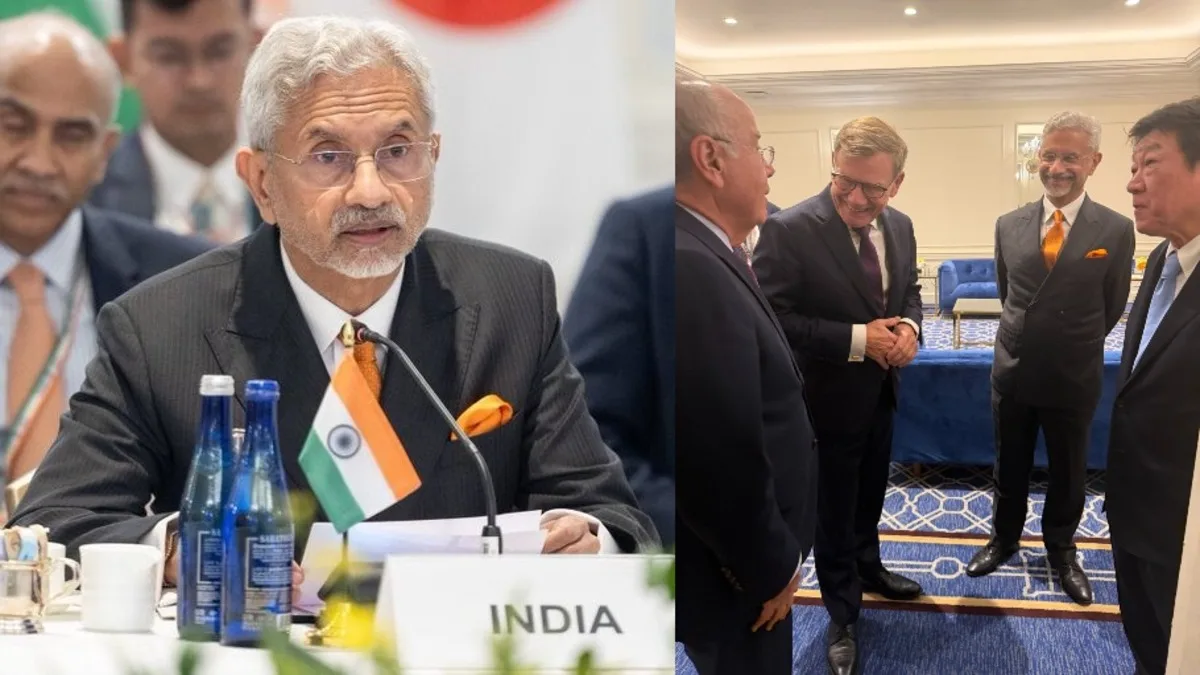
New York: India, Brazil, Germany and Japan who form the G4 coalition, have renewed their push for an early and comprehensive reform of the United Nations Security Council(UNSC), arguing that its eight-decade-old structure no longer reflects contemporary geopolitical realities, thereby limiting its ability to effectively respond to global peace and security challenges.
Joined my G4 counterparts from Brazil, Germany and Japan in New York #UNGA81
Discussed the imperative of reformed multilateralism and a more representative, responsive and effective UN Security Council that reflects today’s global realities.
Will continue to work together to… pic.twitter.com/IjuNBR1zLd
— Dr. S. Jaishankar (@DrSJaishankar) September 23, 2026
G4 calls for an urgent overhaul of the Security Council
External Affairs Minister Dr. S. Jaishankar chaired a meeting of the G4 Foreign Ministers in New York on September 22, Wednesday on the sidelines of the 81st session of the United Nations General Assembly(UNGA). The meeting was attended by Brazil’s Foreign Minister Mauro Vieira, Germany’s Federal Minister for Foreign Affairs Johann David Wadephul and Japan’s Foreign Minister Motegi Toshimitsu.
In a joint ministerial statement issued after the meeting, the four countries said that the UNSC is currently unable to effectively discharge its core responsibility of maintaining international peace and security. “The representativeness, legitimacy, credibility and efficacy of the UNSC are in question”, the Ministers said, identifying the Council’s “eight-decade-old architecture” as one of the key reasons behind its shortcomings.
EAM Jaishankar, in a post on X following the meeting, said that the ministers had discussed the need for “reformed multilateralism” and a Security Council that is “more representative, responsive and effective” and reflects today’s global realities. Germany’s Wadephul similarly stressed that the international system has changed substantially since the UN was found and called for the more appropriate representation of African voices.
Expansion of permanent and non-permanent seats central to reform
At the centre of the G4’s demand is an expansion of the Security Council in both permanent and non-permanent categories. The four countries said that such expansion is central to meaningful UNSC reform and noted that a majority of UN Member States support expanding the Council in both categories.
They also called for greater representation of underrepresented and unrepresented regions and groups, particularly Africa, the Asia-Pacific and Latin America and the Caribbean. The G4 further highlighted the need to address historical underrepresentation while increasing the participation of countries that make significant contributions to maintaining international peace and security and advancing the purposes of the United Nations.
For India, the demand is significant as New Delhi has long sought a permanent seat on the Security Council. India, Brazil, Germany and Japan formed the G4 to coordinate their positions and campaign for permanent membership as part of wider UNSC reform.
G4 backs Africa’s permanent representation
The four ministers also reiterated their support for Africa’s longstanding demand for enhanced representation on the Security Council, including in the permanent category. The G4 welcomed the reform model presented by the African Group during the previous round of Intergovernmental Negotiations (IGN) under the 80th UNGA session.
The grouping said it would continue supporting Africa’s case while working with other reform-oriented groups to develop a consolidated model that reflects the views of a majority of UN Member States. Japan’s Foreign Ministry said that the G4 had agreed to work towards an early consolidated model while consulting relevant countries, including existing permanent members and African nations.
18 years of negotiation continous
The G4 also voiced strong concern over the prolonged lack of progress under the Intergovernmental Negotiation(IGN framework), describing the process as “largely ineffective” in producing concrete outcomes despite 18 years of discussions.
The ministers expressed particular reservations over a so-called “bridging proposal” presented before the commencement of text-based negotiations. According to the G4, the proposal did not take into account the position of a clear majority of Member States favouring expansion of the Council in both permanent and non-permanent categories.
G4 pushes for text-based negotiations
Looking ahead, the G4 said that it would deepen cooperation with other reform-oriented groups and identify areas of convergence to develop a consolidated reform model. The grouping identified the commencement of text-based negotiations as a high priority, arguing that substantive negotiations are essential for translating calls for reform into concrete outcomes.
The ministers also said that the discussions on UNSC reform need not remain confined to the IGN framework. They expressed willingness to engage with the wider UN membership through other forums, including the UN General Assembly.
The G4 said that the meaningful reform would be essential to restoring the representativeness, legitimacy, credibility and efficacy of the Security Council while strengthening the multilateral system with the United Nations at its centre.
G4 countries also said that they would maintain close coordination throughout the 81st UNGA session. Officials from Brazil, Germany, India and Japan have been tasked with following up on the discussions and advancing coordination on reform. Progress is expected to be reviewed at the next Director General-level G4 meeting in New Delhi.