The Domestic Tourism Expenditure Survey (DTES), conducted by the National Statistics Office (NSO), mainly captures the details of domestic overnight trips like duration of trip, mode of transport, type of stay availed, trip expenses, etc. Additionally, some information is also collected on domestic same-day trips and expenditure incurred on them.
The present survey was conducted during July, 2025 to June, 2026 as a part of the NSS 80th round. The Ministry of Statistics and Programme Implementation (MoSPI) has released the findings of this survey through a report titled ‘Domestic Tourism in India’.
Data for this survey were collected for (i) domestic overnight trips completed during last 365 days with leading purposes: holidaying, leisure and recreation; pilgrimage & religious; health & medical; and shopping, (ii) domestic overnight trips completed during the last 30 days with leading purposes: business, social, education & training and others and (iii) same-day trips completed during the last 30 days.
A brief account of the survey in terms of coverage, sample design, etc., along with a glossary of terms, is provided in the endnote.
Key findings
B1. Domestic overnight trips completed during the last 365 days with leading purposes: holidaying, leisure and recreation; pilgrimage & religious; health & medical; and shopping:
-Number of overnight trips generated per 100 households reporting at least one overnight trip (tourist household) during the last 365 days was 127 per 100 rural tourist households (118 per 100 rural tourist households in 2014-15) and 132 per 100 urban tourist households (121 per 100 urban tourist households in 2014-15).
-The highest share of trips was reported for ‘pilgrimage & religious’ purposes (48%) by both sectors.
The second-largest share in overnight trips was for ‘health & medical’ purposes in rural areas (38.4%) and ‘holidaying, leisure & recreation’ in urban areas (36.4%).
-Average trip size was recorded as 2.03 overnight visitors per trip. Around 80% of visitors preferred to stay for 5 days or less during their respective overnight trips.
-May and October were the peak months for domestic overnight trips undertaken for holidaying, leisure & recreation purposes during the last 365 days.
-For rural households, bus was the dominant mode of travel with a 32% share in visitor trips, while train (35%) was the most availed mode for travelling by urban households for such trips.
-Among urban overnight visitors, hotels and guesthouses were the most preferred type of stay, accounting for a 36% share of visitor trips. In rural areas, other non-commercial stays accounted for the largest share (28%), which included stays in one’s own vacation home (second home), temporary accommodation provided by employers, accommodation provided by religious or missionary organisations free of charge, etc.
-Combining visitors both from within the state and from other states, Uttar Pradesh accounted for the highest share in total visitor-trips (15.7%), followed by Tamil Nadu (13.4%) and Rajasthan (8.0%).
-Health & medical trips incurred maximum expenditure (including both package & non-package components) in both rural (Rs. 29,454) and urban (Rs. 41,649) areas among all the trips completed during the reference period.
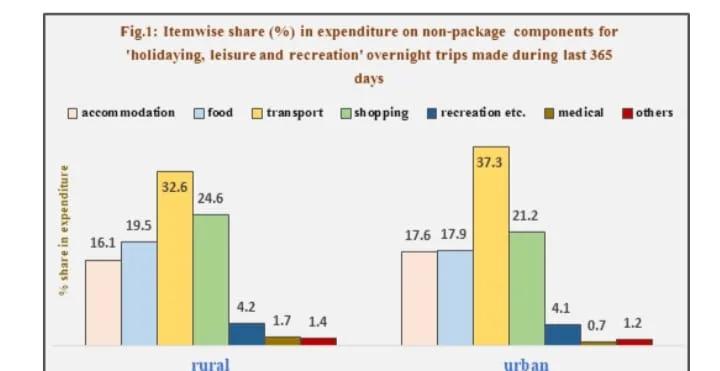
-The highest share of expenditure was reported on the ‘transport’ component for overnight trips performed with the leading purpose ‘holidaying, leisure and recreation’.
B2 Domestic overnight trips completed during last 30 days with leading purposes business, social, education & training and others:
-Number of overnight trips generated per 100 households reporting at least one overnight trip (tourist household) during the last 30 days was 113 per 100 rural tourist households and 111 per 100 urban tourist households.
-Trips made for the leading purpose, ‘social ’, accounted for the maximum share of 89% among all such trips.
Average trip size reported was 1.95 overnight visitors per trip, while average trip duration for around 45% of visitor-trips was 2-3 days.
-Bus was the most preferred mode of travel, having 48% & 44% share in visitor-trips in rural and urban areas, respectively.
-Both for rural and urban households, friend & relatives’ place was the major type of stay.
-Combining visitors both from within the state and from other states, Uttar Pradesh registered the highest share of visitor-trips (15.5%) as the state of main destination for such trips, followed by Bihar (10.5%) and Tamil Nadu (9.6%).
– For the trips completed during the last 30 days, both rural (Rs. 5,179) and urban (Rs. 6,934) households spent the most on overnight trips, with the leading purpose being business.
B3. Same-day trips completed during last 30 days:
-In rural areas, 65.1% (57.1 % in 2014-15) households and 46.2% (40.6% in 2014-15) households in urban areas undertook at least one same-day trip during the last 30 days.
-The number of overnight trips generated per 100 households reporting at least one same-day trip (tourist household) during last 30 days was 185 per 100 rural tourist households and 156 per 100 urban tourist households.
-Same-day trips with leading purposes ‘social (rural-32%, urban-37%)’ and ‘shopping (rural-29%, urban-17%)’ were the two most frequently undertaken same-day trips by both rural and urban households.
-Highest expenditure was observed for same-day trips, with the leading purpose ‘shopping’ followed by ‘health & medical trips’ in both rural and urban areas.
-Maximum share of expenditure was reported on the ‘shopping’ component among all same-day trips performed by both rural (51%) and urban (41%) households.
Endnote: A brief about the geographical coverage, sample size, sample design, reference periods for the Domestic Tourism Expenditure Survey
A. Geographical coverage
This survey covered the whole of the Indian Union, except the villages in Andaman and Nicobar Islands, which remain difficult to access throughout the year.
B. Sample size
A total of 24,778 FSUs were surveyed at the all-India level, consisting of 14,371 rural and 10,407 urban FSUs for this survey. The number of households surveyed was 2,46,113 (1,42,603 in rural areas and 1,03,510 in urban areas).
C. Sample design
A multi-stage stratified sampling design was used for this survey, where villages/urban blocks or Sub-Units (SUs) of these were regarded as the First Stage Units (FSUs) and the households as the Ultimate Stage Units (USUs). Both the FSUs and USUs were selected with Simple Random Sampling Without Replacement (SRSWOR).
D. Data Collection Mechanism:
The data for the Domestic Tourism Expenditure Survey of the NSS 80th round were collected through Schedule 21.1. The data for the survey were collected on a tablet using Computer Assisted Personal Interviewing (CAPI).