NITI Aayog maps India’s 28 states and 8 Union Territories through the lens of heritage, pilgrimage, nature, cuisine and living traditions by offering every traveller a compass for the country memorable journey.
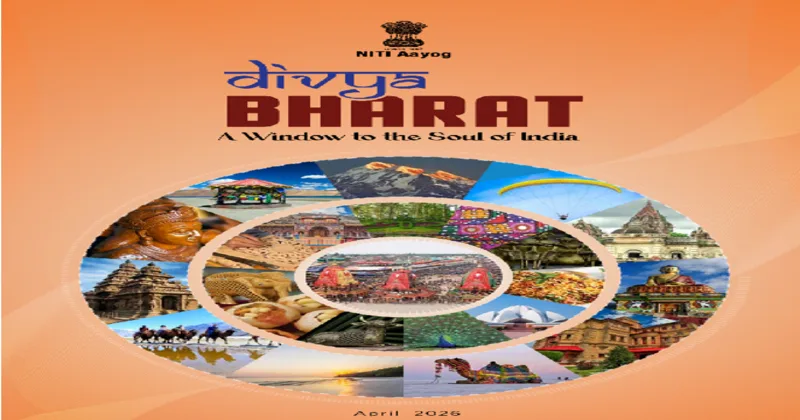
India has long defied the idea that tourism is a seasonal affair. From the frozen lakes of Ladakh in July to the golden deserts of Rajasthan in winter, the living root bridges of Meghalaya to the ghats of Varanasi at Dev Deepawali the country resonates with distinctiveness at every hour of every month. Despite this inexhaustible richness, a coherent authoritative and accessible guide that maps all of Indian tourism offerings across twelve months has been conspicuously absent. NITI Aayog has now addressed that gap with the release of Divya Bharat: A Window to the Soul of India, a comprehensive tourism anthology published in April 2026.
Conceived and produced by the Communication Division and Tourism & Culture Division of NITI Aayog and validated by academic experts from the Indian Institute of Tourism and Travel Management(IITTM), Noida and the Indian School of Public Policy(ISPP), Divya Bharat is not a coffee table book or a promotional brochure. It is a structured research-backed repository that has travel calendar, encyclopaedic references that takes the reader on an organised journey through Indian 28 states and 8 Union Territories.
A Dual Architecture: Calendar meets state profiles
The anthology is built around two interlocking sections that together serve as a year round companion for any traveller. The first section is a Monthly Calendar with twelve curated maps recommending the best destinations across states for each month, alongside reasons to visit. January points the traveller to the Rann Utsav in Gujarat Rann of Kutch, to the frozen magic of Gulmarg ski slopes in Jammu & Kashmir, to the rhino safaris of Kaziranga in Assam and to the Buddhist pilgrimage circuit of Bodh Gaya and Nalanda in Bihar. By July month the focus shifts to Ladakh’s absolute peak adventure season where biking, mountaineering the Hemis Festival and the Ladakh Polo Festival occur.
It also recommends the monsoon greenery of Goa Dudhsagar Falls and Odisha grand Rath Yatra at Puri. In October, the anthology notes the chinar trees of Srinagar turning gold, Mysuru Dasara splendour and Navratri celebrations in Gujarat all in one panoramic sweep. This calendar structure resolves a practical problem that confronts every traveller by knowing not just where to go. By aligning India staggering seasonal diversity with specific destinations and experiences, the Monthly Calendar transforms travel planning from guesswork into purposeful discovery.
The second and larger section comprises state wise chapters. Each chapter provides a structured portrait of the state tourism landscape, organised across several consistent themes of places to visit (heritage, pilgrimage and nature) lesser-known attractions, handicraft and textile heritage, fairs, festivals, cuisine and culinary heritage, best time to visit, popular tourism circuits and Did You Know facts that illuminate the region distinctive character.
Heritage, pilgrimage and the living traditions
The anthology coverage of heritage is both sweeping and granular. Major UNESCO sites involve Hampi, Khajuraho, Ajanta and Ellora, Konark, Mahabalipuram, find their place alongside lesser known gems that the casual traveller seldom encounters. In Andhra Pradesh, the anthology draws attention to Borra Caves in Visakhapatnam, ancient limestone caverns adorned with stalactites and stalagmites, to Kolleru Lake in Eluru, a large freshwater bird sanctuary. In Jharkhand, the text directs the reader to Hundru Falls, Dassam Falls, Netarhat and the Jain pilgrimage site at Parasnath Hill.
Pilgrimage travels a form of tourism that is organically and profoundly Indian receives dedicated attention throughout. The anthology recognises that India pilgrimage economy is among the most dynamic and geographically distributed in the world. The ghats of Varanasi and the Magh Mela at Prayagraj represent Uttar Pradesh. Vaishno Devi and the Dal Lake houseboats of Srinagar define Jammu & Kashmir spiritual draw. The Chhath Puja season makes Bihar Bodh Gaya and Rajgir a November destination of immense cultural significance. Puducherry Auroville and yoga retreats represent a different but equally authentic form of inner seeking.
Hidden India: Offbeat attractions and living crafts
The most significant editorial choice in Divya Bharat is its consistent emphasis on lesser known attractions. The anthology explicitly positions itself as a guide not just to popular tourist trails but to hidden gems for authentic, offbeat experiences. Tripura Neermahal lake palace, the rock-cut sculptures at Unakoti and the lush heritage of Agartala are brought into the frame. Mizoram Vantawng Falls, Reiek Hills and the city views of Aizawl Durtlang Hills appear alongside notes on clear mountain views and short hikes details that matter to a traveller planning a visit. Nagaland Dzukou Valley and Khonoma a village that pioneered community conservation of the Amur falcon are presented as windows into a tribal culture that is both ancient and innovating.
Handicraft and textile heritage is woven into every state chapter. The anthology recognises that the artisan is as much a part of Indian cultural tourism landscape as the monument. Andhra Pradesh Dharmavaram silk sarees, the hand-crafted traditions of Manipur, embroidery of Kashmir and the pottery of various regions are documented as integral experiences. For the culturally curious traveller, this framing is significant India crafts are not museum exhibits but living, breathing, market available forms of heritage.
Cuisine as cultural cartography
The culinary sections of Divya Bharat treat food as an entry point into the soul of each region. This is consistent with a growing recognition both in policy and in practice that culinary tourism is one of the most direct and democratic ways to experience a culture. Signature regional flavours, street foods and local delicacies are mapped for each state, creating a gastronomic guide that runs parallel to the heritage and nature recommendations. A traveller in Kerala in September, exploring the post-monsoon backwaters of Alleppey and the Ayurveda retreats of Wayanad, can also find the anthology notes on the state culinary heritage as a companion guide to the region flavours.
India for every kind of traveller
The anthology introduction makes an explicit and inclusive gesture whether you are a domestic traveller seeking to reconnect with your homeland or an international visitor experiencing India for the first time, Divya Bharat transforms planning into seamless discovery. This dual address is not merely rhetorical. The structure of the book with its practical Best Time to Visit guidance, curated circuits and factual Did You Know sections serves both the returning Indian traveller and the first-time international visitor equally well.
India has long been undersold as a year round destination in global tourism markets, partly because its sheer complexity can be overwhelming to navigate. Divya Bharat attempts to resolve this by providing what the tourism industry calls a decision architecture a logical framework that allows a traveller to identify, with confidence where to go, what to expect and why each destination is worth the journey at a particular time of year.
Policy statement in the form of an anthology
Divya Bharat is in its own quiet way, a statement of intent. NITI Aayog decision to invest in a publication of this depth and scope signals a recognition at the highest levels of policy that tourism with its enormous potential for employment, foreign exchange, cultural preservation and regional development. It deserves the same quality of structured attention that other sectors of the economy receive. The acknowledgement section credits the Ministry of Tourism and State Tourism Departments alongside the publication own research team, indicating that the anthology emerged from a genuine collaborative process rather than a top-down exercise.
Validated by academic institutions with domain expertise and produced with the involvement of Young Professionals from the State Support Mission of NITI Aayog, the anthology reflects a bottom-up gathering of insights on tourist attractions, culture, cuisine, crafts, festivals and lesser-known experiences from across the country. India awaits and Divya Bharat, in its quiet comprehensive way tells you exactly how to meet her.