In the digital age, the speed of a lie often outpaces the truth by a country mile, but when that lie is peddled by those who claim the mantle of journalistic integrity, the damage is not just personal—it is systemic. Recently, we witnessed a textbook case of this phenomenon involving Paranjoy Guha Thakurta, a veteran journalist who has long positioned himself as a left watchdog of corporate and political power. Yet, when faced with the consequences of spreading unverified, defamatory claims against N. Chandrasekaran, the Chairman of Tata Sons, the veneer of the crusading journalist crumbled into a hollow, forced apology.
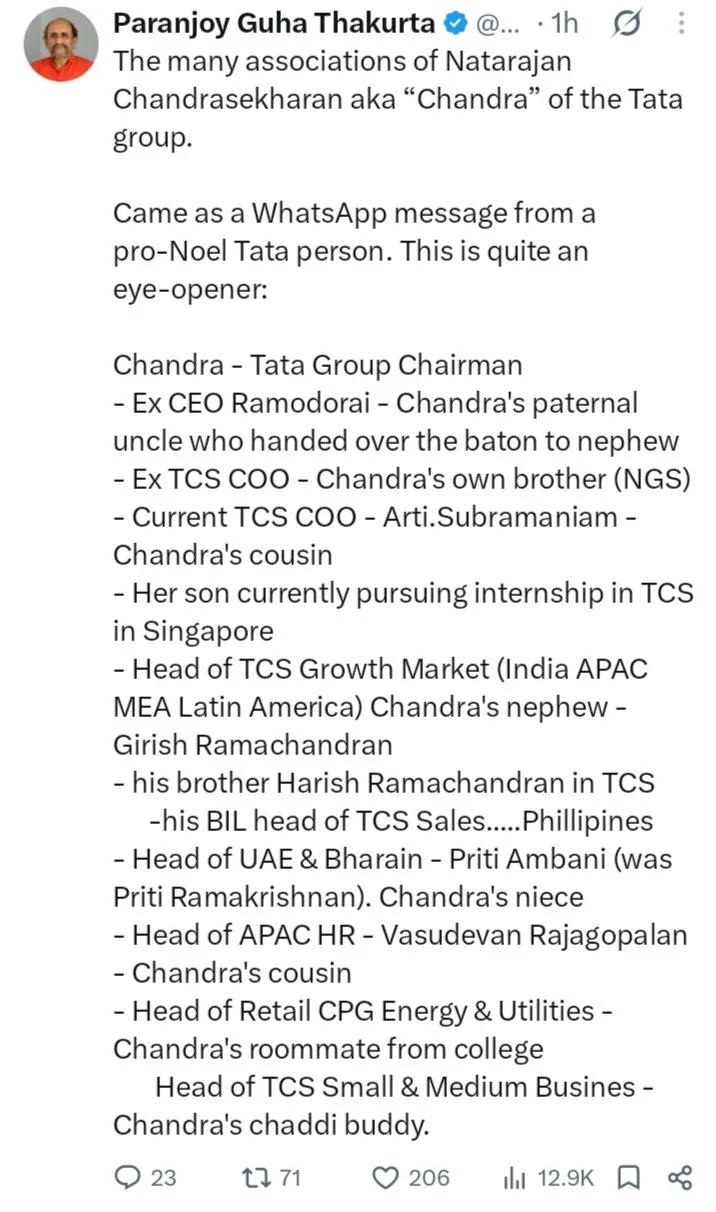
Guha Thakurtha Deleted Post, Followed by an Apology
However, within hours, Thakurta deleted the post and issued an apology, admitting that he had relied on a WhatsApp message that he believed to be factually accurate. In his apology, he acknowledged that the post contained “several inaccuracies and errors” and expressed his regret for the post concerning Tata Group Chairman N. Chandrasekaran.
To whom it may concern:
I sincerely apologise for putting out a post on Shri N Chandrasekharan of the Tata group based on a WhatsApp message that I believed was factually correct. The post had several inaccuracies and errors. As soon as these were brought to my notice, I…
— Paranjoy Guha Thakurta (@paranjoygt) September 22, 2026
Paranjoy Guha Thakurta’s Whats App Universities
This incident is not merely about a social media post gone wrong; it is about the erosion of accountability in our public discourse. When a figure of Thakurta’s stature chooses to amplify a WhatsApp forward—the very medium he and his peers often deride as the source of misinformation—it reveals a profound hypocrisy. It suggests that for some, the goal is not the pursuit of truth, but the pursuit of a narrative, regardless of the collateral damage inflicted upon the reputation of India’s most storied corporate institutions.
For the Indian reader, this episode serves as a stark reminder of the ‘hit-job’ culture that has permeated our information ecosystem. When the targets are pillars of Indian industry—entities that drive our GDP, provide employment to lakhs, and represent the ‘Make in India’ spirit on the global stage—the stakes are far higher than a mere Twitter spat. It is time we scrutinise the gatekeepers of our discourse with the same intensity they apply to the institutions they seek to delegitimise.
What Happened Now? Post against Tata Group leadership
The sequence of events was as predictable as it was damaging. A baseless claim regarding the Tata Group leadership was circulated, and instead of performing the basic due diligence expected of a cub reporter, let alone a veteran, Thakurta amplified it. The subsequent apology, issued only after the error was exposed, was a masterclass in damage control that lacked the weight of genuine contrition.
By his own admission, Thakurta ‘blindly believed’ a WhatsApp message. This is a staggering confession for someone who has built a career on investigative rigor. It begs the question: if the standard for ‘investigation’ is now the unverified content of a messaging app, what does that say about the quality of the ‘exposés’ we have been fed for years? The ease with which he discarded his professional responsibilities highlights a dangerous trend where the narrative is prioritised over the facts.
This is not an isolated incident but part of a broader pattern where Indian corporate leaders and institutions are subjected to trial by social media. When these attacks are directed at the Tata Group—a conglomerate that is synonymous with India’s industrial development and global standing—it is not just an attack on an individual; it is an attempt to undermine the credibility of the very engines of our economic growth.
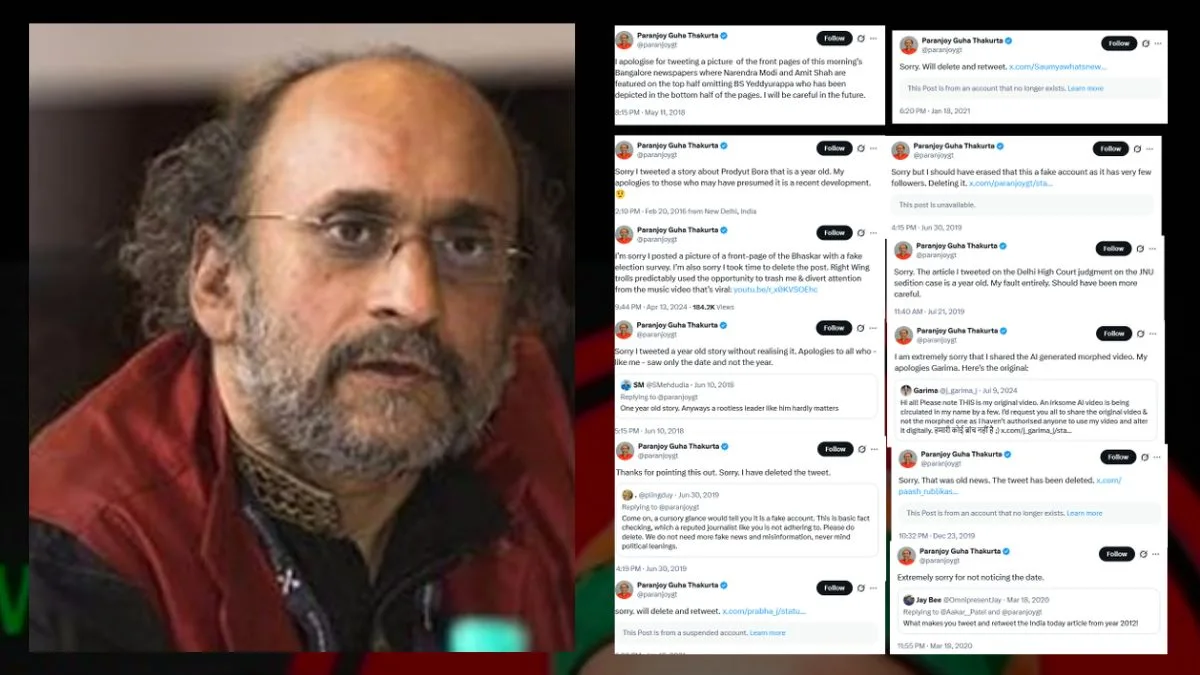
Paranjoy Guha Thakurta: A Pattern of Misinformation; Collage of Past Apologies
However, reports are emerging that this was not the first time he has peddled falsehoods and subsequently apologised. Multiple screenshots have surfaced showing him apologising for several of his posts. The revelations have raised questions about his credibility, his alleged use of false narratives, and whether personal grudges against individuals or organisations have influenced his attempts to push and spread a particular left-wing narrative. Hence, his posts and activities warrant a thorough scrutiny, particularly in light of concerns that he may have been attempting to promote or impose certain interests or narratives influenced by Western or other external actors.
Once can be a mistake. Twice may be a mistake. After that it is deliberate misinformation & malicious propaganda. "Journalist" Paranjoy Guha Thakurta does this repeatedly, with impunity, as there are no consequences. In any other country, his reputation would be mud
(HT… pic.twitter.com/D5cxaO4U0P— Smita Barooah (@smitabarooah) September 23, 2026
Hypocrisy of the ‘Watchdog’: A Recurring Pattern on the Left Activists
The irony of Thakurta’s position is palpable. He has frequently lectured the public on the dangers of fake news and the necessity of media literacy. Yet, when the shoe was on the other foot, he became the very thing he claims to oppose. This hypocrisy is not just a personal failing; it is a professional betrayal of the trust that the public places in journalists.
When journalists abandon the bedrock of verification, they do not just lose their credibility; they provide ammunition to those who wish to paint the entire Indian media landscape as biased and unreliable. This creates a vacuum where genuine, evidence-based journalism is drowned out by the noise of manufactured controversies and character assassinations.
We must ask ourselves: who holds the ‘watchdogs’ accountable? When a journalist of this profile can casually smear a titan of Indian industry and then retreat behind a perfunctory apology, it signals a lack of institutional consequences. It is a reminder that in the current media environment, the ‘correction’ rarely receives the same visibility as the ‘accusation,’ leaving the target’s reputation permanently scarred.
Thakurta’s Name Surfaces in NewsClick Funding Probe
Thakurta’s name had earlier surfaced in connection with investigations into the funding of digital news platform NewsClick. In February 2021, the Enforcement Directorate searched premises linked to NewsClick as part of its probe into alleged irregularities involving foreign remittances received by the company.
In 2023, the Delhi Police Special Cell registered a UAPA case alleging that NewsClick had received foreign funds routed through the United States, with some of the funding allegedly linked to China. The FIR also referred to a funding network involving US-based businessman Neville Roy Singham.
Thakurta was among several journalists questioned during the investigation. He had worked as a consultant for NewsClick since May 2018.
Narratives of Delegitimisation
The incident involving Thakurta is emblematic of a wider, more insidious trend: the systematic delegitimisation of Indian institutions. By targeting the leadership of the Tata Group, the narrative seeks to cast doubt on the integrity of India’s corporate governance. This is a recurring theme in the work of certain commentators who seem intent on portraying India’s growth story as a facade built on corruption and malpractice.
This framing is inherently anti-development. It seeks to undermine the confidence of domestic and international investors by painting a picture of a ‘crony’ system, rather than one of legitimate, hard-won economic progress. When these narratives are pushed, they do not just hurt the individuals involved; they hurt the Indian State and its institutions by eroding the public trust necessary for a functioning democracy and a thriving economy.
While there is no explicit anti-Hindu sentiment in this specific instance, the broader pattern of these ‘hit-jobs’ often aligns with a worldview that is reflexively hostile to the success of the Indian State and its traditional pillars of strength. It is a narrative that thrives on cynicism and seeks to tear down rather than build up, ultimately serving to weaken India’s global standing.
A Call for Accountability
As we look toward the future, the Indian public must become more discerning consumers of information. We can no longer afford to be passive recipients of narratives that are designed to sow discord and undermine our national progress. The era of the ‘untouchable’ commentator must come to an end, replaced by a culture of rigorous accountability.
For the media fraternity, this is a moment of reckoning. If we are to regain the trust of the people, we must hold our own to the same standards we demand of others. A journalist’s primary duty is to the truth, not to a political or ideological agenda. When that duty is abandoned, the consequences must be real and lasting.
Let this incident be a turning point. Let us move away from the culture of ‘shoot first, apologise later’ and toward a discourse that values evidence, nuance, and integrity. India’s growth story is too important to be derailed by the reckless actions of those who prioritise their own relevance over the truth. It is time to demand better, for the sake of our institutions, our economy, and our democracy.