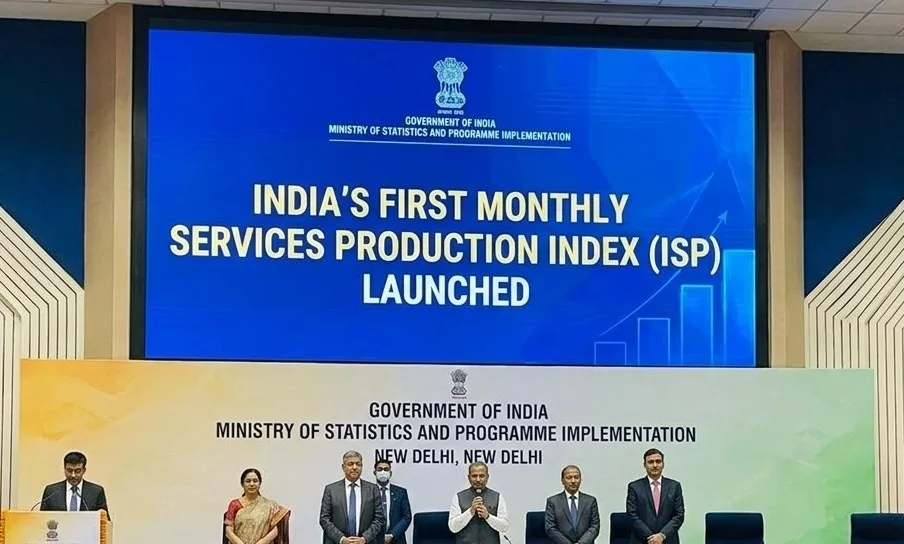
India has rolled out its first-ever Index of Services Production (ISP), marking a significant milestone in the country’s statistical framework. Announced by the Ministry of Statistics and Programme Implementation (MoSPI), the new index has been designed to measure short-term changes in the volume of output produced by the formal services sector, using 2024-25 as the base year.
The launch fills a long-standing gap in India’s economic measurement system. While the Index of Industrial Production (IIP) has long tracked manufacturing, mining and electricity, there has never been a dedicated monthly indicator to measure the country’s services sector despite it being the largest contributor to the economy. Officials believe the ISP will provide policymakers, businesses, economists and researchers with timely data to better understand economic trends and take informed decisions.
Bridging a critical data gap
The services sector has emerged as the backbone of India’s economy over the past two decades. According to MoSPI, it contributes 52.9 per cent of the country’s Gross Value Added (GVA), accounts for nearly 30 per cent of total employment and has generated around 40 million jobs over the last six years.
Despite its growing dominance, India’s economic assessment relied largely on quarterly GDP estimates and indirect indicators to gauge the health of the services sector. The introduction of the ISP is expected to bridge this gap by providing regular monthly estimates of service sector output, enabling faster assessment of economic activity and improving the accuracy of national income estimates.
The Ministry said the new index would strengthen economic monitoring, improve policymaking and provide a more comprehensive understanding of India’s growth trajectory.
Trial index shows strong growth
Alongside the launch, MoSPI released the first trial Index of Services Production for April 2026. The trial index covers 19 service sub-sectors that together account for nearly 60 per cent of India’s services economy.
The initial data points to broad-based growth across the sector. According to the Ministry, 14 of the 19 sub-sectors registered double-digit year-on-year growth in April 2026 compared with the corresponding month last year.
Accommodation and food services emerged as the fastest-growing segment with a growth rate of 37.2 per cent. Retail trade followed with 30.8 per cent growth, while administrative and support services expanded by 28.7 per cent. Real estate activities recorded growth of 27.7 per cent, and telecommunications grew by 22.8 per cent.
Officials said the figures indicate strong momentum across consumer-oriented services as well as business support activities, reflecting sustained domestic demand and expanding economic activity.
Strong performance during FY 2025-26
The Ministry also released annual growth estimates for the financial year 2025-26, highlighting robust performance across several service industries.
Accommodation and food services remained the best-performing segment with annual growth of 35.6 per cent. Retail trade followed closely at 30.5 per cent, while repair services recorded 25.1 per cent growth. Wholesale trade expanded by 23.6 per cent and road transport registered growth of 22.6 per cent during the year.
According to officials, these sectors have played a major role in driving the expansion of India’s services economy and reflect rising consumer demand, increasing mobility and growing commercial activity.
How the Index Works
The Index of Services Production measures changes in the real volume of services produced rather than simply tracking revenues. Since nominal revenues are influenced by inflation, the Ministry uses appropriate price deflators, including the Consumer Price Index (CPI) and Wholesale Price Index (WPI), to estimate actual production levels.
Officials said this approach provides a more accurate picture of economic activity by separating real growth from price increases.
The Ministry noted that the index has been developed using multiple high-frequency data sources, including Goods and Services Tax (GST) records, administrative databases and the Annual Survey of Incorporated Services Sector Enterprises (ASISSE).
Significantly, this is the first time GST data has been extensively used for official statistical applications, a move expected to improve the quality, frequency and reliability of economic measurement.
Coverage of the New Index
The current version of the ISP covers 19 major service industries spread across various segments of the economy. These include wholesale and retail trade, road transport, telecommunications, information technology services, real estate, professional and technical services, administrative and support services, accommodation and food services, banking, insurance, repair services and arts, entertainment and recreation.
Together, these sectors account for nearly 60 per cent of India’s services economy.
However, government-dominated and non-market activities have been excluded from the present framework. These include public administration, defence, government education, government healthcare and certain financial sector activities. According to MoSPI, these sectors require different methodologies and may be incorporated in future versions as better data becomes available.
Developed Using Global Best Practices
The conceptual framework for the ISP was prepared by a Technical Advisory Committee constituted by MoSPI in May 2025. The committee developed the methodology after studying internationally accepted standards and best practices.
The Ministry said the framework draws upon the OECD Compilation Manual for Index of Services Production as well as guidance issued by Eurostat. Adopting internationally recognised statistical standards is expected to improve the credibility of the index and enable better comparison with other major economies.
Officials described the ISP as an important step in modernising India’s statistical system and aligning it with global practices.
Why the Index is significant
The introduction of the Services Production Index is expected to benefit policymakers, businesses, researchers and investors alike.
For the government, the monthly data will provide a clearer understanding of economic activity, enabling quicker policy interventions whenever required. It is also expected to strengthen national accounts estimation and improve the quality of macroeconomic analysis.
For businesses and investors, the index will offer regular insights into demand conditions across different service industries, supporting investment decisions and business planning. Economists and researchers will also gain access to a reliable high-frequency dataset for analysing trends in India’s largest economic sector.
Officials believe the ISP will eventually become as important for the services sector as the Index of Industrial Production has been for manufacturing and industry.
Monthly Releases to Continue
MoSPI said the Services Production Index will initially be released as a trial series every month with a lag of around 60 days. The data will generally be published on the 29th of every month or on the next working day if the date falls on a holiday.
Regular publication of the index is expected to improve transparency and ensure timely availability of data for all stakeholders.
The launch of the Index of Services Production marks one of the most significant reforms in India’s statistical architecture in recent years. As the services sector continues to drive the country’s economic growth, employment and consumption, the availability of a dedicated monthly indicator is expected to transform the way policymakers assess economic performance.
By combining modern administrative databases such as GST records with internationally accepted statistical methodologies, the government aims to create a more accurate and timely picture of India’s evolving economy. The Ministry believes the new index will not only complement existing indicators like the Index of Industrial Production but also strengthen evidence-based policymaking, improve economic forecasting and provide a comprehensive assessment of the country’s largest and fastest-growing economic sector.