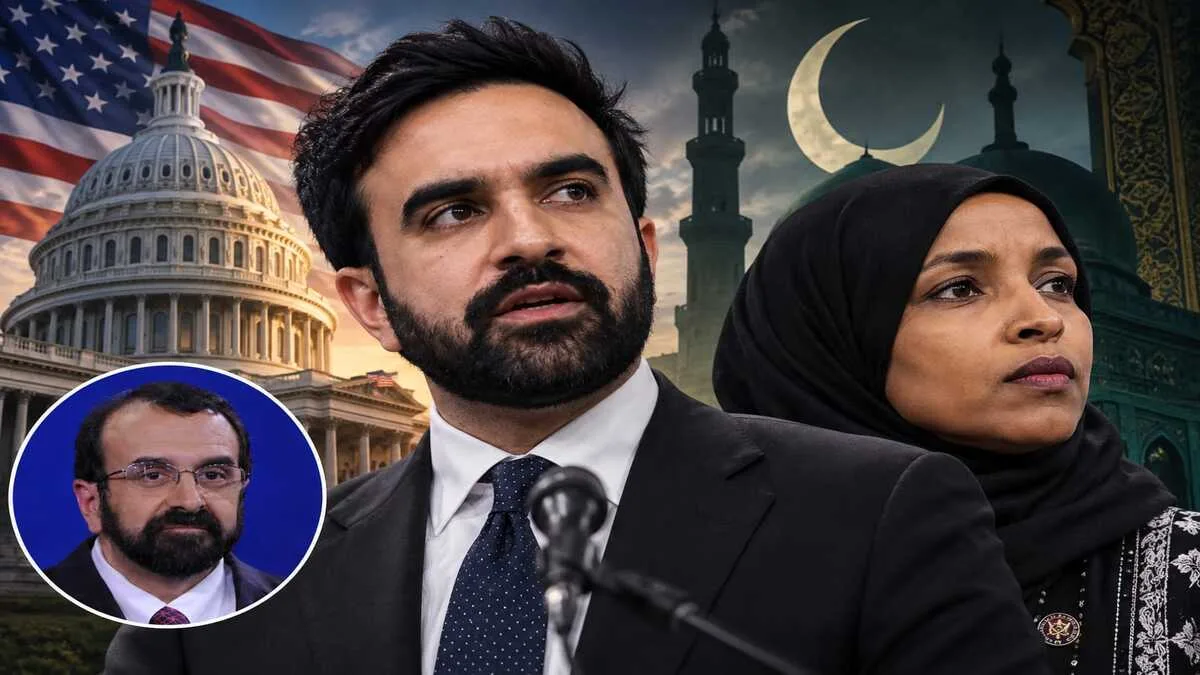
Robert Bruce Spencer, an American scholar, has presented a broad critique of what he describes as “stealth jihad” in the United States, Europe and elsewhere, arguing that jihad extends beyond armed violence into political, cultural and institutional activity aimed at expanding Muslim political power and ultimately establishing the hegemony of Sharia.
Spencer made the remarks in an interview with French journalist Gregoire Canlorbe. The discussion ranged from the different forms of jihad and political Islam to Muslim migration, the transformation of churches into mosques, the decline of Christian influence in America, Byzantine civilisation, the fall of Constantinople and the lessons Spencer believes the United States should draw from that history.
Stealth jihad and the political expansion of Islam
Responding to Canlorbe’s question about the different forms of jihad and their reach in America and around the world, Spencer argued that jihad should not be understood only in terms of armed conflict. He identified what he called the “jihad of the tongue”, “jihad of the pen” and “jihad of the pocketbook”, alongside armed jihad and other forms.
According to Spencer, these different forms share a political objective that replacing the existing order of non-Muslim states with what he described as the hegemony of Sharia. In this framework, “stealth jihad” refers to activity that advances that objective without necessarily taking the form of conventional armed warfare.
Spencer said stealth jihad is already “well advanced” in America. He specifically accused the American left of enabling and aiding the expansion of Muslim political power, arguing that this support is taking place without sufficient recognition, or despite awareness, of what he characterises as the intolerant and supremacist dimensions of the ideology.
His assessment extends beyond America. Spencer said the process is further advanced in Europe, which he attributed principally to the continent’s high level of Muslim migration. He warned that, in his view, the demographic and political trajectory could eventually contribute to civil conflict and the emergence of Islamic states in parts of Europe and Britain before the end of the 21st century. Russia, he added, is not exempt from the phenomenon, although he said it currently has fewer Muslims and therefore, in his assessment, less jihad.
Europe, churches and the struggle over Christian space
A central part of Spencer’s argument concerns changes that he says are taking place in Europe, particularly the acquisition and conversion of churches into mosques. He pointed to what he described as an increase in churches being purchased and transformed into mosques. Spencer argued that, in his interpretation, Muslims may prefer converting existing churches to constructing entirely new buildings because the transformation carries a symbolic meaning.
Mosques or military bases?
In the Islamic world, there’s no difference — and now that model is being exported town by town across America.
This isn’t multiculturalism. It’s Stealth Jihad, funded by foreign regimes and shielded by tax-exempt status. These mosques are not being… pic.twitter.com/gWnHRsEqIQ
— Amy Mek (@AmyMek) April 2, 2025
He characterised a former church becoming a mosque as a visible manifestation of what he sees as Islam’s victory over Christianity, its superiority over Christianity and its anticipated political and cultural hegemony.
The argument forms part of Spencer’s wider assessment of Europe’s changing religious and political landscape. Rather than treating the issue simply as a matter of changing religious buildings, he presents the conversion of Christian spaces as evidence of a broader contest over political Islam, religious identity and cultural influence. His comparison between Europe and America also rests on what he sees as a weakening of Christianity in Western societies.
America, Christian heritage and the Sharia question
Asked about America’s future and its historical identity as a Christian nation, Spencer argued that the United States has undergone a major retreat from its Christian heritage. He said America has experienced this transformation to a considerably lesser degree than Europe but nevertheless “unmistakably”. In his account, popular culture, the education system and mass media have contributed to a large-scale change in public attitudes and beliefs over the past half-century.
Spencer described the resulting decline in Christian influence as creating a vacuum that Islam is seeking to fill, pointing again to Europe as an example. He connected this argument with the conversion of churches into mosques, presenting the phenomenon as part of what he considers a wider advance of political Islam.
The discussion then moved directly to American political leadership. Spencer argued that Democrats are encouraging the growth of Muslim political power while, in his assessment, ignoring political, supremacist, expansionist and violent aspects that he associates with Sharia.
This is Islam. Listen to what he is teaching to Canadian Muslims.
He is “glorifying young boys who dream of becoming terrorists & little girls who aspire to raise them”
This is what’s here in Texas, most Texans have no idea stealth Jihad is happening!pic.twitter.com/1essLBlu5B
— John Ferguson (@JohnnyWhiskyTX) May 11, 2025
He said relatively few politicians understand what he considers the nature and scale of the threat, or are determined to respond to it. Spencer therefore framed “stealth jihad” as a political and institutional challenge rather than merely a question of terrorism or armed jihad.
This argument is central to his warning about America’s future that he said the United States could ultimately experience a historical parallel to Constantinople if political leaders remain, in his words, short-sighted and self-serving.
Byzantium, Islam and the legacy of Athens, Rome and Jerusalem
Spencer’s critique of political Islam is closely connected to his interpretation of Byzantine history. Discussing the Byzantine Empire, he argued that the Byzantines regarded themselves as Romans living in the Roman Empire and played a decisive role in preserving the classical Greek intellectual tradition. He rejected the commonly presented idea that Muslims were principally responsible for preserving ancient Greek literature, instead crediting Byzantium with maintaining these works within its educational system until the empire’s fall in 1453.
Spencer specifically cited Plato, Aristotle, Aeschylus and Euripides. He argued that their writings became foundations of Western political, philosophical, scientific and literary traditions and continued to influence Western civilisation even among people who had never read them.
He contrasted this with his interpretation of Islamic civilisation. Spencer pointed to Muslim philosophers who influenced thinkers such as Thomas Aquinas but stressed that some of those philosophers were regarded as heretics within the Islamic intellectual tradition.
He singled out the Persian theologian and philosopher al-Ghazali and his work The Incoherence of the Philosophers. Spencer argued that al-Ghazali’s criticism effectively weakened the Islamic philosophical tradition and reinforced what he called an anti-intellectual tendency that, in his view, hindered scientific development and continues to affect the Islamic world.
Spencer also contrasted Byzantium with Catholic Europe, arguing that Western Europe had comparatively little direct knowledge of Plato and Aristotle until Gemistos Plethon began lecturing on their works in Florence during the mid-15th century. Those lectures, he said, helped contribute to the Renaissance.
For Spencer, this history establishes a substantial but often overlooked debt of the Western world to Byzantium.
Constantinople, May 29, 1453 and Spencer’s warning to America
The historical centrepiece of Spencer’s argument is the fall of Constantinople. He attributed the weakening and eventual destruction of the Roman Empire centred on Constantinople to hundreds of years of jihad attacks. But his explanation also included internal and external political factors.
According to Spencer, Constantinople’s failure to receive sufficient assistance from Western Europe was partly connected to suspicions generated by the Great Schism. He also emphasised internal disunity among Byzantine leaders. Some leaders, he said, were sufficiently short-sighted and self-interested to seek and obtain assistance from Muslim forces.
Spencer draws a direct analogy between that history and contemporary America. He argued that the United States faces what he described as a comparable threat from its own short-sighted and self-serving political leaders.
His warning specifically targets the Democratic Party, which he accused of encouraging Muslim political power while overlooking the political, supremacist, expansionist and violent elements he associates with Sharia.
Ex-Muslim Jihadi Kamal Saleem new interview
Muslim Brotherhood and Stealth Jihad, (4 min) pic.twitter.com/jA2aPPozt9
— Bob (@Shariakill) July 8, 2025
Spencer said that if the trend continues, America could eventually experience its own equivalent of May 29, 1453, the date Constantinople fell to Ottoman Sultan Mehmed II after a 53-day siege. For him, Constantinople represents a historical warning about the consequences of external pressure combined with political division, inadequate assistance and decisions by leaders whom he regards as acting in their own short-term interests.
The interview finally turned to whether particular religions are more vulnerable than others to what Canlorbe described as “self-imposed submission to Islam”. Spencer rejected a distinction between religions on this question, saying that probably all religions are affected. At the same time, he acknowledged that there are notable individuals who have not been afraid to speak out or who have not been prevented from doing so.
Spencer is identified in the interview as a Christian American scholar whose work covers Islam, Orthodoxy and the Byzantine Empire. He is a Shillman Fellow at the David Horowitz Freedom Centre. The interview notes that he has conducted seminars on Islam and jihad for organisations including the FBI, the United States Central Command and the U.S. intelligence community.
Canlorbe, the interviewer, is a journalist living in Paris who has conducted interviews for publications and organisations including Man and the Economy, the Mises Institute and the Gatestone Institute.
Taken together, Spencer’s argument presents “stealth jihad” as a broad political, cultural and institutional campaign rather than a phenomenon restricted to armed attacks. His focus is on America, Europe, Britain and Russia, with particular attention to Muslim political power, migration, religious conversion of existing Christian spaces and the role of Western political leadership.
The historical comparison with Byzantium and the fall of Constantinople provides the framework through which he warns that political Islam, in his interpretation, can advance not only through force but also through political influence, demographic change, cultural transformation and the decisions of Western leaders.