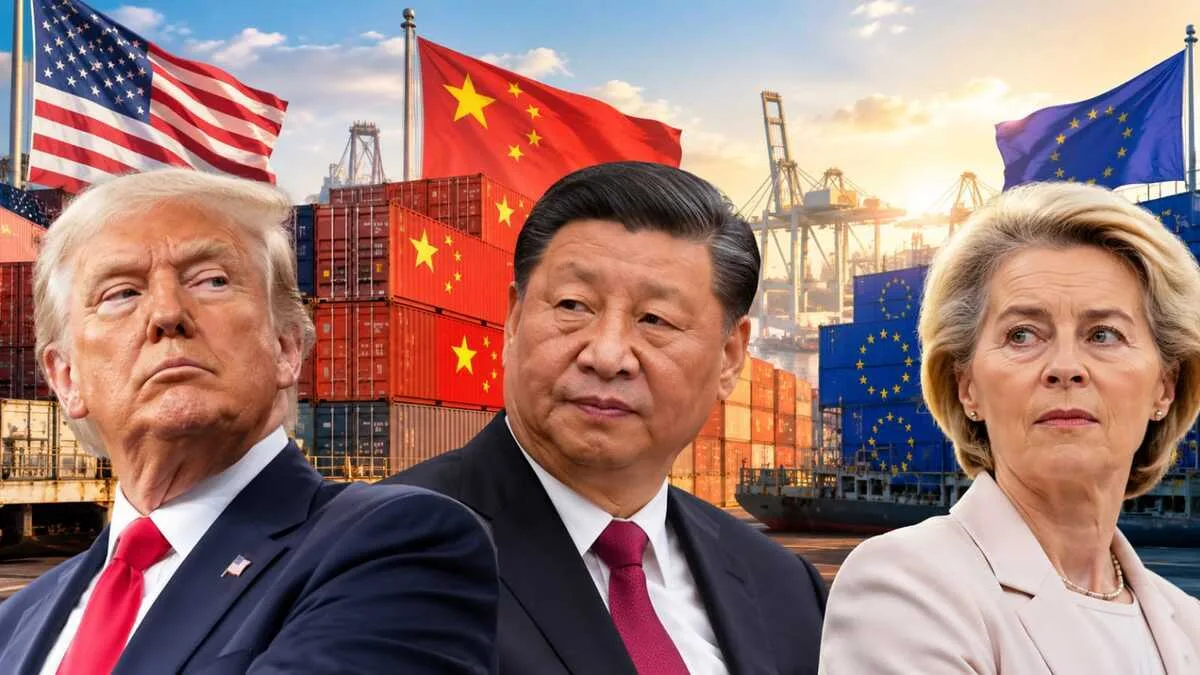
China is facing a growing trade dilemma as tariffs and restrictions in the United States narrow the space available for its exports, increasing the importance of the European Union as a major destination for Chinese goods.
At the same time, the rapid expansion of China’s industrial capacity is intensifying competition for European manufacturers, particularly in machinery, transport equipment, electric vehicles and clean-energy products.
The European Central Bank said on September 22, 2026, that China’s rapid industrial transformation is reshaping global trade and putting uneven pressure on EU economies. The overlap between China’s export structure and those of European countries has increased substantially since 2019, especially in machinery and transport equipment. Germany, whose manufacturing base has the greatest similarity with China’s export profile, is among the economies most exposed to the shift.
The development comes as the United States continues to use tariffs as a major instrument in its trade relationship with China. Although Washington and Beijing agreed in September to reduce tariffs on $30 billion of non-sensitive goods in each direction, the broader tariff dispute has not disappeared.
The agreement followed President Donald Trump’s meeting with Chinese President Xi Jinping and extended the existing trade truce through January 10, 2027. For China, the combination of U.S. tariff barriers, weaker domestic demand and persistent industrial overcapacity is increasing the importance of overseas markets. Europe, in particular, remains a crucial destination because of the scale of its consumer market and its industrial demand.
EU-China trade gap reaches critical point
European Commission President Ursula von der Leyen highlighted the growing imbalance in her State of the Union address on September 16, 2026. She said the European Union’s trade deficit with China had reached €1 billion per day and described the situation as a “tipping point”.
She also said the EU would use all available tools to rebalance its economic relationship with China. Von der Leyen also linked the trade imbalance to China’s weaker domestic demand. According to her assessment, China’s reduced internal consumption means that Chinese producers increasingly need access to the European market. She argued that both sides therefore have an interest in finding solutions, while warning that the EU cannot allow the existing imbalance to continue indefinitely.
The pressure is particularly significant because China is simultaneously reducing its dependence on European industrial imports. The ECB said China’s imports have become less aligned with the export structures of EU economies since 2019, while EU exports to China have declined. Germany has been particularly affected because of its strong exposure to machinery, automobiles and other capital goods.
This creates an increasingly asymmetric relationship. China is becoming more capable of supplying products that European companies traditionally exported, while Chinese demand for European manufactured goods has weakened.
The result is growing concern in Brussels about the impact of China’s export expansion on European industry. Chinese products can reach European markets at highly competitive prices, while European producers face pressure from declining market shares, weaker margins and rising competition in sectors once dominated by European companies.
The issue is especially visible in the electric-vehicle industry. The EU introduced additional duties on Chinese battery-electric vehicles in October 2024 following an anti-subsidy investigation. Combined with the existing 10 percent most-favoured-nation tariff, the overall tariff burden can reach about 45 percent for some Chinese EV producers.
China responded with trade measures affecting European products, including cognac, pork and dairy goods. The confrontation demonstrated how quickly disputes over China’s exports can spread across different sectors of the European Union economy.
Yet the tariffs have not eliminated the underlying competitive pressure. China remains a major source of electric vehicles, solar equipment and other manufactured products entering Europe, while Chinese manufacturers continue to expand their technological capabilities and production capacity.
China’s export pressure hits European industry
The ECB’s September 22 analysis identified machinery and transport equipment as particularly important areas of competition. China’s industrial rise has moved beyond low-cost manufacturing into increasingly sophisticated and technology-intensive production. This has brought Chinese firms into direct competition with European companies in sectors central to the EU’s industrial base.
Germany faces particularly strong exposure because its economy depends heavily on manufacturing and exports. The ECB found that Germany’s export structure has become increasingly similar to China’s, leaving German producers more directly exposed to Chinese competition in global markets.
The pressure extends beyond automobiles and machinery. Solar panels represent another major area of dependence. China accounted for 98 percent of the EU’s extra-EU solar-panel imports in 2024, according to Eurostat-based data.
Cheap Chinese solar equipment has supported the expansion of renewable energy in Europe, but the same dependence has weakened the position of European manufacturers. The result is a difficult policy balance for the European Union that Chinese imports can reduce costs for consumers and accelerate deployment of clean technologies, while excessive dependence can undermine domestic manufacturing capacity.
Analysts have warned that continued Chinese export growth could therefore contribute to further industrial displacement in Europe. If European manufacturers lose market share not only within the EU but also in third-country markets, the consequences could extend beyond individual companies to employment, investment and industrial supply chains.
The pressure is compounded by China’s domestic economic conditions. Official data released on September 16 showed that Chinese retail sales of consumer goods rose only 0.4 percent year on year in August 2026. For January-August, consumer-goods retail sales increased 1.1 percent, while total retail sales of goods and services rose 2.5 percent.
Weak domestic consumption makes overseas markets more important for Chinese manufacturers carrying large production capacities. If Chinese households cannot absorb the output of domestic factories, producers have greater incentives to expand exports.
That creates the possibility of an expanding export cycle in which surplus production is redirected toward markets such as the European Union.
U.S. tariffs push China toward Europe and emerging markets
The United States has been one of the most important markets to come under pressure from the China trade dispute. Trump’s tariff strategy has increased the cost of Chinese goods entering the USA, encouraging Chinese producers to look for alternative destinations. Even after the latest U.S.-China tariff agreement, strategic sectors such as electric vehicles and semiconductors remain outside the September tariff reductions.
This makes Europe increasingly significant for China’s export strategy. China’s trade surplus with the EU has expanded sharply. The wider imbalance has prompted European policymakers to consider additional trade-defence measures as Brussels prepares to review the relationship with Beijing.
The possibility of tougher EU restrictions presents a major problem for China because Europe is difficult to replace as a market. Developing countries can absorb additional Chinese exports, but their purchasing power and market structures differ from those of the European Union. A large redirection of Chinese exports toward Southeast Asia could also intensify competition among Chinese manufacturers already operating in the region.
Another challenge is the potential growth of transshipment and “origin washing” as exporters seek to avoid tariffs. If Chinese companies increasingly route products through third countries and classify them as locally produced, European and U.S. authorities could face greater difficulties in enforcing trade restrictions.
For Beijing, therefore, the European market has become both an economic opportunity and a strategic vulnerability. China needs foreign markets to absorb industrial output, but the very scale of its exports is provoking stronger protection from trading partners.
The European Union faces a similar dilemma. Cutting Chinese imports too quickly could raise costs for consumers and businesses, particularly in sectors such as solar energy and electric vehicles. Allowing imports to expand unchecked, however, could intensify pressure on European manufacturers.
The result is a difficult trade equation involving China’s export capacity, EU industrial competitiveness and U.S. tariffs. Washington’s tariff policies have increased pressure on Beijing, while Brussels is simultaneously confronting the effects of Chinese overcapacity.
China’s immediate challenge is therefore not simply finding new customers. It is maintaining access to major markets while preventing trade barriers from multiplying across the United States, European Union and other economies. For Europe, the central question is how to preserve access to competitively priced Chinese goods while protecting the industrial capacity needed for the European Union’s long-term economic resilience.