Nestled within the Sri Sathya Sai district of Andhra Pradesh, Penukonda Fort stands not merely as stone and mortar, but as an eternal sentinel guarding the sacred civilisational ethos of Bharat. It is a living monument to Hindu resilience, artistic genius, and military strategy. Born under the patronage of Hindu dynasties, Penukonda remains a luminous chapter in our history-a place where the flame of Sanatana Dharma burned brightly even during the subcontinent’s most challenging eras.
The Genesis: Hoysala Roots and Sacred Origins
The story of Penukonda begins in the 1st quarter of the 14th century CE. Established as the crucial northeastern bulwark of the Hoysalas of Dvarasamudra, tradition attributes its foundation to the venerated Kriya Sakti Udaiyar (Vodayar).
Penukonda Fort is located in Penukonda, District Sri Sathya Sai, Andhra Pradesh. Traditionally, it is believed that this fort was founded by Kriya Sakti Udaiyar (Vodayar). The earliest reference to this fort occurs in the 1st quarter of the 14th century CE, as the north-eastern… pic.twitter.com/AlyWvLFT1T
— Archaeological Survey of India (@ASIGoI) September 2, 2026
Raised upon massive granite hills, the citadel was designed to protect the rich cultural and spiritual heartlands of the Deccan from northern invasions. Every stone along its paths was laid with the vision of safeguarding a sacred lifestyle and indigenous sovereignty.
The Vijayanagara Epoch: A Shield for Sanatana Dharma
While the fort owes its origins to the Hoysalas, its true glory unfolded under the great Vijayanagara Empire. Following the pivotal Battle of Talikota in 1565 CE, when imperial Hampi faced widespread destruction, Penukonda rose to become the capital of the empire.
It was from these towering heights that the Vijayanagara rulers kept the administrative and spiritual spirit of Southern Bharat alive. Over the centuries, its geopolitical importance made it a prized possession. Control shifted dynamically between the Vijayanagara rulers, the Golconda Sultanate, the Marathas, Mysore’s Tipu, the Hyderabad Nizams, and the British.
Penukonda Fort stands as a remarkable testament to the Hoysala and Vijayanagara legacy, reflecting the architectural and historical richness of India’s living heritage.
— Maitri Cultural Economy Samiti (@mcesofficial) September 2, 2026
Penukonda became the ultimate redoubt of resistance-a sanctuary where royal traditions, Vedic scholarship, and architectural patronage continued uninterrupted.
Engineering Marvels: The Impregnable Bastions
Penukonda’s architectural planning reflects classical Indian military science (Durgavidya). The hill fort features an intricate defence network comprising deep moats, massive stone fortifications, and strategised bastions positioned at precise intervals.
Sacred Gates and Sentinel Bastions: Defending the Eternal Fortress
Access to the inner sanctuary of the royal quarters and sacred precincts was strictly guarded through magnificent, heavy-granite gateways (Vakili) and fortified positions. Built in accordance with classical Indian military treatises (Durgavidya), each gateway was strategically named after local sacred geography, regional routes, and protective Hindu deities to invocation divine guardianship over the city:
Erramanchi Uru Vakili: The Gateway of Strength Serving as the principal arterial entrance into the heart of Penukonda, this grand portal was designed to awe visitors and deter aggressors alike. Constructed with massive stone monoliths and defensive arches, it stood as the primary line of military defence, ensuring that only those loyal to the empire crossed into the sacred realm.
Gorantla Uru Vakili: The Portal of Strategic Sovereignty Positioned to command and regulate key trade and military routes connecting Penukonda to the broader Deccan region, this gateway was a masterpiece of tactical planning. It allowed the Vijayanagara rulers to maintain swift communications, move troops efficiently, and manage imperial commerce while securely choking off potential invader routes.
Cheruvu Uru Vakili: The Guardian of Life-Sustaining Waters
Overlooking the extensive dressed-stone water reservoirs and complex hydraulic systems of the fort, this entrance safeguarded the citadel’s most vital resource. In ancient Indian warfare, water security was paramount; this gateway stood sentry over the town’s water supply, guaranteeing that Penukonda could endure prolonged sieges without compromise.
Anjaneya Uru Vakili: The Divine Shield of Bhagwan Hanuman
Dedicated to Bhagwan Hanuman-the ultimate symbol of unyielding devotion, strength, and warrior spirit-this sacred gateway invoked celestial protection over the garrison. Soldiers passing through this arch sought the blessings of the eternal protector, reinforcing the profound bond between martial duty and spiritual faith in the defence of Sanatana Dharma.
Ramaburuzu: The Eastern Sentinel of Imperial Might Anchoring the fort’s defence along its eastern flank, Ramaburuzu was a heavily fortified stone bastion designed for artillery and archers.
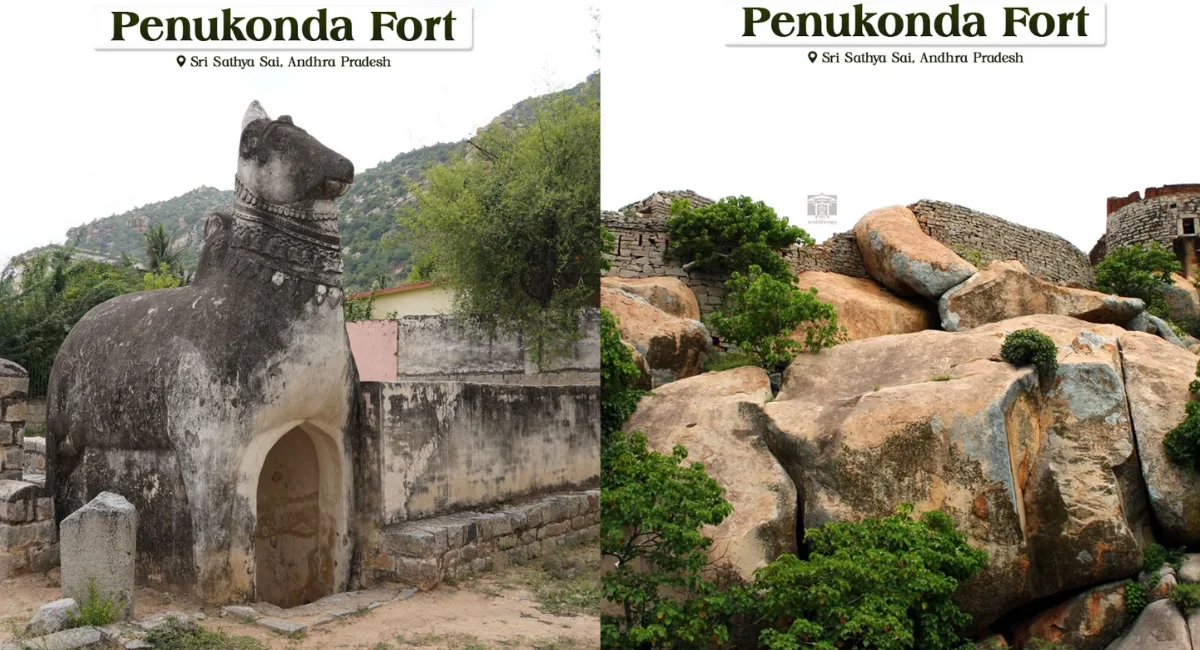
The hill fort consists of a moat, long fortifications enclosing the old town of Penukonda, and a number of bastions at regular intervals. It has gateways namely Erramanchi Uru Vakili, Gorantla Uru Vakili, Cheruvu Uru Vakili, Anjaneya Uru Vakili and Ramaburuzu.
Inside the fort… pic.twitter.com/kqhrYKb4u9
— Archaeological Survey of India (@ASIGoI) September 2, 2026
Named in honour of the ideal warrior king, Sri Rama, this imposing tower provided a sweeping vantage point across the surrounding plains, ensuring no hostile force could approach the citadel unseen.
Sacred Architecture: Temples and Royal Palaces
Within the sprawling enclosures lies a complex of artistic and cultural marvels. The citadel atop the western hill, accessed via a stone-paved ramped pathway, served as the ultimate high-altitude stronghold. At the heart of the lower fort stands the Gagan Mahal (Palace of the Sky), built around 1575 AD. Designed as the royal residence and courtly hall for Vijayanagara monarchs-including the legendary Samrat Sri Krishnadevaraya, who used Penukonda as his strategic retreat-the palace showcases classical Dravidian architectural mastery. Its soaring multi-tiered pavilions, stone arches, and vaulted ceilings demonstrate the sophisticated engineering of indigenous builders.
Beyond the royal quarters, Penukonda features a vibrant network of sacred spaces:
Shri Ghanagiri Lakshmi Narasimha Swamy & Yoga Narasimhaswamy Temples: Holy shrines dedicated to the fierce protector deity of the Vijayanagara royalty.
Kashi Vishwanatha & Yoga Rama Temples: Sacred sites showcasing classic Vijayanagara pillar carvings and intricate stonework.
Basavanna Stepwell: An engineering marvel where subterranean water channels are accessed through a beautifully sculpted Nandi entrance.
Saluva Timmarusu Pavilion: A historic structure commemorating Mahapradhani Timmarusu, the legendary prime minister whose political genius helped elevate Sri Krishnadevaraya to greatness.
An Enduring Symbol of Heritage
Penukonda Fort-historically venerated as the grand bastion of Ghanagiri-stands as far more than a silent archaeological relic; it is an active, breathing monument to Hindu civilisational endurance and the unyielding defence of Sanatana Dharma.
In an era when our culture faced existential threats, this sacred citadel served as the formidable sanctuary where imperial visionaries, master architects, and fearless warriors united under a shared spiritual consciousness to protect Bharat’s sacred land, faith, and heritage.
As the fortress that kept the glorious flame of the Vijayanagara Empire burning bright through its darkest hours, Penukonda remains an indispensable pillar of our true national memory-a timeless reminder that our rooted identity, built upon unparalleled valour and divine devotion, must be fiercely preserved, celebrated, and passed down as a beacon of pride for generations to come.