
Kaimur: India is home to thousands of ancient Mandirs, many of which stand as enduring symbols of the country’s religious traditions, architectural heritage and civilisational history. Among them, Mundeshwari Mandir in Bihar’s Kaimur district occupies a special place. Often described as one of the oldest continuously functioning Hindu Mandirs in India, the shrine is believed to date back nearly 1,900 years.
Perched on the Mundeshwari Hills, the Mandir is dedicated to Mundeshwari Devi, a form of Shakti, and is also closely associated with Bhagwan Shiva. Its antiquity, distinctive octagonal structure and uninterrupted tradition of worship make it an important destination for devotees, historians and heritage enthusiasts.
Mundeshwari Mandir is situated in Kaimur district of Bihar, on the summit of the Mundeshwari Hills. The Mandir stands at an elevation of roughly 600 feet and is surrounded by the landscape of the Kaimur region. Its location on a hill adds to the Mandir’s distinctive character. Devotees have traditionally climbed the hill to reach the shrine, while the elevated setting provides views of the surrounding countryside. The Mandir is also considered an important part of Bihar’s ancient religious heritage, reflecting the region’s long history as a centre of Hindu worship.
How old is Mundeshwari Mandir?
The exact date of the Mandir’s construction remains a subject of historical discussion. However, an inscription discovered in the area has been associated with the Gupta period, while archaeological and historical studies have placed the origins of the shrine broadly between the early centuries of the Common Era.
The Mandir is therefore frequently described as being around 1,900 years old. The Archaeological Survey of India (ASI) recognises the monument as an important protected heritage site. While the structure has undergone changes and repairs over the centuries, the continued religious significance of the site makes Mundeshwari particularly noteworthy.
It is important to distinguish between the age of the present structure and the age of worship at the site. Ancient Indian temples were often renovated, reconstructed or expanded over different periods. Therefore, claims about the Mandir being “1,900 years old” generally refer to the antiquity of the shrine and its historical tradition rather than suggesting that every stone visible today dates from the same period.
A Mandir dedicated to both Shakti and Shiva
One of the most fascinating features of Mundeshwari Mandir is its association with both Shakti and Shiva. The principal deity is Mundeshwari Devi, regarded as a manifestation of Maa Shakti. The temple also houses a distinctive four-faced Shiva lingam, which is among its most important religious features. The presence of both forms of worship reflects the interconnected traditions of Shaivism and Shaktism that have existed in India for centuries.
According to local traditions, the goddess is associated with the defeat of the demon Munda, one of the demons mentioned in Hindu religious traditions. This association has contributed to the temple’s identity as a powerful Shakti shrine.
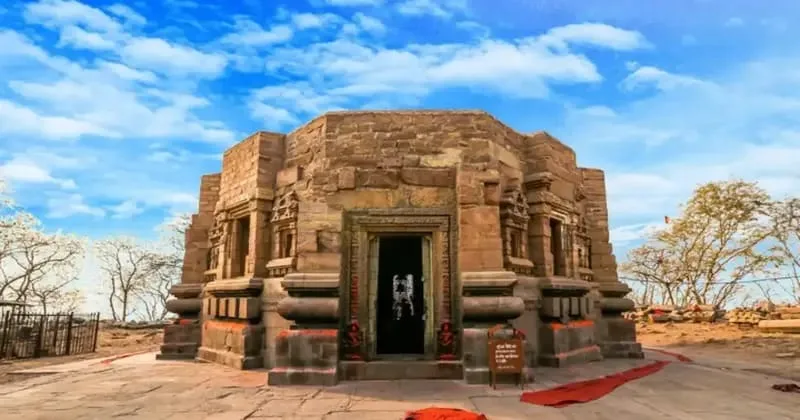
Mundeshwari Mandir is particularly notable for its octagonal plan, an unusual feature among ancient Indian temples. The stone-built structure has a compact design, with the sanctum forming the central focus of the Mandir. Its architectural character differs considerably from the towering temple structures commonly associated with later periods of Indian temple architecture.
The relatively modest size of the monument should not be mistaken for a lack of historical importance. Its value lies largely in its antiquity and the architectural evidence it provides about early Mandir-building traditions in India. Over the centuries, parts of the structure have been damaged and altered, but the basic form of the ancient shrine has survived.
The four-faced Shiva lingam
The Shiva lingam at Mundeshwari is another feature that makes the Mandir particularly significant. Unlike a conventional Shiva lingam, the shrine’s four-faced lingam represents Shiva in a distinctive form. Devotees worship the lingam as a manifestation of Bhagwan Shiva and consider it one of the temple’s most sacred objects. The presence of this ancient form of Shiva worship, alongside the worship of Mundeshwari Devi, gives the temple a distinctive religious character.
Perhaps the most remarkable aspect of Mundeshwari Mandir is that it is not merely an archaeological monument. Worship continues at the Mandir, making it a living centre of Hindu faith. Devotees visit the shrine throughout the year, particularly during religious festivals associated with Maa Shakti and Bhagwan Shiva. This continuity distinguishes Mundeshwari from many ancient structures that survive primarily as archaeological remains.
For generations, devotees have regarded the Mandir as a sacred place of prayer and pilgrimage. The continued rituals and religious practices connect the modern Mandir with a tradition that stretches back many centuries.
The Mandir attracts particularly large numbers of devotees during Navratri, one of the most important festivals dedicated to Maa Durga and Shakti. During the festival, devotees offer prayers to Mundeshwari Devi and seek her blessings. The hill and temple complex take on a festive atmosphere as pilgrims arrive from different parts of Bihar and neighbouring regions. The association with Shakti makes Mundeshwari especially important during religious occasions dedicated to the Goddess.
Like many ancient Indian Mandirs, Mundeshwari is surrounded by religious legends that have been preserved through local traditions. One prominent tradition connects the Mandir with the battle between Maa Chandi and the demon Munda. According to the legend, the goddess defeated the demon, and the site became associated with her victory. Such legends form an important part of the temple’s cultural identity. Although they belong to the realm of religious tradition rather than archaeological evidence, they help explain why the shrine continues to hold deep significance for devotees.
India’s Mandir heritage developed over many centuries, with different regions producing distinct architectural styles. The grand Dravidian Mandirs of Tamil Nadu, Nagara temples of northern India and rock-cut Mandirs of western India represent different stages of this long architectural history. Mundeshwari belongs to a much earlier phase of this development. Its relatively simple form offers an opportunity to understand how Hindu temple architecture evolved before the emergence of some of the monumental temple complexes seen in later centuries. Its survival is therefore important not only to devotees but also to historians and students of Indian architecture.
Mundeshwari Mandir represents something particularly remarkable in India’s cultural landscape: an ancient sacred site that has continued to remain relevant to generations of worshippers.