Rakhigarhi: The archaeological site of Rakhigarhi in Haryana, widely regarded as the largest known settlement of the Indus-Saraswati Civilisation, has entered a new phase of historical and scientific exploration. Human skeletal remains excavated during recent archaeological investigations have been formally transferred by the Archaeological Survey of India (ASI) to the Anthropological Survey of India (AnSI) for advanced multidisciplinary research that could reshape our understanding of one of the world’s earliest urban civilisations.
The transfer follows a recently signed Memorandum of Understanding (MoU) between the ASI and AnSI, marking a significant collaboration between two premier institutions under the Ministry of Culture. Researchers believe the skeletal remains could provide unprecedented insights into the ancestry, lifestyle, health, migration patterns, and genetic history of the Harappan people.
Major Discovery at Rakhigarhi Cemetery
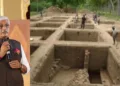
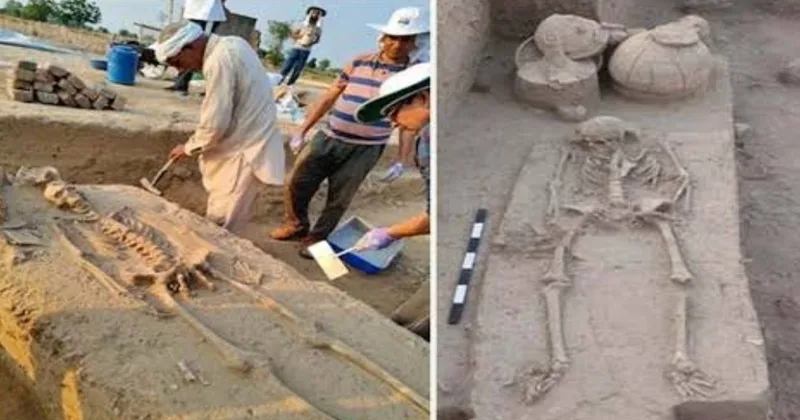
During excavations carried out by ASI’s Excavation Branch-II, Greater Noida, during the 2025-26 field season, archaeologists uncovered eight burials at Mound No. 7, a location previously identified as an ancient cemetery. Among the findings were three complete human skeletons and several skeletal fragments from other burial sites.
These remains have now been transferred to AnSI’s ancient human skeletal repository and laboratory in Kolkata, where scientists will conduct detailed examinations using cutting-edge analytical techniques. Additional skeletal material recovered from the site is expected to be transferred in the coming days.
The discovery is particularly significant because human remains from the Indus-Saraswati Civilisation are relatively rare, making each skeleton an invaluable source of information about life more than 4,000 years ago.
Rakhigarhi: The Largest Indus-Saraswati Settlement
Spread across nearly 550 hectares in Haryana’s Hisar district, Rakhigarhi is considered the largest known urban centre of the Indus-Saraswati Civilisation, surpassing even Mohenjo-daro and Harappa in size.
Excavations over the years have revealed extensive evidence of advanced urban planning, including well-designed drainage systems, residential complexes, craft production centres, trade networks, storage facilities, and burial grounds. Archaeological findings indicate continuous habitation from the Early Harappan period through the Mature Harappan phase, demonstrating the site’s long-term importance in ancient South Asia. The settlement offers a rare opportunity to study the evolution of urban life in one of humanity’s earliest civilisations.
Scientists plan to employ a range of modern research methods to analyse the skeletal remains. These include:
* Ancient DNA (aDNA) analysis
* Stable isotope studies
* Osteological assessments
* Palaeopathological investigations
* Environmental reconstruction studies
* Bioarchaeological examinations
Through these techniques, researchers hope to determine genetic ancestry, dietary habits, disease prevalence, mobility patterns, environmental adaptations, and relationships between ancient populations.
Ancient DNA research is expected to play a particularly important role. By extracting genetic material from the remains, scientists may be able to trace population movements, genetic diversity, and evolutionary adaptations dating back to around 3000 BCE.
National and International Collaboration
The project will involve collaboration between several leading institutions, including:
* Anthropological Survey of India (AnSI)
* Archaeological Survey of India (ASI)
* Birbal Sahni Institute of Palaeosciences (BSIP), Lucknow
* University College London (UCL), United Kingdom
* Banaras Hindu University (BHU)
* Other specialist research groups in genetics and archaeology
This multidisciplinary approach combines expertise from anthropology, archaeology, genetics, palaeosciences, and environmental studies to create a comprehensive picture of Harappan society.
Experts Welcome the Initiative
Several prominent scholars have praised the transfer of the remains and the renewed focus on palaeoanthropological research. Professor Vijay Prakash, a former faculty member of Andhra University, described the initiative as an important step in ensuring that biological heritage recovered through archaeological excavations is scientifically preserved and studied for future generations.
Professor Udai Pratap Singh of Lucknow University noted that AnSI’s expertise in human biology and osteology would help reconstruct important aspects of population history, health, lifestyle, and cultural adaptation during the Indus-Saraswati period.
Padma Shri awardee Dr Kumaraswamy Thangaraj, a renowned geneticist from the Centre for Cellular and Molecular Biology (CCMB), Hyderabad, highlighted the transformative potential of ancient DNA analysis. According to him, genomic studies could reveal how human populations evolved and adapted over thousands of years.
Professor Gyaneshwer Chaubey of BHU emphasised that integrating genetic evidence with osteological and isotopic data would provide valuable insights into ancestry, mobility, health, and daily life in the Harappan world.
Revival of Palaeoanthropological Research in India
Officials noted that the Anthropological Survey of India has a long tradition of studying skeletal remains recovered from archaeological sites associated with the Indus-Saraswati Civilisation. However, research activities in this field had slowed over the years due to various institutional and technical challenges.
In recent years, AnSI has undertaken efforts to revive this important area of study by establishing dedicated research teams, enhancing laboratory capabilities, and conducting specialised training programmes.
The institution has already completed palaeopathological studies on skeletal remains from several archaeological sites and is preparing scientific publications based on its findings. The transfer of the Rakhigarhi remains is expected to further strengthen India’s capabilities in ancient DNA research and bioarchaeology.
Anthropologist Professor Subhash Walimbe of Deccan College highlighted the importance of examining how urbanisation influenced human health and biological adaptation. The remains may help answer questions about disease patterns, nutrition, occupational stress, and social organisation within one of the world’s earliest cities.
Former National Monument Authority Chairman Professor Kishore K. Basa also welcomed the initiative, noting that such studies have relevance beyond archaeology. Findings from the project could contribute to disciplines including history, population studies, nutrition, epidemiology, genetics, and environmental science.
A Window into One of Humanity’s Earliest Civilisations
The transfer of the Rakhigarhi skeletal remains represents far more than a routine scientific exercise. It marks a major step toward integrating archaeology, anthropology, genetics, and environmental sciences to reconstruct India’s ancient past with unprecedented accuracy.
As scientists begin analysing the remains, researchers hope to uncover answers to longstanding questions about the origins, movement, health, and biological history of the people who built one of the world’s earliest urban civilisations. The findings could significantly enrich our understanding of the Indus-Saraswati Civilisation and provide fresh evidence in debates surrounding the ancestry and development of South Asia’s ancient populations. More than four millennia after they were laid to rest, the people of Rakhigarhi may finally tell their story through the language of modern science.