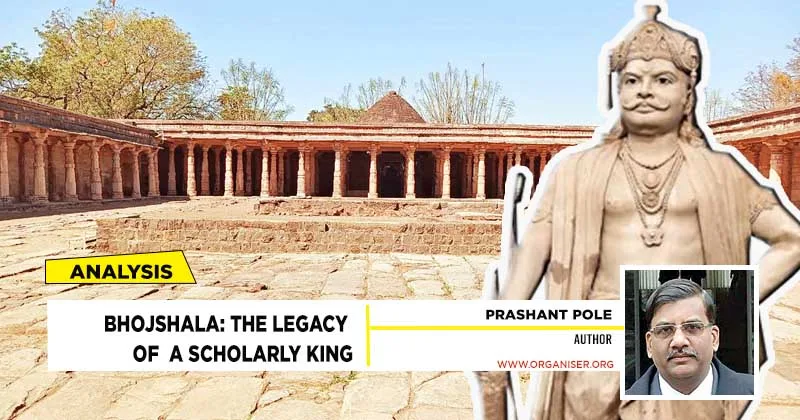
The eleventh century marked a turning point in the history of Bharat. Islamic invasions had already begun. The whole of Gandhara (Afghanistan), Multan and parts of Punjab had come under Islamic rule. Yet more than 80 per cent of Bharat, unafraid, continued to follow Hindu customs and Sanatan traditions. Mahmud of Ghazni had attacked Mathura, Kannauj and Somnath. He plundered Somnath. However, he was unable to rule Gujarat, where the Solanki dynasty continued to reign.
It was during this period that Raja Bhoj of Malwa was shaping an ideal system of governance. He was crowned in 1010 CE and ruled for the next forty-five years. This entire period proved to be a golden age for Malwa. Raja Bhoj himself was a philomath, a patron of the arts and a master of engineering. He became widely respected as a sage-like king. He brought together numerous scholars, commissioned several works and also authored many himself. During these forty-five years, nearly eighty-four treatises were composed, many of which continue to inspire wonder even after a thousand years. Most of these works are encyclopaedic in nature, and the knowledge they contain remains timeless.
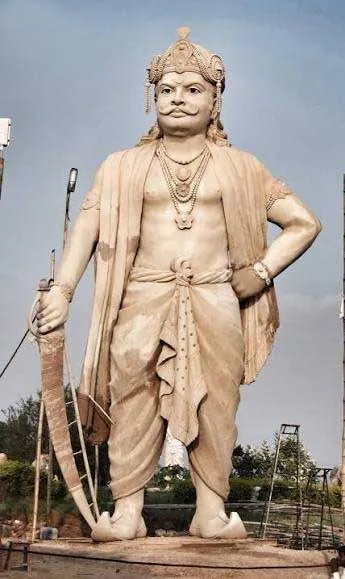
Dharanagari (Dhar) was the capital of Raja Bhoj. However, the earlier capital of the Paramara dynasty, Avantika (Ujjayini/Ujjain), had for thousands of years been a renowned centre of learning. Subjects such as Mathematics and Astronomy were studied there continuously. A tradition of great scholars had flourished, including Varahamihira in the fourth century, Brahmagupta in the sixth century and Lalla in the eighth century. It was undoubtedly an important centre of research and education, though not a large university. During Raja Bhoj’s reign, the astronomer Shripati was carrying out remarkable work in Ujjain.
While preserving the scholarly traditions of Ujjain, Raja Bhoj wished to establish a centre of learning devoted to literature, Sanskrit, engineering and other disciplines that were especially dear to him. Therefore, this knowledge centre, effectively a small university, was established in the capital city of Dharanagari (Dhar). Completed in 1034 CE, it came to be known as Bhojshala.
A Centre Of Knowledge
Bhojshala was a centre of knowledge, a seat of learning and an abode of wisdom. Naturally, Raja Bhoj installed a beautiful idol of Goddess Saraswati, the deity of learning, within the institution. This is the same idol of Vagdevi that today remains in a museum in London.
Modelled on the Gurukul tradition, Bhojshala was devoted to the intensive study and teaching of Sanskrit and grammar. The inscriptions carved on its walls and floors contain grammatical rules and charts of Sanskrit. Advanced subjects such as astronomy, weapons science, aviation and architecture were taught and researched there. Students from different parts of Bharat and abroad came to study these disciplines.
It was also during this period that Raja Bhoj was composing treatises on various subjects. Among these were Samarangana Sutradhara, Yukti Kalpataru, Saraswati Kanthabharanam, Shringara Prakasha, Rajamartanda, Tattvaprakasha, Vyavahara Samuchchaya, Namamalika, Charucharya, Rajyamriganka and Ayurveda Sarvasva.
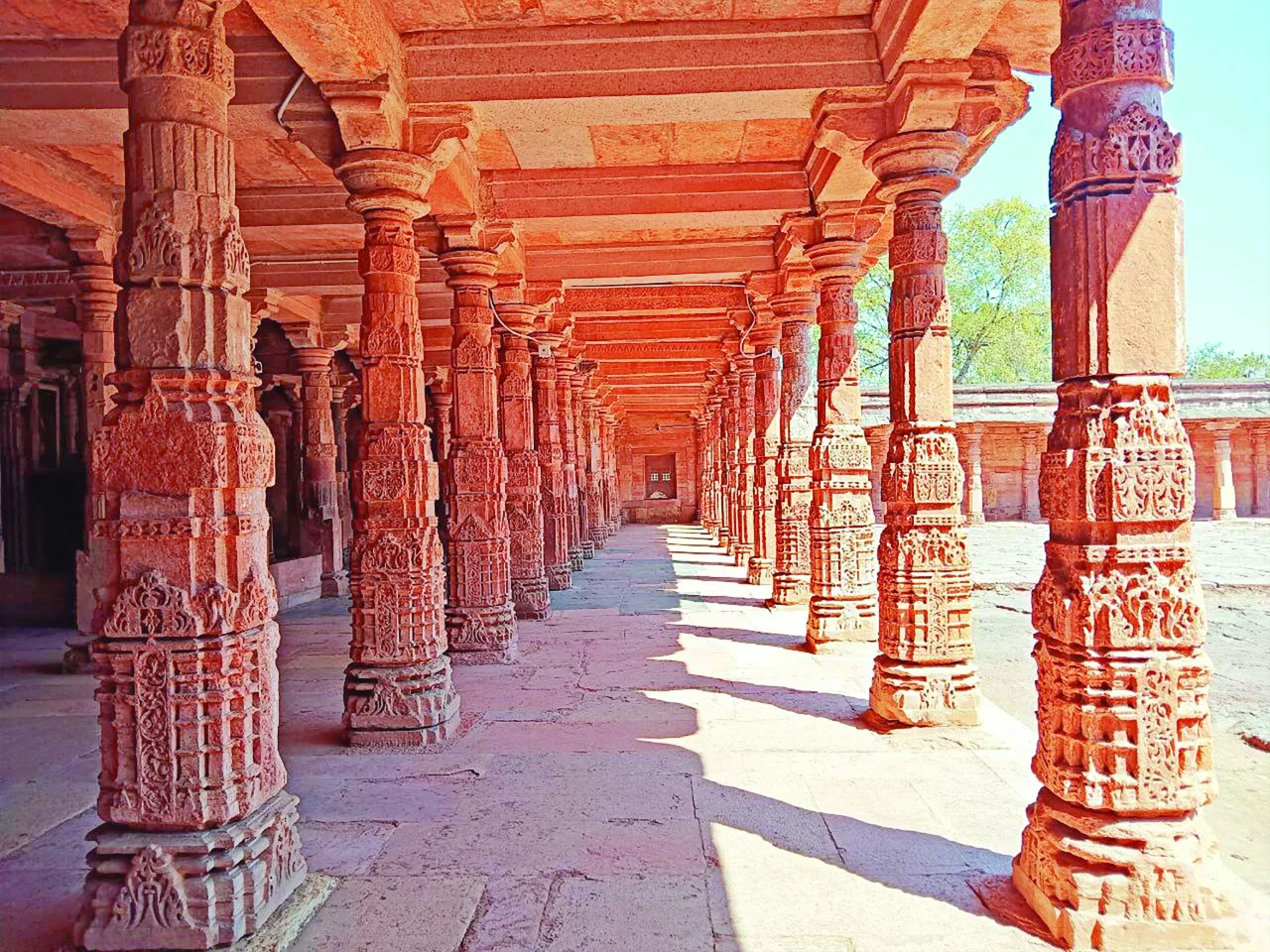
At that critical stage in history, when Bharat was becoming complacent because of its immense prosperity and wealth, Raja Bhoj sought to redirect society towards the path of knowledge and the continuity of knowledge traditions. Bhojshala became the symbol of that effort. Nearly three to four centuries before the Renaissance took place in Europe, Raja Bhoj had initiated a renaissance in Bharat through Bhojshala. Unfortunately, Islamic invasions intensified in the following centuries, Bharatiya rulers suffered defeats, and this Bharatiya renaissance came to an end.
Raja Bhoj also established Bhojshala as a cultural centre. During his reign and under the subsequent Paramara rulers, it became a prominent forum for scholars and poets. Literary gatherings were held there regularly. Dramas were also staged at Bhojshala. The Archaeological Survey of India has discovered inscriptions mentioning a two-act play composed by a court poet during the reign of Raja Bhoj’s successor.
Reach Of Bharatiya Knowledge
The treatises written by Raja Bhoj were taught at Bhojshala. In Samarangana Sutradhara, Raja Bhoj wrote extensively about town planning and architecture. Approximately 116 years after the construction of Bhojshala, in 1150 CE, an enormous place of worship was built in Kambuja (Cambodia), nearly 3,180 kilometres from Dharanagari (Dhar). This is the famous Angkor Wat, the world’s largest place of worship and a complex of Hindu temples. Interestingly, the principles, concepts and references employed in the construction of Angkor Wat are all found in Samarangana Sutradhara. The text contains a detailed description of the Vastu Purusha Mandala in Chapters 11 to 14. The title of Chapter 14 is Purushangadevata Nighantvadi Nirnayah. The entire layout of Angkor Wat is based on the grid system of the Vastu Purusha Mandala. The central structure and directional alignments were determined with the flow of cosmic energy in mind.
Samarangana Sutradhara also describes different types of mandalas. For temples and royal palaces, the sixty-four-square Manduka Mandala is considered especially significant. The master plan of Angkor Wat, including its sanctum sanctorum, clearly reflects the influence of the Manduka Mandala. The central tower stands at the Brahmasthana, the centre of the sixty-four-square grid, symbolising Mount Meru. The vast temple complex built by Suryavarman II reflects Sanskrit, the Bharatiya calendar, the Ramayan, the Mahabharat, temple architecture and the concept of Rajadharma.
Bharat was becoming complacent because of its immense prosperity and wealth, Raja Bhoj sought to redirect society towards the path of knowledge and the continuity of knowledge traditions
It is difficult to believe that Angkor Wat could have been constructed solely on the basis of Samarangana Sutradhara within little more than a century. The text itself did not introduce entirely new concepts. Rather, it drew upon earlier architectural treatises such as Mayamatam and Manasara Shilpashastra. Angkor Wat too was built on the foundations of these ancient architectural traditions. This demonstrates that despite the vast geographical distance, Bharat’s knowledge tradition flowed across both regions.
Custodian Of A Knowledge Tradition
It was this tradition that was preserved by Bharatiya centres of higher learning and universities. Takshashila, Nalanda, Uddayantapura (Odantapuri), Vikramashila, Sulotgi, Kanchi and many others sustained this intellectual continuity. Bhojshala was also one of its important custodians. It was a vibrant centre of science, art and spirituality where thousands of students came to satisfy their intellectual curiosity.
In the eleventh century, the Arab traveller and historian Al-Biruni accompanied Mahmud of Ghazni to Bharat. In his historical work Tarikh-ul-Hind, Al-Biruni wrote about Raja Bhoj, his capital Dharanagari and its centre of learning: “Dharanagari is the city of scholars. The observatory established in its centre of learning functions with remarkable precision and accuracy.” (At the time of Al-Biruni’s visit to Dharanagari, the construction of Bhojshala was still underway.) Contemporary foreign historians such as Firishta and Nizamuddin Ahmad also praised Dhar and Bhojshala. Unfortunately, because of successive Islamic invasions, Bharat’s great centres of learning and universities gradually disappeared. In 1193 CE, Bakhtiyar Khilji destroyed Nalanda, then the largest university in the world. Its vast library burned for months. At Vikramashila University, ten thousand students were massacred. A similar fate befell almost all the universities.
The tradition of higher education and advanced knowledge in Bharat was nearly broken. Following the destruction of Nalanda in 1193, almost all the major universities ceased to function within the next few years. Vallabhi in Gujarat had already been devastated by Islamic invaders in the eighth century. Along with the other great centres of learning, it too breathed its last. Yet amidst this darkness of ignorance, one lamp continued to flicker—that of Bhojshala. Owing to the courage of the Paramara rulers, Malwa remained free from Islamic invaders until the beginning of the fourteenth century. Finally, in 1305 CE, after 271 years, Alauddin Khilji invaded and destroyed Bhojshala. With this, the last flame of Bharat’s ancient knowledge tradition was extinguished. The continuous flow of Bharat’s glorious intellectual heritage came to a halt.
The message is clear. The knowledge tradition of Bharat must resume from where it was interrupted and continue with the same splendour. The knowledge that once made Bharat the most prosperous and affluent nation in the world must once again be carried forward. Bhojshala needs to be restored to its original grandeur. If that happens, the flow of this knowledge tradition will once again continue uninterrupted.