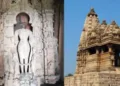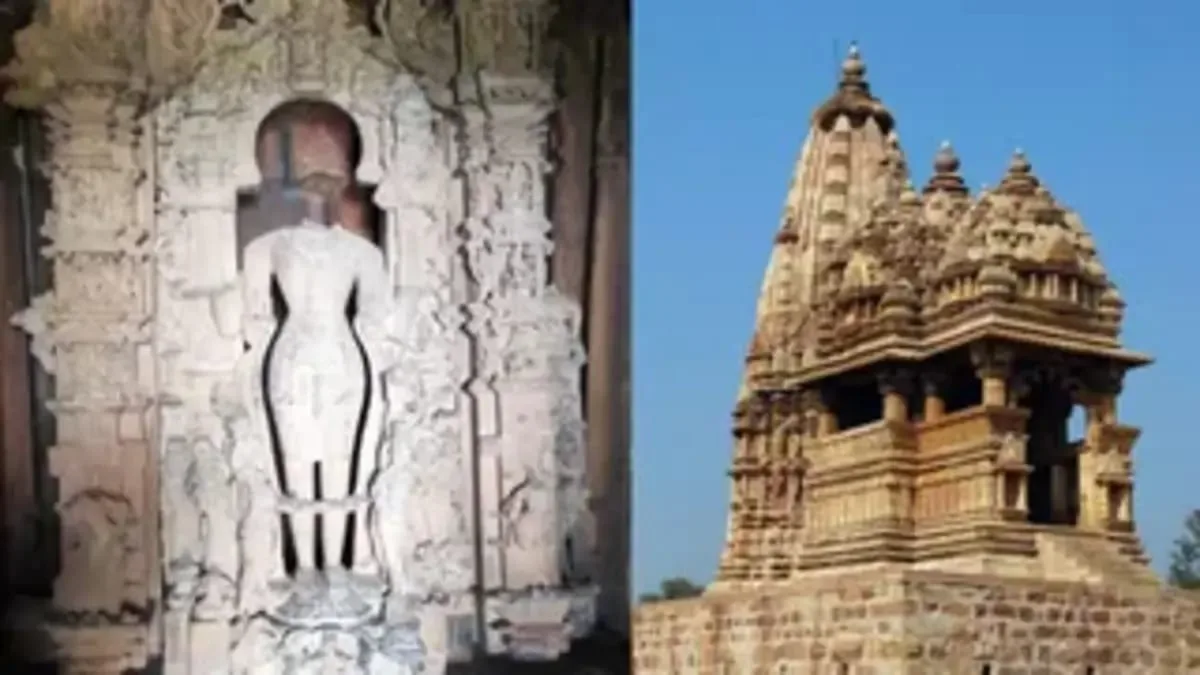
KHAJURAHO: The Archaeological Survey of India (ASI) has found the missing head of an 11th-century Vishnu murti at the Javari Mandir in Madhya Pradesh’s Khajuraho, bringing the long-pending restoration of the historic sculpture closer to completion. The head had been kept in an ASI store, and experts are examining it before it is reattached to the seven-foot statue, ASI Director General Yadubir Singh Rawat has said.
In an exclusive interview, Rawat said he learnt about the discovery during a visit to Bhopal for the BRICS summit. According to him, the person in charge of the store informed him that someone might have attempted to break off the idol’s head to steal it but had failed. “We are having experts examine it and will soon reattach it to the statue,” Rawat said.
The development comes after the damaged Vishnu murti became the centre of a controversy that reached the Supreme Court last year. Advocate Rakesh Dalal had approached the court seeking restoration, replacement or reconstruction of the seven-foot statue.
The petition was dismissed by the then Chief Justice of India, BR Gavai, whose remark asking the petitioner to approach the deity itself drew widespread criticism. Gavai later clarified his statement in court, saying that he respected all religions and that his words had been taken out of context. Subsequently, a lawyer attempted to throw a shoe at him inside the courtroom.
The recovery of the missing head now offers a possible resolution to the restoration issue, subject to expert examination and the successful reattachment of the original piece.
ASI introduces three-year deadline for excavations
Alongside the development at Khajuraho, the ASI has introduced administrative reforms aimed at reducing delays in archaeological research and conservation work.
Rawat said the organisation has established a three-year timeframe for completing archaeological excavation projects. Permissions will continue automatically across financial years, helping prevent administrative delays from interrupting ongoing research. He acknowledged that some researchers displayed considerable enthusiasm during fieldwork but took longer to complete their final reports, delaying the publication of archaeological findings. The new deadline is intended to improve accountability and ensure that excavations progress from fieldwork to the documentation and publication of results within a defined period.
The ASI has also delegated greater financial powers to its circle officers, allowing them to approve expenditure ranging from Rs 50 lakh to Rs 1 crore. This measure is expected to reduce dependence on headquarters for routine approvals and enable quicker decision-making at the regional level.
According to Rawat, most annual conservation programmes now receive clearance within 15 to 20 days. Projects requiring consultation with specialists may take longer.
Preliminary excavation planned at Ujjain’s Vaishya Tekri
The ASI is also preparing for a preliminary excavation at Vaishya Tekri in Ujjain, Madhya Pradesh, where a recent survey identified a cluster of Buddhist stupas and a water reservoir. Rawat said the structures differ from those at Sanchi because they were built using unbaked bricks. The last excavation at the site was conducted in 1973.
The site has attracted interest because the Buddhist stupa complex could potentially be larger than the famous Sanchi stupa complex. However, its actual dimensions, archaeological significance and overall extent can be established only through further investigation.
The ASI plans to begin with a limited vertical excavation to assess the site before considering a larger project estimated to cost Rs 60 crore.
“The true picture will only emerge after excavation. We will proceed only after confirming its significance, although the site already falls within a protected area,” Rawat said. He explained that acquiring and excavating the entire area would require substantial financial and administrative resources. A preliminary investigation would therefore help determine whether a full-scale excavation is justified.
The proposed approach is intended to establish the site’s archaeological importance before committing significant resources to a larger project. Rawat also raised concerns about the continued reliance on a list of protected monuments prepared during British rule under the Ancient Monuments Preservation Act of 1904.
He argued that the list was adopted by the government after Independence without a comprehensive review to determine which sites deserved protection based on their significance to the country’s heritage.
According to Rawat, the colonial-era list included cemeteries and graves associated with British soldiers, horses, mules and pets, reflecting the priorities of the administration at the time.
“The root of this problem lies in the list prepared by British rulers in 1904 under the ‘Ancient Monuments Preservation Act’—a list that the then-central government adopted post-independence without any review,” he said.
Rawat maintained that a detailed assessment should have been conducted before the list was adopted to establish which monuments were genuinely important from the perspective of national interest. He noted that a review in 1953 incorporated state monuments into a definitive list, but the central list remained unchanged. The resulting difficulties eventually led to 17 monuments being removed from the central list. His remarks highlight the need to reassess the framework governing centrally protected monuments, particularly where historical classifications and present-day conservation priorities may differ.
Focus on faster conservation and archaeological research
The recovery of the Vishnu idol’s head at Khajuraho, the proposed excavation at Vaishya Tekri and the administrative reforms indicate the range of issues facing the ASI, from restoring individual sculptures to investigating major archaeological sites and managing protected monuments.
The three-year excavation deadline, expanded financial powers for circle officers and faster approvals for conservation programmes are intended to make the organisation’s work more efficient.
At Khajuraho, the immediate priority is to complete the expert examination and restore the original head to the Vishnu murti. At Vaishya Tekri, the focus will be on establishing the scale and significance of the Buddhist remains before a larger excavation is undertaken. These initiatives could help strengthen archaeological documentation, improve conservation timelines and support a more systematic assessment of India’s historical heritage.