



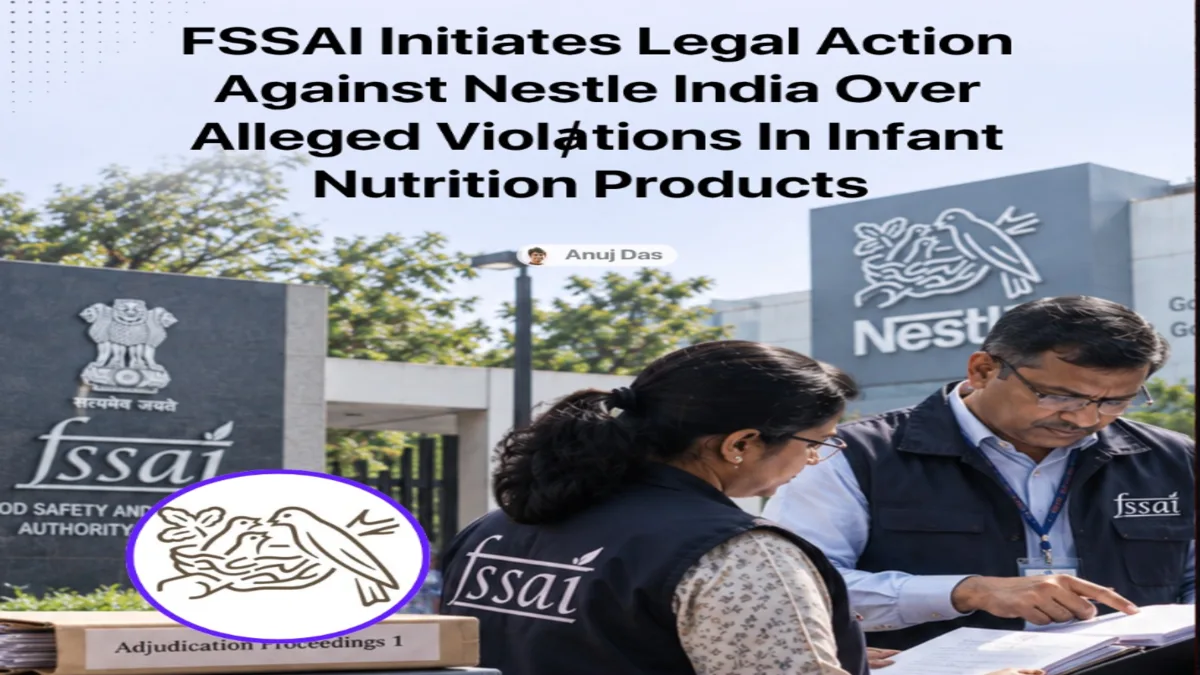
On September 18, the Food Safety and Standards Authority of India (FSSAI) filed three separate adjudication cases against the company over two infant formulas and a follow-up formula, citing prohibited promotional claims and a sample found sub-standard in biotin.
On October 17, it followed up with show-cause notices over a kidney-care nutrition powder marketed without the required prior approval and over inconsistent labelling of Nescafé ready-to-drink coffees.
The actions strike at a sensitive segment for the Swiss multinational. Milk and nutrition products, including infant formula and baby food, were Nestlé India’s largest revenue category in the year ending March 2026, accounting for a third of its product sales worth $2.4 billion.
The company has denied wrongdoing, maintaining that its products comply with all applicable regulations.
Three Cases Over Infant Nutrition
FSSAI said it examined NAN Excella Pro Stage 1, Lactogen Pro 1 and a follow-up formula, along with the promotional material for these products on e-commerce platforms, and sought clarifications from the company before acting.
On NAN Excella Pro Stage 1, the regulator objected to promotional claims of 5 HMOs and Whey Protein. HMOs, or human milk oligosaccharides, are complex sugars found naturally in breast milk and added to some formula products. On Lactogen Pro 1, it flagged a claim that the product’s whey protein is easy to digest.
According to FSSAI, both products contravened Regulation 4(2) of the Food Safety and Standards (Foods for Infant Nutrition) Regulations, 2020 which restricts promotional claims or material aimed at increasing the saleability of infant foods.
The regulator also invoked Section 3 of the Infant Milk Substitutes, Feeding Bottles and Infant Foods (Regulation of Production, Supply and Distribution) Act, 1992, which bars the advertisement or promotion of such products.
The third case is of a different nature. Laboratory analysis found a sample of Nestlé’s follow-up formula sub-standard with respect to biotin, a B-group vitamin. FSSAI, which announced the action on Instagram, did not say whether it would order a recall.
Nestlé Defence and the Market’s Reaction
Within hours, the company added that NAN Excella Pro, Lactogen Pro and their labels had been approved by FSSAI own expert committee. It said it had again submitted a detailed response on the label statements, which it described as factual and backed by scientific literature and that it would keep working closely with the regulator.
Investors were less sanguine. Nestlé India shares reversed early gains to fall as much as 2.8 per cent even as the Nifty 50 advanced, before closing 1.4 per cent lower at Rs 1,353.10 on the BSE.
Kidney-Care Powder and Nescafé
The second action came on 17 October as part of a wider enforcement drive that also covered Hindustan Unilever Ltd (HUL) and saw the licences of two other food businesses suspended.
Nestlé India received a notice over Nestlé Resource Renal Vanilla Flavour Powder, intended for the dietary management of people with conservatively treated chronic kidney disease. FSSAI said the product had been marketed without the required prior approval and that its label did not carry the mandatory vegetarian or non-vegetarian symbol.
A separate notice, issued to Nestlé India along with two dairy manufacturers, concerns three Nescafé ready-to-drink beverages from Intense Cafe Cappuccino, Choco Mocha and Chilled Latte.
The regulator found the packaging described both as Flavoured Milk and as Proprietary Food – 1.12 Dairy Based Drink and held that such inconsistencies across labels, product descriptions and advertisements violated the FSS (Advertising and Claims) Regulations, 2018 and the FSS (Labelling and Display) Regulations, 2020.
HUL was served two notices over its Horlicks range. FSSAI termed the Healthy Birth Weight claim on Horlicks Mother’s Plus Kesar potentially misleading, and questioned bone-health claims on Horlicks Women’s Plus Chocolate, including Clinically Proven to Help Improve Bone Strength in 6 Months. It further said the drink’s No Added Sugar label was potentially misleading because the product contains maltodextrin.
The companies have been asked to respond within the stipulated period. A notice does not by itself establish a violation further action will depend on their replies.
The Laboratory Question in Court
How such matters fare in court can turn on procedure. In July 2023, a Delhi sessions court set aside a summoning order against Nestlé India in a separate food safety prosecution because the complaint did not show that the sample had been analysed in a duly notified laboratory.
The case, Nestlé India Ltd & Anr vs State (NCT of Delhi), arose from a complaint by Delhi Food Safety Officer Brijender Pal Saroha. Nestlé challenged a summoning order of 4 July 2017 passed by the Additional Chief Metropolitan Magistrate at Patiala House Courts, arguing that the Food Analyst had tested the sample in a laboratory not authorised under Sections 3(p) and 43(1) of the FSS Act.
Deciding the revision on 19 July 2023, Additional Sessions Judge Harjyot Singh Bhalla relied on the Bombay High Court’s 2015 Maggi judgment, which held that a food laboratory must pass a twin test accreditation by the National Accreditation Board for Testing and Calibration Laboratories (NABL) alongwith recognition and notification by the Food Authority.
He also cited the Supreme Court’s ruling in Pepsico India Holdings vs Food Inspector, which treated such testing provisions as mandatory rather than directory.
Since punishments under food safety law are severe, the judge observed, the prosecution must follow procedure meticulously. Yet he declined to rely on Nestlé’s own documents on the laboratory’s status, as they were uncertified photocopies never placed before the trial court.
The relief was therefore narrow the summoning order was set aside as passed in haste and remanded to the Magistrate, with the complainant free to produce the laboratory’s notification before any fresh summons.
The ruling underlines that enforcement must be procedurally watertight. Of the three September cases, only the biotin finding rests on laboratory analysis where the two formula cases turn on marketing claims.
A Familiar Pattern from Past Around the Globe
This is not Nestlé India’s first major collision with the regulator. In June 2015, FSSAI ordered Maggi noodles withdrawn, alleging excess lead and objecting to a no added MSG label, the company destroyed over 25,000 tonnes of stock.
The Bombay High Court lifted the ban that August, finding the testing laboratories fell short of statutory requirements, and Maggi returned to shelves in November 2015 after fresh tests.
The government Rs 640 crore consumer case, revived by the Supreme Court in 2019, was dismissed by the National Consumer Disputes Redressal Commission in April 2024.
India is not the only country where regulators have taken on Nestlé in recent years. In Europe, the company has faced its largest-ever recall, a criminal investigation and a fine, much of it in the same category now under FSSAI’s scrutiny.
In January 2026, Nestlé began public recalls of batches of its SMA, Beba, Guigoz and Alfamino infant formulas. Cereulide, a toxin produced by Bacillus cereus bacteria that causes vomiting, had been traced to arachidonic acid (ARA) oil sourced from China, an ingredient that also reached Danone and Lactalis.
Austria’s health ministry called it the largest recall in Nestlé’s history, spanning more than 800 products from over 10 factories, and Vietnam halted sales of Beba and Alfamino.
Governments from European Union has answered with tighter rules. From 26 February 2026, the European Union required Chinese ARA oil shipments to carry certificates showing they are free of cereulide, with half of all consignments physically checked at the border. France lowered its permitted toxin threshold, forcing Nestlé to widen its Guigoz recall.
Paris prosecutors opened a criminal investigation into Nestlé and other formula makers after the consumer group Foodwatch complained on behalf of eight families whose babies fell ill. Prosecutors in Bordeaux and Angers ruled out a link between the formula and two infant deaths, a third remains under investigation.
The company’s own handling has come under question. Reports allege Nestlé detected the bacteria on 26 November 2025 but notified Dutch authorities only on 9 December. In May 2026, French, Belgian and Swiss public broadcasters alleged that products were quietly withdrawn in Austria and Germany before the public recall. Nestlé called those reports “inaccurate and misleading” and booked a $210 million cost for the recall.
The 2024 Cerelac findings drew official attention beyond India. Nigeria’s regulator, NAFDAC, opened an investigation after one Nigerian Cerelac product was found to contain up to 6.8 grams of added sugar per serving. Brazilian versions sold as Mucilon held nearly 4 grams. Nestlé maintained that it complies with local regulations and international standards.
In France, Nestlé admitted using treatments banned for natural mineral water on brands including Perrier, Vittel, Contrex and Hépar, and paid a €2 million fine to avoid prosecution. A Senate inquiry in May 2025 went further, finding that the French state had deliberately concealed the practice since 2021. The country fraud agency estimated the fraud at over €3 billion.
Nestlé India said it had cut added sugars in its infant cereals by up to 30 per cent over five years and FSSAI took up the findings for examination.
The infant-feeding question has older roots still. A US consumer boycott of Nestlé in 1977 over formula marketing fed into international action that shaped India’s 1992 IMS Act, the very law now invoked against the company.
In a country where the protection of breastfeeding is written into statute, FSSAI message is that promotional language on infant formula is a legal matter not only a marketing one.
With the cases now in adjudication in Indian court and replies are due on the October notices, the outcome will test both the strength of the regulator’s evidence and the company’s claim that its labels carried the regulator own approval.