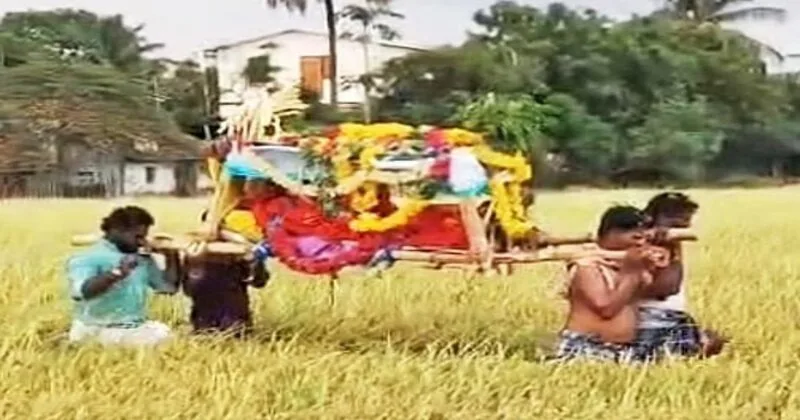
Pudukkottai: In a shocking and recurring incident, Scheduled Caste members of Theeyathur village in Avudaiyarkoil taluk of Pudukkottai were forced to carry a corpse through paddy fields to reach the burial ground due to the absence of a proper access pathway on June 12.
After the issue surfaced, highlighting the hardship and indignity faced by the community, activists, including members of the Neelam Cultural Centre, urged the district administration to immediately provide a dedicated road and resolve the long-pending issue. A video on social media captured everyone’s attention.
Dalit residents of Theeyathur village in Avudaiyarkoil taluk of Pudukkottai are being forced to carry corpses through paddy fields to reach the burial ground due to the absence of a proper access pathway on Friday. Highlighting the hardship and indignity faced by the community,… pic.twitter.com/cH2DOntERd
— Pearson abraham/பியர்சன் (@pearsonlenekar) June 20, 2026
One of the netizens, in a post on X, said: “A decades-long issue affecting residents of Ambedkar Nagar in Theeyathur village of Avudaiyarkoil taluk came to the fore once again on June 18. When a resident, A. Devi, died following an illness, the Dalits had to carry the body through a paddy field yet another time to reach the Adi Dravidar burial ground, owing to the lack of an access road.”
A decades-long issue affecting residents of Ambedkar Nagar in Theeyathur village of Avudaiyarkoil taluk came to the fore once again on June 18. When a resident, A Devi, died following an illness, the Dalits had to carry the body through a paddy field yet another time to reach the… https://t.co/spov25YT5s pic.twitter.com/TmchC2VbCL
— Pearson abraham/பியர்சன் (@pearsonlenekar) June 21, 2026
There have been instances where Scheduled Caste members were denied access to common burial or cremation grounds. In severe cases, families have been forced to lower dead bodies from bridges or traverse private land belonging to other castes to perform the last rites.
There have also been instances where grieving families were forced to carry bodies across canals or lower them from bridges. Such incidents have been reported across several districts in the state, including Vellore, Coimbatore, Krishnagiri, Kancheepuram and Thoothukudi.
Society is working in all areas to address caste-based discrimination and promote social harmony among different castes. However, social challenges still exist.
According to critics, an “untouchability wall” or “caste wall” refers to a physical brick-and-mortar structure constructed by non-Scheduled Castes to segregate Scheduled Caste communities from the rest of the village.
For example, people belonging to the Thottia Naicker community, an intermediate caste, who had built an “untouchability wall” allegedly to prevent access for people belonging to the Arunthathiyar community, a Scheduled Caste, at Muthuladampatti in Karur, Tamil Nadu, began removing the structure on August 9, 2025, amid tight security.
Former Tamil Nadu Governor RN Ravi (now Governor of West Bengal) said that Dalits face discrimination in the state. He cited issues such as restricted access to public spaces and contaminated water tanks. He argued that these occurrences contradicted the then DMK government’s frequent claims of championing social justice and a model of social governance. Ravi alleged that crimes against the Scheduled Castes increased by 50% over a two-year period, alongside a low conviction rate for these offences. These kinds of issues remind us of the deep-rooted divisions among people based on caste and the need for continuous efforts to eradicate this menace from society.