



Netram gyanasya Karanam: the eye is the instrument of all knowledge, says an old Sanskrit maxim, and nowhere is that truer today than in the network of cameras. Which now watches over Indian streets, factories and borders.
In a move that strengthens the country push for indigenous semiconductor capability, the Technology Development Board (TDB), under the Department of Science & Technology (DST), Government of India, has signed an agreement with M/s BigEndian Semiconductors, Bengaluru, for financial support of Rs 130 crore under the Research Development and Innovation (RDI) Fund.
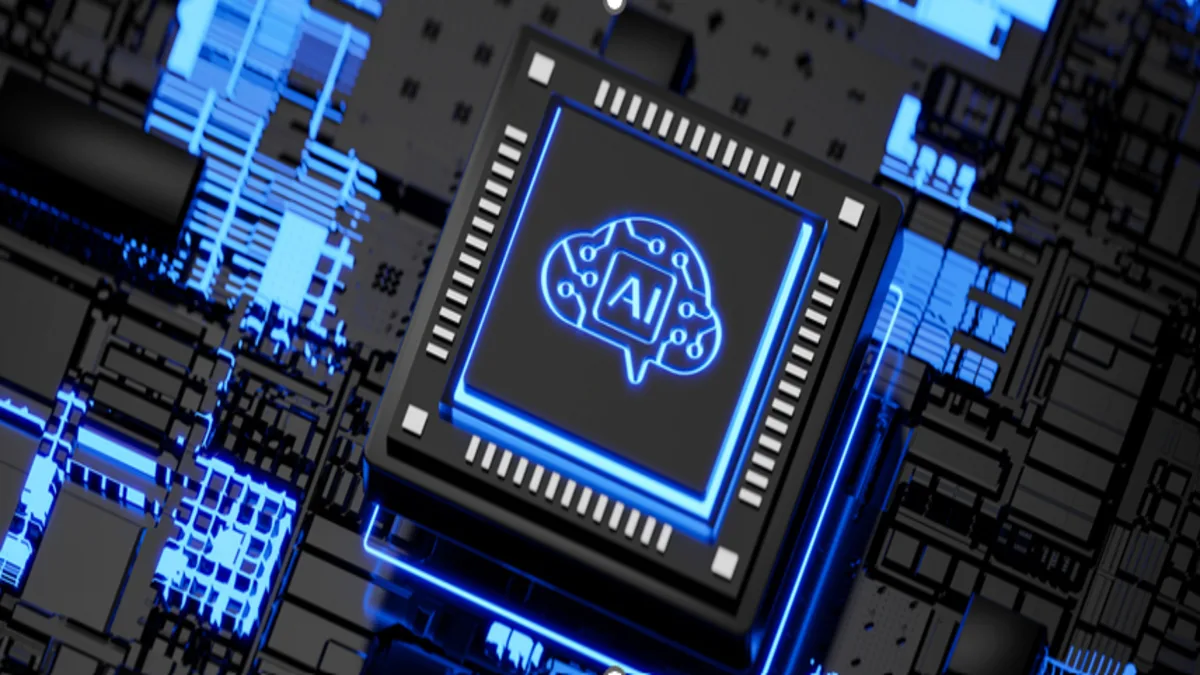
The agreement backs Project VeerAI, which carries a total project cost of Rs 260 crore and aims to take an indigenous, camera-focused AI Vision System-on-Chip (SoC) from Technology Readiness Level (TRL)-5 to full commercial maturity at TRL-9, with the support routed through Optional Convertible Debt (OCD).
A Chip timed to Indian CCTV reckoning
The timing of TDB support is significant. From April 1, 2026, India enforced sweeping certification rules under the Standardisation Testing and Quality Certification (STQC) framework that effectively barred uncertified, internet-connected CCTV cameras from Chinese manufacturers such as Hikvision, Dahua and TP-Link from the domestic market.
Chinese brands have accounted for close to a third of India camera sales and industry estimates suggest nearly four-fifths of all CCTV components sold in the country, including chipsets, originated from China.
The new rules require manufacturers to declare the country of origin of critical components such as the System-on-Chip itself and to clear vulnerability testing at accredited Indian labs, placing the semiconductor behind the brain of every camera at the centre of the country security calculus.
As of early 2026, only about 507 camera models stood certified for sale under the new regime, a bottleneck that homegrown brands such as CP Plus, already commanding roughly half the domestic market and newer entrants like Qubo, Prama and Matrix are now rushing to fill by pivoting toward India and Taiwan sourced chipsets.
It is this vacuum that Indian chipmakers are racing to fill. Beyond BigEndian, companies such as Chennai’s Mindgrove Technologies and L&T Semiconductor Technologies are also developing India-designed SoCs for AI-powered CCTV and IP camera systems, with industry estimates valuing India’s surveillance-chip opportunity alone at nearly $1 billion as camera penetration expands across sectors.
BigEndian leadership has pointed to this expanding addressable market as the commercial logic behind Project VeerAI, even as the project stated purpose remains explicitly strategic: reducing dependence on externally developed semiconductor and technology supply chains for applications where data security and surveillance integrity cannot be compromised.
Project Veer AI
Project VeerAI is built around a camera-focused AI Vision SoC on what BigEndian describes as a sovereign technology platform with one designed to combine on-chip AI processing with built-in security, privacy and connectivity features, rather than treating security as an add-on to an imported chip.
The company’s initial focus is CCTV and surveillance systems for India and the Global South, but its publicly stated roadmap extends the same silicon platform to defence, automotive, industrial and medical applications, positioning Project VeerAI less as a single product than as a reusable foundation for Indian wider electronics ecosystem.
The RDI Fund’s support will finance the technology development, validation, integration, testing and scale-up work needed to carry the chip from its current TRL-5 stage where a technology has been validated in a relevant environment through to TRL-9, commercial deployment at full operational scale.
The funding instrument chosen, Optional Convertible Debt, reflects the RDI Fund broader design: concessional, long-tenure capital that can convert to equity, sharing risk with the company rather than demanding collateral upfront precisely the kind of patient financing that deep-tech hardware ventures have long found missing in India.
“Semiconductors are foundational to almost every emerging technology, and building indigenous capabilities in application-specific AI chips is an important part of strengthening Indian technology ecosystem. The support to BigEndian Semiconductors reflects TDB focus on enabling Indian companies to develop strategic semiconductor capabilities and translate domestic design expertise into deployable products.” — Sh. Rajesh Kumar Pathak, Secretary, TDB
TDV RDI Fund: Bridging Indian Deep-tech valley of death
The RDI Fund is the financing vehicle that made the BigEndian agreement possible, and understanding it explains why TDB traditionally a modest technology-financing body is now able to sign agreements of this scale.
Approved by the Union Cabinet in 2025 with a corpus of ₹1 lakh crore over six years, the RDI Scheme was created precisely to address a financing gap that has stalled Indian deep-tech for decades with the years long, capital intensive gap between a laboratory proven technology and a commercially deployable product, a stage private investors have historically found too risky and banks too illiquid to fund.
The Fund operates through a Special Purpose Fund housed in the Anusandhan National Research Foundation (ANRF), with institutions such as TDB acting as Second-Level Fund Managers that identify and finance Eligible Technology Entities in strategic sectors, including artificial intelligence, semiconductors, quantum computing and energy security.
By May 2026, TDB alone had received 124 proposals worth nearly Rs 25,000 crore within three months of opening its RDI call, against an estimated funding demand of around Rs 10,000 crore, a measure of the pent-up appetite for patient, strategic capital in Indian hardware and deep-tech sectors.
The BigEndian agreement is among the Fund’s early, marquee disbursements, and its structure concessional financing with equity-linked risk-sharing through OCD is likely to become a template for how India backs sovereign technology platforms going forward.
From a Bengaluru start up to sovereign Silicon
BigEndian Semiconductors’ own trajectory mirrors the urgency of India’s semiconductor moment. Founded in March 2024 in Bengaluru by Sunil Kumar, Renuka Prasad, Dinesh Annayya, Kanagaraju Ponnusamy and Jansen Cheng, the fabless chip-design startup raised $3 million in seed funding in 2024 led by Vertex Ventures SEA & India, followed by a $6-million pre-Series.
A round in 2026 that drew in IAN Alpha Fund, IvyCap Ventures and a clutch of angel investors taking its total private funding past $9 million even before the TDB agreement. Within eighteen months of its first investment, the company had already taped out its first commercial chip, a pace its investors have cited as unusually fast for an Indian hardware startup.
“Raising capital in semiconductors is never about the money alone.” — Sunil Kumar, Co-Founder & CEO, BigEndian Semiconductors
On the RDI support specifically, BigEndian’s promoters struck a similar note of measured ambition The RDI support from TDB will enable us to accelerate the development and validation of Project VeerAI and take our AI Vision SoC towards commercial readiness.
Our focus is on building a secure, application-specific semiconductor platform that can address the requirements of surveillance and other critical sectors while leveraging India’s indigenous semiconductor design capabilities.
This partnership will help us progress the technology towards TRL-9 and contribute to the development of a stronger domestic semiconductor ecosystem.
Silicon Valley Awakening to AI Valley
Project VeerAI does not arrive in isolation. It is one more entry in an India Semiconductor Mission (ISM) pipeline that, by mid-2026, had approved a dozen projects worth a combined investment exceeding ₹1.6 lakh crore, spanning fabrication, assembly, testing and packaging across six states.
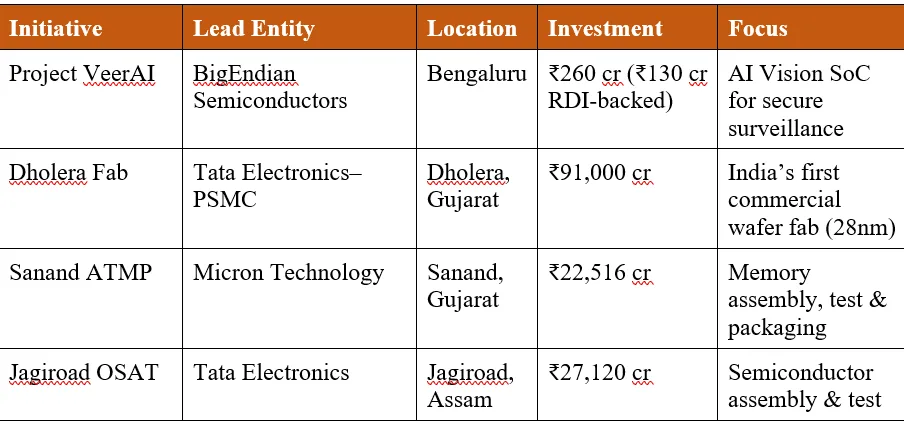
The anchor among them is Tata Electronics Rs 91,000-crore wafer fabrication facility at Dholera, Gujarat developed with Taiwan’s Powerchip Semiconductor Manufacturing Corporation and built for 50,000 wafers.
Alongside Micron Technology’s already-operational Rs 22,516-crore assembly and test plant at Sanand, which has begun shipping made-in-India memory modules. India’s overall semiconductor market, government projections suggest, is on course to reach $100–110 billion by 2030, up from roughly $45–50 billion in 2024-25.
Where BigEndian’s Project VeerAI distinguishes itself is scale and specificity. Rather than a general-purpose fab or memory plant, it is an application-specific design effort aimed squarely at a sector surveillance where India’s strategic exposure is acute and immediate.
The comparison below with the Mission larger fabrication illustrates the range of India’s semiconductor strategy, from heavy manufacturing infrastructure to focused, security-critical chip design.
Atmanirbharta, One chip at a time
For a country that imports the overwhelming majority of the silicon inside its phones, cars and cameras, a Rs 130-crore government commitment to a two-year-old Bengaluru startup might appear modest beside the lakh-crore fabs rising in Gujarat and Assam.
It also answers a different, sharper question with not simply where chips are made, but who designs the intelligence inside the cameras watching Indian citizens and critical infrastructure.
As New Delhi tightens rules on foreign surveillance hardware and pursues a $100-billion domestic semiconductor economy, projects like VeerAI represent the quieter, design-led half of Atmanirbhar Bharat. The future half where sovereignty is measured not in square feet of cleanroom, but in the architecture written into silicon itself.
If BigEndian roadmap holds, the eyes watching over Indian cities, factories and borders in the coming decade may finally be of indigenous design that secure by architecture and not merely by policy.