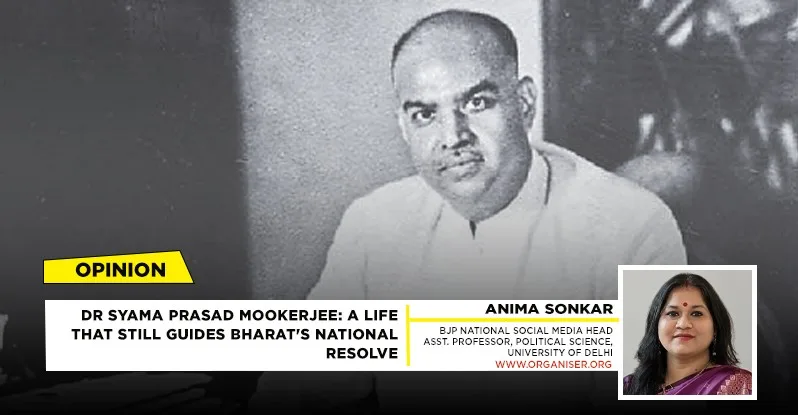
On 23 June every year, we remember Dr Syama Prasad Mookerjee on his Balidan Diwas. On this day, Bharat recalls his supreme sacrifice for national integration, constitutional unity and the dignity of every Indian. His death in detention in Srinagar in 1953 did not mark the end of a political life; it marked the beginning of a deeper national resolve. From 23 June to his birth anniversary on 6 July, the nation is not merely remembering two dates on a calendar, but it is reliving a full and purposeful life – of scholarship, of conviction, of organisation and of sacrifice. Even today, Dr Mookerjee’s life and ideals inspire Bharat’s march towards greater unity, self-confidence and resurgence of its timeless civilisation.
For the Bharatiya Janata Party (BJP), and for each of its karyakartas whose existence has been moulded by the long and difficult journey from Bharatiya Jana Sangh to the present era of national resurgence, Dr Mookerjee is a living and abiding source of inspiration because his life teaches Bharat that at its best, politics is a tool of conviction, sacrifice and dedicated service to our civilisation.
Dr Mookerjee belonged to that rare generation that brought together intellectual brilliance and public courage. Born on 06 July 1901 in Calcutta, he was the scion of a family that had dedicated itself to the pursuit of learning and public service, and he grew up with a deep reverence for education, discipline and national duty because his father, Sir Ashutosh Mookerjee, had already made a gigantic impact on Bengal’s intellectual life.
Dr Mookerjee continued that legacy with distinction, and he went on to become one of the youngest Vice-Chancellors of the University of Calcutta, thus showing that for him, scholarship and patriotism were not two separate roads.
His public life was a rare example of unflinching moral clarity. In Bengal, in national politics, and later as a member of independent India’s first Cabinet, he refused to be swayed by the notion that the possession of public office meant either silence in the face of injustice or compromises when the national interest was at stake. As Minister for Industry and Supply after Independence in Nehru’s Cabinet, he was tasked with the arduous responsibility of nation-building.
The test of his convictions, however, came in 1950 when Dr. Mookerjee resigned from Prime Minister Jawaharlal Nehru’s Cabinet over the Nehru-Liaquat Pact, which was formally couched as a treaty between India and Pakistan to protect the minorities in both countries. Dr Mookerjee believed that the pact failed to address the lived reality of Hindus and other persecuted minorities fleeing East Bengal. For him, this was not a question of diplomatic propriety, but one of civilisational duty and constitutional responsibility.
Train after train was bringing refugees scarred by Partition, uprooted from their homes and living in a state of perpetual fear, and he believed that the Government of India needed to speak and act with far greater clarity and firmness for their safety, dignity and rehabilitation. It was for this reason that his resignation was not an act of mere political protest, but an act of conscience, which clarified that for him power had value only to the extent that it protected the vulnerable and served the nation’s self-respect.
His resignation marked the beginning of a much larger political turning point. It was in this spirit that the Bharatiya Jana Sangh was founded in 1951. Dr. Mookerjee did not set up a new political party out of personal ambition or in reaction to any individual. He created a democratic platform for an idea of India that was culturally rooted, constitutionally unified and nationally self-assured. He was convinced that democracy required real alternatives, and that Bharat needed a political current anchored in national integration, cultural confidence, economic self-belief and disciplined organisation.
Over time, that small seed grew through the tireless efforts of countless karyakartas, the philosophical clarity of Deendayal Upadhyaya’s Integral Humanism, and the democratic struggles led by Atal Bihari Vajpayee and Lal Krishna Advani, eventually taking shape as today’s BJP – the principal force of national transformation. The journey from Jana Sangh to BJP is not the story of a political organisation, but it is the story of an idea that has withstood the test of time, overcome adversity, inspired sacrifice, widened its base, and eventually borne the weight of responsibility of governance.
Dr. Mookerjee’s stand on Jammu and Kashmir was, perhaps, the most appropriate expression of his national vision because he firmly believed that the special constitutional provisions that came in the way of Jammu and Kashmir becoming emotionally and constitutionally a part of India was a challenge to the unity of the country. His call of “Ek Vidhan, Ek Nishan, Ek Pradhan” was not an exclusionary call, but rather a plain assertion that in one sovereign republic, equal citizenship and constitutional unity must apply equally to all, not partially or selectively.
In 1953, when he entered Jammu and Kashmir to challenge the permit system, he did so with the courage of a patriot willing to bear the consequences of conviction. His arrest and death in detention in Srinagar on 23 June 1953 became one of the most painful chapters in post-Independence politics. For generations of Jana Sangh and BJP workers, his sacrifice was not remembered as grievance alone. It became a vow that the integration of Bharat would remain incomplete until constitutional separatism gave way to national equality.
That is why the decision of 05 August 2019 occupies such a central place in the political and emotional memory of the BJP. Under the leadership of Prime Minister Narendra Modi, and with the decisive stewardship of Union Home Minister Amit Shah in Parliament, Article 370 was rendered inoperative and Jammu and Kashmir was brought into a fuller constitutional relationship with the Union. For the millions who had been nurtured in the ideological tradition of Dr Mookerjee, it was not only a victory in Parliament, but it was the realisation of a long-standing national aspiration and deeply cherished conviction.
The importance of that decision is not just about the abrogation of one provision of the Constitution, but it is a manifestation of a leadership that brings together clarity of purpose and firmness and effectiveness of governance. Many of the ideals that Dr. Mookerjee lived and fought for are being realised in present times with renewed vigour under Prime Minister Narendra Modi, including invincible national unity, deep cultural self-confidence, welfare that reaches the poorest of the poor without any discrimination, strong security underpinned by political will, and development that lifts human dignity.
The Modi government has carried that same spirit forward in institutions and policy, especially in national integration, internal security and constitutional equality.
The BJP’s resounding victory in West Bengal in May 2026 has given this entire historical journey an even deeper emotional resonance. Bengal is the land where Dr. Syama Prasad Mookerjee was born, where his mind was shaped, where he devoted himself to scholarship, public service and politics. For decades, BJP karyakartas kept his ideals alive in that very soil with quiet determination – working with patience, embracing sacrifice and building organisation, often amid hostility and adversity. That is why the 2026 election mandate of Bengal elections was far more than just an electoral win. It symbolised the homecoming of Dr Mookerjee’s ideological legacy to the place where his public life first took shape. In that sense, Bengal’s verdict became a heartfelt tribute to his vision of a culturally rooted, nationally integrated and politically self-assured Bharat.
Dr Mookerjee’s canvas was far larger than the Jammu and Kashmir question. He imagined an India that would be modern without losing its soul, strong without being arrogant, democratic without being directionless. For him, civilisational self-confidence was not the opposite of constitutionalism, but it was the foundation which gave constitutional democracy meaning and durability. He envisioned Bharat not as a loose arrangement of competing identities, but as a nation bound by history, culture, destiny and the equal citizenship of all its people.
That vision continues to guide the BJP’s governance to this day and welfare schemes that reach the last person in the queue, infrastructure that bridges the distance to the remotest corner of the country, national security policies that answer every threat with unambiguous resolve, and cultural programmes that reclaim civilisational pride – all of them stem from the same ideological wellspring of Dr Mookerjee.
The most fitting tribute to Dr Syama Prasad Mookerjee on his birth anniversary would not be a ritual or ceremony but a solemn pledge to carry forward the movement that he started. This is exactly what the BJP, under the leadership of PM Narendra Modi and Amit Shah, is doing today – taking forward Dr Mookerjee’s vision of a united, confident and developed India, rooted in its civilisational ethos. His life teaches us that conviction has to be translated into organised action, ideas have to be transformed into enduring institutions, and that personal sacrifice has to finally become a collective national resolve.
Dr. Syama Prasad Mookerjee’s life was brutally cut short at the age of fifty-one in a detention cell in Srinagar, but his legacy and work have gone well beyond his time. He did not just find a party, but he gave shape to a new political movement. He showed that one life, committed to a principle, can illuminate the path of an entire nation. On 6 July, Bharat will remember Dr. Syama Prasad Mookerjee as a scholar, a patriot, an organiser, and a martyr for national integration. To remember Dr Mookerjee is not an exercise in nostalgia; it is a call to renew our pledge to build the India he fought for – one nation, with one Constitution, one people and one shared future – a nation where everyone has dignity, strength and a deep sense of civilisational self-confidence.