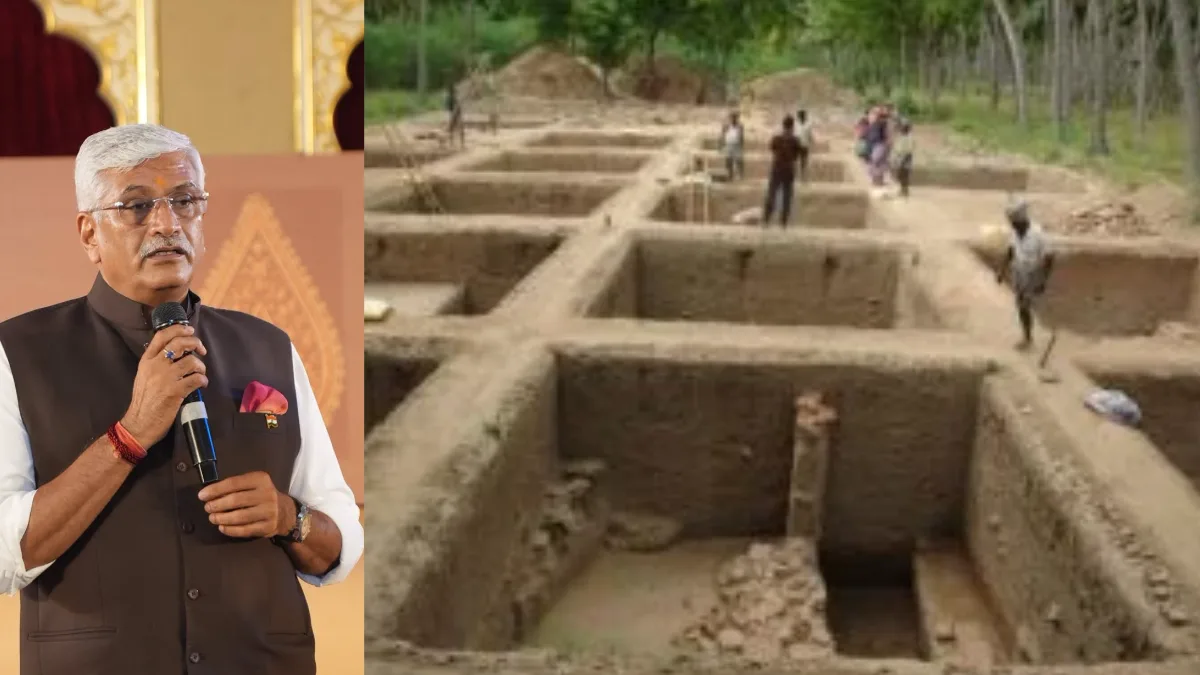
Union Minister for Culture and Tourism Gajendra Singh Shekhawat has said that the Archaeological Survey of India (ASI) report on the Keeladi excavations in Tamil Nadu cannot be published until the scientific procedures and validation required for such an excavation are completed. He said the Centre would be “more than happy” to promote the findings once the report is scientifically completed and validated.
Shekhawat made the remarks while participating in ‘The Indian Express Idea Exchange’, on September 20, where he was asked what the Central Government and his Ministry were doing to generate national and international interest in the Keeladi excavations, which have attracted considerable interest in South India. The interviewer also pointed out that the Tamil Nadu Government had established a museum and that the excavation site itself had become a tourist attraction.
Responding to the question, Shekhawat said the excavation had been conducted by the ASI with the permission of the Government of India and stressed the international reputation and credibility of the archaeological institution.
“An excavation happened. With the permission of the Government of India, the ASI conducted the excavation. The officer who was there — that officer — there is a scientific [process] to excavation. It is established worldwide, and the Archaeological Survey of India has its own reputation throughout the world regarding this. It has prestige, it has credibility,” Shekhawat said.
He said the report submitted by the concerned officer had shortcomings and alleged that the officer had become “politically influenced” while preparing the report.
“Whatever gentleman he was, that gentleman, somewhere, having been politically influenced, he presented a report which, compromising the basic principles and core principles and all the procedures that are there, he prepared a report and sent that report to the Government of India saying that you publish this report,” the Union Minister said.
“Should we finish our credibility and publish it only to support someone’s political ideology?”
Gajendra Singh Shekhawat, Minister of Culture and Tourism, speaks on the Centre’s efforts to promote Keeladi and create national and international interest in its archaeological… pic.twitter.com/1yxoHDeZIu
— The Indian Express (@IndianExpress) September 21, 2026
Explaining the procedure followed by the ASI, Shekhawat said that reports submitted after excavations are examined by a team and that shortcomings are communicated to the excavator for further work and scientific validation.
“The system is that whenever any report comes, a team examines it. Some shortcomings are found in it. Those shortcomings are communicated back to the excavator, saying that you complete this. You collect all this evidence. You scientifically validate all this periodical evidence. For that, make all the charts, make diagrams, take photographs. Create all this evidence-based [material]. They sent it back,” he said.
As per Minister, the concerned officer, who was subsequently removed, did not complete the observations communicated to him or undertake further work on the report.
“Now, after sending it back, because that gentleman, who was later removed from there — that gentleman, he had become politically influenced, or he had some person of his own interest; a government employee is ultimately also a human being — somewhere he slipped. He did not complete the observations that had been made and sent back. He did not do any further work on it,” Shekhawat said.
The Union Minister also accused the previous DMK government in Tamil Nadu of politicising the issue by claiming that the report was not being published.
“The State Government, the previous government (DMK government), politicised it, saying that our report is not being published,” he said.
Shekhawat questioned whether the Centre should publish an incomplete report without the required scientific validation merely to support a political position.
“Then He further said, without scientific validation and without completing the procedure, should we publish it by ending our credibility merely to support someone’s political ideology?”
He maintained that the report, in its present form, was incomplete and said it had not yet been scientifically established.
“It has not been scientific, or it has not been proven. The report is incomplete. The report has been made with mala fide intent,” Shekhawat said.
At the same time, Shekhawat said the Centre would welcome the findings if the report was completed in accordance with scientific procedures and the archaeological evidence was properly validated.
“Let that report be complete. Let all the scientific value of the excavation be there. We will be more than happy. Whatever the finding is, if the finding comes out, I, as the Union Minister for Culture, say that we will be extremely pleased. Our civilisational development will get a new dimension because of it,” he said.
He concluded by questioning whether established archaeological procedures should be compromised to fulfil what he described as a political ambition.
“But just to fulfil political ambition, the same ambition that Rahul Gandhi Ji has, has awakened there as well. For its fulfilment, should we crush the established system?”
In 2013-14, the Archaeological Survey of India (ASI) carried out explorations in 293 sites along the Vaigai river valley in Theni, Dindigul, Madurai, Sivaganga and Ramanathapuram districts of Tamil Nadu. Keezhadi in Sivaganga district was chosen for excavation and artefacts unearthed by the ASI in the second phase of the excavation at Pallichanthai Thidal of Keezhadi.