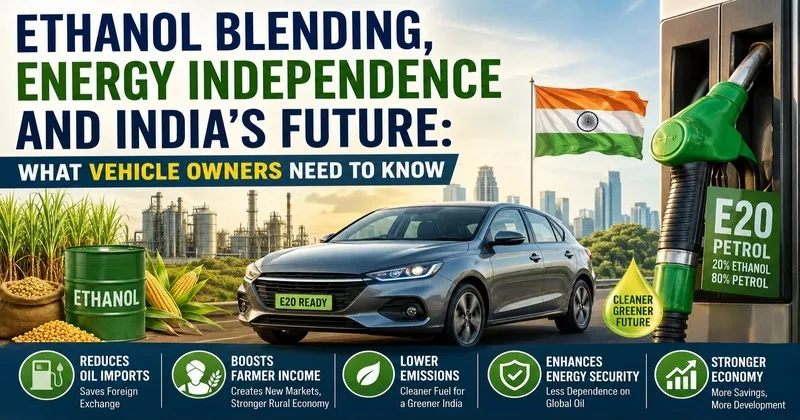
India is rapidly expanding the use of E20 petrol, a fuel containing up to 20 per cent ethanol blended with petrol. As this transition gathers pace, many vehicle owners have a common question:
Will E20 petrol damage my vehicle?
The first thing to understand is that ethanol itself does not directly damage an engine. Countries around the world have successfully used ethanol-blended fuels such as E10, E20 and even E85 for many years. India is now moving in the same direction as part of a larger strategy aimed at strengthening energy security, reducing oil imports, supporting farmers and improving environmental sustainability.
Why Is India Promoting Ethanol Blending?
India imports nearly 85% of its crude oil requirement from foreign countries. This dependence on imported energy results in a massive outflow of foreign exchange every year. Increasing ethanol blending has emerged as one of the most effective strategies to reduce this dependence. Every litre of domestically produced ethanol blended into petrol reduces the amount of imported crude oil required to meet India’s fuel demand.
This is one of the key reasons behind the Government of India’s push toward achieving higher ethanol blending targets and reducing foreign exchange outflows associated with petroleum imports.
In simple terms, every percentage increase in ethanol blending helps preserve India’s foreign exchange reserves.
Why Ethanol Matters for India’s Future?
The benefits of ethanol blending extend far beyond fuel substitution.
1. Reduced Dependence on Foreign Oil
Higher ethanol blending directly reduces India’s reliance on imported crude oil, strengthening national energy security.
2. Additional Income for Farmers
Ethanol production creates a new and stable market for agricultural produce and by-products, providing additional revenue streams for farmers.
3. Lower Emissions
Ethanol burns cleaner than conventional petrol and contributes to lower greenhouse gas and pollutant emissions.
4. Strengthening Rural Economies
The ethanol industry supports rural employment, investments in processing infrastructure and local economic development.
5. Enhanced Energy Security
A diversified fuel mix protects the country from fluctuations in global oil prices and geopolitical disruptions.
How Much Foreign Exchange Has India Saved?
Ethanol blending is not merely an environmental initiative; it has become one of India’s significant economic success stories. In 2014, ethanol blending in petrol averaged only about 1.5 per cent. Today, the country has achieved blending levels approaching 20 per cent.
Foreign Exchange Savings Over the Last Three Years:
2022-23 (Ethanol Supply Year)
* Blending Rate: 12.06 per cent
* Foreign Exchange Savings: Approximately Rs 24,300 crore
2023-24
* Blending Rate: 14.6 per cent
* Foreign Exchange Savings: Approximately Rs 30,000–35,000 crore
2024-25
* Blending Rate: Around 19 per cent
* Foreign Exchange Savings: Approximately Rs 40,000 crore
National-Level Benefits Achieved So Far:
According to recent government and parliamentary data, India’s ethanol blending programme has delivered substantial benefits:
* More than Rs 1.70 lakh crore in cumulative foreign exchange savings
* Reduction in crude oil imports by over 180 lakh metric tonnes
* Reduction of approximately 736 lakh metric tonnes of carbon dioxide emissions
* More than Rs 1.25 lakh crore in additional income for farmers
These figures demonstrate that ethanol blending has become an important pillar of India’s energy and economic strategy.
What Does Rs 40,000 Crore Mean in Practical Terms?
The annual savings generated through ethanol blending are significant enough to fund major national development initiatives, including:
* Construction of new national highways
* Establishment of medical colleges and healthcare infrastructure
* Railway modernization projects
* Strategic investments in defence and national security
In effect, money that would otherwise have been spent on importing petroleum is being retained within the Indian economy.
Does Ethanol Blending Threaten Food Security?
One of the most common criticisms of ethanol production is that it diverts food resources toward fuel production. However, the Indian situation is more nuanced. India currently produces surplus quantities of several agricultural commodities. Ethanol production primarily utilises:
* Molasses derived from sugarcane processing
* Surplus grain stocks
* Damaged or excess food grains unsuitable for regular consumption
* Maize and other approved feedstocks
In 2025, excess rice stocks beyond strategic requirements were also redirected toward ethanol production.
Therefore, the current policy approach is not a choice between “food or fuel.” Rather, it focuses on converting surplus agricultural production into value-added energy resources while creating additional income opportunities for farmers.
Are Modern Vehicles Compatible with E20 Fuel?
Yes, Most vehicles manufactured in India after April 2023 under BS6 Phase II (OBD-II) norms are designed to operate on E20 petrol without any modifications. For owners of newer vehicles, there is generally little cause for concern. The primary focus should be on older vehicles.
What BS4 Vehicle Owners Should Know:
Contrary to popular misconceptions, E20 fuel does not automatically damage older vehicles. However, certain components in older fuel systems may require attention.
1. Avoid Storing Fuel for Long Periods
Ethanol has a tendency to absorb moisture from the atmosphere.
If a vehicle remains unused for several months:
* Water accumulation may occur inside the fuel tank
* Starting issues may develop
* Corrosion risks may increase in older metallic components
It is advisable to avoid storing large quantities of fuel if the vehicle will not be used regularly.
2. Inspect Fuel Lines and Rubber Components
Older vehicles may contain:
* Rubber hoses
* Seals
* Gaskets
Over time, these components may deteriorate when exposed to higher ethanol concentrations.
Replacing them with ethanol-compatible materials during routine servicing can improve long-term reliability.
3. Monitor Fuel Filters
Ethanol can loosen deposits and contaminants that have accumulated inside older fuel tanks.
As a result, fuel filters should be inspected periodically.
4. Check Engine Oil Regularly
Some older vehicles may experience minor fuel dilution effects. Following recommended service intervals and monitoring engine oil condition is advisable. Preparing Vehicles for Higher Ethanol Blends:
As India progresses toward higher ethanol blends in the future, certain upgrades may become beneficial:
* Ethanol-resistant fuel hoses
* Improved rubber seals and O-rings
* Ethanol-compatible fuel pumps
* Corrosion-resistant fuel line components
* Updated ECU calibration where applicable
Flex-Fuel Vehicles: The Future of Mobility
Countries such as Brazil have widely adopted Flex-Fuel vehicles. These vehicles can operate on:
* E20
* E50
* E85
* Conventional petrol
The engine automatically adjusts to the fuel mixture being used. India is also expected to witness greater adoption of flex-fuel technologies in the coming years.
What About Mileage Reduction?
A frequently asked question is: “If ethanol reduces mileage, won’t India end up consuming more fuel overall?”
The answer requires understanding energy density. Ethanol contains less energy per litre than petrol. Consequently, some vehicles may experience a mileage reduction of approximately 1 per cent to 4 per cent when using E20 fuel. However, this does not eliminate the benefits of reduced petroleum imports.
Consider a simple example:
A 100-litre E20 fuel blend contains:
* 80 litres of petrol
* 20 litres of ethanol
Assume fuel efficiency decreases by 3 per cent. Instead of consuming 100 litres, the vehicle now requires 103 litres of E20 fuel.
Petrol content in 103 litres of E20:
103 × 0.80 = 82.4 litres
Previously, the vehicle consumed 100 litres of petrol. Now it effectively consumes only 82.4 litres of petrol.
Therefore, despite a slight reduction in fuel efficiency, approximately 17.6 litres of petrol imports are still avoided. In practical terms:
* Petrol consumption decreases by 20 per cent
* Mileage reduction may be around 3 per cent
* Net petroleum savings remain approximately 17 per cent
Furthermore, modern BS6 vehicles use advanced Engine Control Units (ECUs) capable of optimising fuel delivery for E20 fuel. In many real-world situations, the difference in mileage may be difficult for drivers to notice.
Factors such as tyre pressure, traffic conditions, driving style and air-conditioner usage often have a greater impact on fuel efficiency than E20 fuel itself.
Looking at the Bigger Picture:
Every litre of ethanol used in India is produced domestically. Every litre of petrol, however, requires:
* Importing crude oil
* Spending foreign exchange
* International transportation
* Refining and distribution
Therefore, even if a small reduction in mileage occurs, the broader benefits remain substantial:
* Reduced foreign exchange outflow
* Increased farmer income
* Lower dependence on imported oil
* Reduced emissions
* Stronger energy security
E20 petrol is not an experiment. It is a major step toward India’s long-term energy independence. With a few simple maintenance practices and selective upgrades in older vehicles, the transition can be managed smoothly. New-generation BS6 vehicles are already designed to operate with E20 fuel.
As India seeks to reduce foreign exchange outflows, support farmers, strengthen energy security and lower emissions, ethanol blending represents an important component of that strategy. The small adjustments made by vehicle owners today can contribute to a larger national transformation tomorrow.