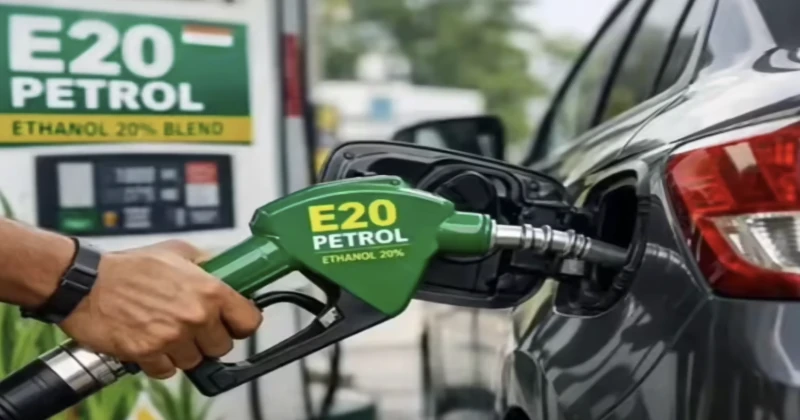
New Delhi: As misinformation surrounding ethanol-blended petrol (E20) gains traction on social media, the Union Ministry of Petroleum and Natural Gas has mounted a comprehensive rebuttal, asserting that there is “no verified evidence of widespread engine damage” caused by ethanol-blended fuel. Backing the government’s position, Institute of Chemical Technology (ICT) Vice-Chancellor Prof. Aniruddha Bhalchandra Pandit dismissed the viral claims as being based on “half-truths and incorrect information”, stressing that decades of scientific research and real-world experience support the nationwide ethanol blending programme.
The Centre’s clarification comes amid growing online speculation that E20 fuel damages engines, reduces mileage and causes corrosion. The Ministry, however, said its conclusions are based on over 25 years of phased implementation, extensive scientific validation, continuous field experience across crores of vehicles, manufacturer service records, stakeholder consultations and ongoing quality monitoring.
Rejecting the allegations outright, the Ministry highlighted that ethanol blending is not an experimental policy but one that has undergone years of testing before nationwide implementation.
According to the Ministry, E15-plus petrol has been in use for over three-and-a-half years, while E19-E20 fuel has been available for more than two-and-a-half years. During this period, over 20 crore two-wheelers and more than three crore petrol cars have operated successfully on ethanol-blended fuel without any verified systemic engine failures.
Addressing concerns regarding older vehicles, the Ministry cited service records from a leading automobile manufacturer that serviced 2.84 crore vehicles during FY 2025-26, including nearly 1.5 crore vehicles that were not originally certified as E20-compatible. The data reportedly found no E20-linked corrosion, abnormal wear or reduction in component life.
Similar findings, the Ministry noted, have also been reported by other major automobile and two-wheeler manufacturers.
Supporting the government’s position, ICT Vice-Chancellor Prof. Aniruddha Bhalchandra Pandit criticised the social media campaign against ethanol blending, saying it is driven by incomplete scientific understanding. “The social media campaign is based on half-truths and incorrect information… incomplete scientific understanding of the whole phenomenon,” he said.
Explaining the technical aspects, Prof. Pandit noted that ethanol has a lower calorific value than conventional petrol, which can result in a 3 to 4 per cent reduction in fuel efficiency under certain conditions.
“The average efficiency of a petrol internal combustion engine ranges from roughly 25 to 28 per cent. If efficiency drops by around 10 per cent relative to that figure, the overall reduction in mileage works out to approximately 3 to 4 per cent. This is exactly what some users are reporting,” he explained.
However, he emphasised that this should not be interpreted as engine damage and can be minimised through proper driving habits and routine engine tuning.
Prof. Pandit also pointed to one of ethanol’s key technical advantages. “Ethanol acts as an octane booster and functions as an oxygenate, improving the quality of combustion inside the engine,” he said.
He added that complaints of occasional engine misfiring can usually be resolved by making appropriate engine timing adjustments suited to the fuel blend being used. Regarding concerns about corrosion, Prof. Pandit explained that ethanol is hygroscopic, meaning it absorbs moisture from the atmosphere, particularly in humid regions.
According to him, such issues are generally associated with ageing rubber components in older vehicles and can be effectively addressed through regular servicing and timely replacement of worn-out parts.
The Ministry also sought to put concerns over mileage into perspective. It stated that any reduction in fuel economy in vehicles originally designed for E10 fuel is generally limited to 3 to 5 per cent, while everyday factors such as driving style, tyre pressure, traffic congestion, road conditions and vehicle maintenance often have a far greater impact on mileage than ethanol blending itself.
The Ministry further highlighted that E20 fuel offers several operational advantages, including a higher octane rating, cleaner combustion and smoother engine performance.
The government emphasised that higher ethanol blends were introduced only after extensive consultations with all stakeholders in the automobile ecosystem.
These included the Society of Indian Automobile Manufacturers (SIAM), the Automotive Research Association of India (ARAI), component manufacturers, testing agencies and oil marketing companies. The Ministry added that automobile manufacturers continue to honour vehicle warranties for compatible vehicles, reflecting confidence in the safety and reliability of E20 fuel.
Beyond its technical merits, Prof. Pandit underscored the broader economic significance of the ethanol blending programme. “This is extremely beneficial to the Indian economy. Farmers engaged in ethanol production stand to gain substantially, while the country can significantly reduce the enormous foreign exchange spent on importing crude oil,” he said.