Punjab’s Dalit communities and the rise of Pentecostal churches
August 19, 2026
  • Read Ecopy
  • Circulation
  • Advertise
  • Careers
  • About Us
  • Contact Us
Android AppiPhone AppArattai
Organiser
  • ‌
  • Bharat
    • Assam
    • Bihar
    • Chhattisgarh
    • Jharkhand
    • Maharashtra
    • View All States
  • World
    • Asia
    • Europe
    • North America
    • South America
    • Africa
    • Australia
  • Editorial
  • International
  • Opinion
  • RSS @ 100
  • More
    • Op Sindoor
    • Analysis
    • Sports
    • Defence
    • Politics
    • Business
    • Economy
    • Culture
    • Special Report
    • Sci & Tech
    • Entertainment
    • G20
    • Azadi Ka Amrit Mahotsav
    • Vocal4Local
    • Web Stories
    • Education
    • Employment
    • Books
    • Interviews
    • Travel
    • Law
    • Health
    • Obituary
  • Subscribe
    • Subscribe Print Edition
    • Subscribe Ecopy
    • Read Ecopy
  • ‌
  • Bharat
    • Assam
    • Bihar
    • Chhattisgarh
    • Jharkhand
    • Maharashtra
    • View All States
  • World
    • Asia
    • Europe
    • North America
    • South America
    • Africa
    • Australia
  • Editorial
  • International
  • Opinion
  • RSS @ 100
  • More
    • Op Sindoor
    • Analysis
    • Sports
    • Defence
    • Politics
    • Business
    • Economy
    • Culture
    • Special Report
    • Sci & Tech
    • Entertainment
    • G20
    • Azadi Ka Amrit Mahotsav
    • Vocal4Local
    • Web Stories
    • Education
    • Employment
    • Books
    • Interviews
    • Travel
    • Law
    • Health
    • Obituary
  • Subscribe
    • Subscribe Print Edition
    • Subscribe Ecopy
    • Read Ecopy
Organiser
  • Home
  • Bharat
  • World
  • Operation Sindoor
  • Editorial
  • Analysis
  • Opinion
  • Culture
  • Defence
  • International Edition
  • RSS @ 100
  • Magazine
  • Read Ecopy
Home Bharat

From Gurdwaras to Pentecostal Churches: Understanding the changing religious landscape of rural Punjab

Punjab’s rural religious landscape is changing as independent Pentecostal churches gain ground among Dalit communities, driven by social support, healing claims and the search for dignity. The trend also highlights deeper concerns over caste divisions, addiction, healthcare gaps and the weakening of traditional community institutions

Aditya TakiarAditya Takiar
Aug 19, 2026, 07:40 pm IST
inBharat, Punjab
Follow on Google News
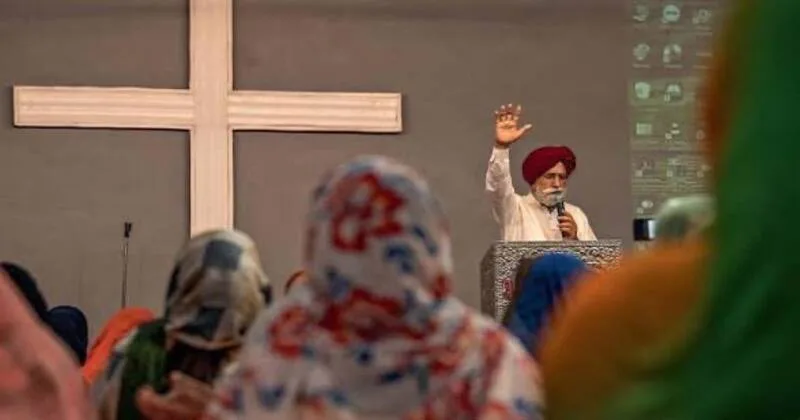
Punjab’s rural religious landscape is shifting as Pentecostal churches gain ground among Dalit communities

Punjab’s rural religious landscape is shifting as Pentecostal churches gain ground among Dalit communities

Facebook
Twitter
WhatsAppTelegramEmail

In villages across Punjab’s Majha and Doaba belts, a demographic shift is underway that official records struggle to capture. In these rural areas, independent Pentecostal churches have gained visibility among Dalit communities. Their growth appears linked to caste exclusion, religious experimentation, social support networks, and the search for healing and dignity in areas marked by economic distress and weak public services.

India’s 2011 Census listed the state’s Christian population at 348,230, accounting for approximately 1.26 per cent of Punjab’s total population. However, some independent observers and ground-level surveys suggest that the actual number today is considerably higher, indicating a gap between what’s recorded on paper and what’s actually happening in practice.

The “Crypto-Christian” Phenomenon

Much of that gap is connected to an informal pattern in which some people adopt Christian beliefs and practices without formally changing their religion on paper.

In India, Scheduled Caste status is rooted in religion, and conversion to Christianity can mean losing SC recognition and the reservations and protections attached to it. In Punjab, this has created a situation where people may have Christian services or follow Christian practices while retaining their original religious identity in official records. This trend has been reported most often in the parts of rural Punjab, including districts such as Gurdaspur, Tarn Taran, Jalandhar, and Amritsar.

Caste, Land, and the Search for Dignity

Underlying the gap, there is a difference between sikh ideals and the rural social reality. Sikhism formally rejects caste distinction, holding that all people are equal. In practice, however, land ownership and political influence in much of rural Punjab remain concentrated among Jat Sikhs, while Dalit Sikh communities, including Mazhabi Sikhs and Valmikis, are often landless.

In many villages, this hierarchy is visible in daily life through separate gurdwaras and even separate cremation grounds.

Against this context, the independent Pentecostal churches present a different kind of social space. Visitors describe being welcomed as equals, “brothers and sisters,” with no questions asked about caste background. For many, that flat social hierarchy meets a need for dignity that isn’t being met elsewhere.

A Distinctly Punjabi Church

These aren’t churches built on a Western framework. Pastors frequently wear turbans and keep beards, dressing in ways that appear distinctly Punjabi rather than foreign. Services swap Western choral music for devotional singing in a Gurbani-influenced style, accompanied by harmonium, tabla, and chimta. Many conclude with langar, a free communal meal eaten sitting on the floor, in the same spirit as Sikh gurdwara tradition, followed by the distribution of prasad. The effect is a form of faith that allows people to convert without feeling they’ve abandoned their cultural roots.

Scale, Addiction, and the Promise of Healing

Some of these congregations have grown enormous. A few church complexes spread over as much as 60 acres and attract crowds of one to three lakh people each week, so large that police sometimes have to manage traffic nearby.

Part of their appeal is practical, not just spiritual. Punjab faces serious drug addiction problems, and rural healthcare is often underfunded. Many families cannot afford private treatment or rehab. Some churches respond by offering claims of miraculous healing, with testimonies of chronic illness cured or addiction broken overnight, often amplified through slick social media production. For families with few other options, the promise of an immediate, low-cost solution, along with genuine community support, can be a powerful draw.

Also Read: Odisha Floods: Over 7.85 lakh affected; CM Majhi tours Jajpur & Bhadrak by boat and motorcycle to review relief efforts

Pushback From Sikh Institutions

The trend has not gone unanswered. The Akal Takht and the Shiromani Gurdwara Parbandhak Committee (SGPC) have launched campaigns such as “Ghar-Ghar Andar Dharamsaal,” aimed at reconnecting Sikh communities with the faith’s own teachings on equality, alongside public reconversion drives. Religious bodies have also pushed the Punjab government to adopt stricter anti-conversion laws, as many conversions are driven by financial incentives and unverified healing claims rather than genuine spiritual conviction. Tensions have occasionally spilt into physical confrontation, including reported clashes between Nihang Sikh groups and church organisers.

Notably, Punjab itself does not currently have a dedicated anti-conversion law, unlike a dozen other Indian states, including Uttar Pradesh, Madhya Pradesh, Gujarat, and Himachal Pradesh, that already restrict conversions through “Freedom of Religion” acts. Union Home Minister Amit Shah has pledged to introduce such a law in Punjab if the BJP wins power, a promise that has become a live political issue ahead of the 2027 state elections.

A Societal Problem, Not Just a Religious one

Taken together, the pattern points to something wider than a simple story of religious competition. It reflects unresolved caste discrimination, a strained rural healthcare system, and the economic distress linked to addiction.

Another factor is the decline of traditional deras and local spiritual centres, which once provided everyday guidance, counsel, and community in rural Punjab. As these institutions have weakened, they have left behind not only a material gap but also a spiritual one. For many people, the appeal of Pentecostal churches is not only practical; it also reflects a genuine need for spiritual meaning and personal support that older institutions are no longer meeting as consistently as before.

If deras want to remain relevant to the communities they once were, they will likely need to modernise and respond more directly to local needs. That means building de-addiction centres, health camps, and trained counselling services instead of relying only on spiritual authority. Legal restrictions or organised protests may slow public gatherings, but they do not answer why people are turning to these spaces in the first place. The change is already underway, and unless deeper issues of dignity, land, healthcare, addiction, and belonging are addressed, the pull toward communities that offer answers and a sense of welcome is likely to continue.


Topics: PunjabReligious Conversioncaste discriminationPentecostal ChurchesDalit CommunitiesRural PunjabPunjab 2027 Elections
Share
Tweet
SendShareSend
✮ Subscribe Organiser YouTube Channel. ✮
✮ Join Organiser's WhatsApp channel for Nationalist views beyond the news. ✮
Previous News

Tamil Nadu gets back 500-year-old Thirumangai Alwar Murti stolen nearly 70 years ago, traced to UK’s Ashmolean Museum

Related News

Amid Shiva worship in Chhattisgarh’s Shivrinarayan, 500 converted families reportedly returned to Sanatan Dharma in a Ghar Wapsi ceremony

Ghar Wapsi in Chhattisgarh: 500 converted Christians return to Sanatan fold; Families reconnect with their roots

Koukoor Dargah in Medchal district, Telangana

Telangana: Police arrest Nazar in Medak after wife alleges he posed as an orphan, used fake Hindu name to marry her

A representative image

Missionary activities under scanner in Bengal: Allegations of tribal conversions, foreign funding spark local backlash

Supreme Court Reaffirms: Scheduled Caste status ends upon religious conversion, upholds constitutional mandate

Sanitation workers assaulted by police officers

Punjab: Ravneet Bittu condemns police action against sanitation workers on strike in Barnala

Punjab must learn the lessons from its tragic past

Load More

Latest News

Punjab’s rural religious landscape is shifting as Pentecostal churches gain ground among Dalit communities

From Gurdwaras to Pentecostal Churches: Understanding the changing religious landscape of rural Punjab

Tamil Nadu Chief Minister Thiru. S. Joseph Vijay on 17.8.2026 viewed the ancient bronze idol of Thirumangai Azhwar, stolen from the Arulmigu Soundararaja Perumal Temple located in Kumbakonam, Thanjavur District,

Tamil Nadu gets back 500-year-old Thirumangai Alwar Murti stolen nearly 70 years ago, traced to UK’s Ashmolean Museum

India strengthens Defence supply chain as 405 items linked to fighter jets, tanks, missiles and warships go indigenous

India Boosts Defence Self-Reliance: 405 more items to be indigenised, covering Su-30MKI, T-90 and key weapon systems

Representative Image

Not Lagging, But Scaling: India’s strategic push in renewable energy and EVs

US Ambassador Sergio Gor (Left), J&K Chief Minister Omar Abdullah (Right)

‘Our problems won’t be solved in Washington’: Omar Abdullah rebuffs US envoy Sergio Gor ahead of J&K visit

Punjab: NHRC takes cognisance of complaint flagging non-observance of I-Day in Govt schools along India-Pak border

KPCC chief B.K. Hariprasad (Left), K.S. Eshwarappa (Right)

‘Only 2 Stanzas’ of Vande Mataram? Eshwarappa hits Congress, says Hariprasad insulted national sentiments

Meta CEO Mark Zuckerberg

Trouble for Zuckerberg: 29 US states seek $1.4T from Meta, putting Facebook, Instagram and his AI ambitions at risk

India’s Akash 1S gains ground in Central Asia as Turkmenistan, Tajikistan show interest following Armenia deal: Report

NIA Court Sentences 12 in Jharkhand Maoist Funding Case

Jharkhand: NIA Court sentences 12 in terror funding and extortion case linked to CPI (Maoist)

Load More
  • Privacy
  • Terms
  • Cookie Policy
  • Refund and Cancellation
  • Delivery and Shipping

© Bharat Prakashan (Delhi) Limited.
Tech-enabled by Ananthapuri Technologies

  • Home
  • Search Organiser
  • Bharat
    • Assam
    • Bihar
    • Chhattisgarh
    • Jharkhand
    • Maharashtra
    • View All States
  • World
    • Asia
    • Africa
    • North America
    • South America
    • Europe
    • Australia
  • Editorial
  • Operation Sindoor
  • Opinion
  • Analysis
  • Defence
  • Culture
  • Sports
  • Business
  • RSS @ 100
  • Entertainment
  • More ..
    • Sci & Tech
    • Vocal4Local
    • Special Report
    • Education
    • Employment
    • Books
    • Interviews
    • Travel
    • Health
    • Politics
    • Law
    • Economy
    • Obituary
  • Subscribe Magazine
  • Read Ecopy
  • Advertise
  • Circulation
  • Careers
  • About Us
  • Contact Us
  • Policies & Terms
    • Privacy Policy
    • Cookie Policy
    • Refund and Cancellation
    • Terms of Use

© Bharat Prakashan (Delhi) Limited.
Tech-enabled by Ananthapuri Technologies