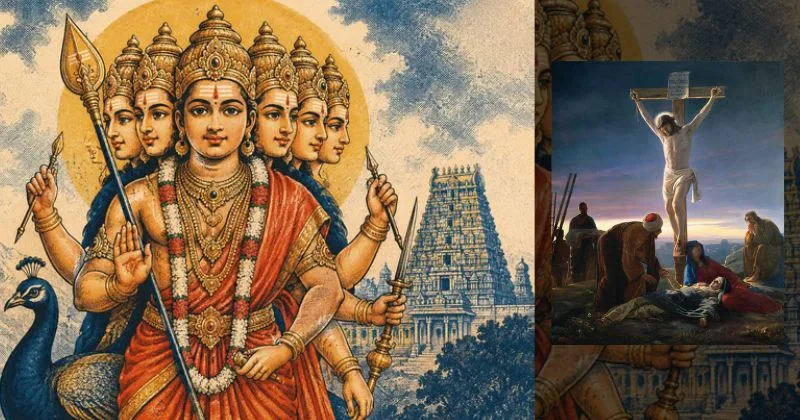
When ideas run dry, when there is a desire to claim achievements, or when an identity feels threatened, some may resort to borrowing from others or attempting to appropriate their heritage through deceptive narratives. One such claim is the portrayal of Jesus as a Tamil who lived in India—more specifically, in Tamil Nadu—and the attempt to identify him with the Hindu deity Murugan, known across Bharat as Subramanya, Kartikeya, Shanmukha and Skanda.
Murugan, Skanda, Guha, Kumara and Karttikeya are different names for the same deity, a continuity that can be traced through some of the earliest available Indic records. The fiery child associated with the river mothers in the Rigveda, the six-star imagery linked to the Harappan tradition, the six-faced child nurtured by the Krittikas in the Mahabharata, and the Lord of the six abodes celebrated in Sangam Tamil poetry can be understood as different expressions of a long-standing tradition, connected by recurring symbols and themes across millennia.
The Abrahamic religions have sought to expand Christianity in India for centuries, with Christian missionary activity gaining significant momentum during the colonial period. Critics argue that, in contemporary Tamil Nadu, Dravidian parties, sections of the Congress and the Left have furthered this agenda by supporting conversion-related activities, allegedly with the backing of NGOs that receive foreign funding. They contend that this is also why these political groups oppose tighter regulations under the Foreign Contribution Regulation Act (FCRA).
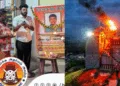
To get back to the issue, a Tamil-language book currently being sold in Tamil Nadu has sparked a fresh controversy. The 400-page book claims that Bhagwan Murugan is Jesus. The book claims that “St Thomas brought Jesus to India, the Tamil Indianised him, and the rest follows.” It further states that Devasena represents Jewish Christians, while Valli, another consort of Bhagwan Murugan, represents Gentiles waiting to be converted. The book also claims that Bhagwan Murugan’s 12 hands represent the 12 apostles, while the kavadi is a forgotten reenactment of Christ carrying the Cross.
The historicity of St Thomas’s arrival in India has itself been the subject of debate. One netizen said, “The St Thomas claim itself is a hoax, created to legitimise the roots of Christianity in India.”
https://twitter.com/gauravsng17/status/2084907053529924095?s=20
John Samuel, then director of the Institute of Asian Studies, organised the first international conference on Skanda-Murugan in Chennai in 1992. At the conference, he claimed that most researchers and scholars, including himself, believed that Murugan had been elevated from a historical person.
Continuing this narrative, John Samuel reportedly said in 2025 that the Somaskanda icon, which depicts Bhagwan Shiva, Uma and child Skanda together, was nothing but a revelation of the “Christian Trinity.” The name of Bhagwan Murugan appears in the Rig Veda and the Mahabharata, where he is associated with the Krittikas. The Sangam-era Thirumurukattrupadai describes Murugan with six faces and associates him with the Pleiades and Agni.
One netizen asked, “If Murugan is Jesus, does that make Shiva the Father in Heaven?”
If Murugan is Jesus, the father in heaven is Shiva😄. https://t.co/sKnIZQIrUM
— Aṁśumān K R (@AmshumanKR) August 18, 2026
The Narrative Today…
"Tamil can't teach me what Christianity did"
"Murugan isn't a Hindu God"
"Onam is secular"
"Murugan is Jesus" pic.twitter.com/DulnqMPeOK
— Āyudhika (@Ayudhika1310) August 19, 2026
One Twitter handle, Shiv Bakthindu, asked, “If Jesus himself has adopted Murugan, a Hindu God, what are Christians waiting for? Christians should do #GharWapasi to Sanatan Hindu Dharma!”
If Jesus himself has adopted to the Murugan – a Hindu God, what for Christians waiting for?
Christians should do #GharWapasi to Sanatan Hindu Dharma!!— शिवभक्त हिंदू ShivBhaktHindu (@MiRajeshPatil) August 18, 2026
Another person said, “Murugan is our God. To reduce him to a mere human while continuing to regard Christ and Allah as God is a clear-cut missionary project that has been running in this region for ages. Language exceptionalism is also part of this larger plan. That is why even a film celebrating Murugan seems to irk them.”
Critics point out that some Christians adopt and incorporate Hindu and Indian cultural traditions, such as pulling temple chariots, carrying kavadi, performing abhishekam, lighting brass lamps, celebrating festivals, hoisting flags, undertaking padayatras in saffron attire, and drawing kolams. They argue that, rather than copying or emulating Hindu traditions and Indian culture, those who identify with these practices should consider returning to the Hindu fold.
S Gurumurthy condemns evangelical materials in Tamil Nadu for equating the Hindu deity Murugan with Jesus through symbolic reinterpretations, citing Mahatma Gandhi’s description of conversion as a business reliant on manipulation and family division for geopolitical ends.
The Evangelists will tell any lies, do any fraud to convert. Mahatma Gandhi called conversion as a business. Business necessarily involves lies and manipulation. All that the converters want is a change of name, disowning ancestors and split in families and communities that will… https://t.co/mtRHYftYcJ
— S Gurumurthy (@sgurumurthy) August 19, 2026
The Thiruvalluvar debate
A similar controversy has surrounded claims by M. Deivanayagam and others that the Tamil saint-poet Thiruvalluvar had Christian influences or was connected to St Thomas. One argument has been that portions of the Tirukkural reflect Christian teachings such as those found in the Sermon on the Mount. These claims have long been disputed and remain part of a wider scholarly debate over the possible religious influences on the Tirukkural.
Here Former DMK Chief M.Karunanidhi in his wishes for Deivanayagam book titled "Is Thiruvalluvar a Christian?" says different religion calling Thiruvalluvar as their own is because of their love. Here, he welcomes Deivanayagam for calling Thiruvalluvar a Christian. (Cont..) pic.twitter.com/xXstfxG2Fz
— Saiganesh (@im_saiganesh) November 4, 2019
“Jesus was Hindu”
In 1946, Ganesh Damodar “Babarao” Savarkar, elder brother of V.D. Savarkar and one of the founders of the RSS, authored Christ Parichay. The book claimed that Jesus was a Tamil Hindu, that he was born a Vishwakarma Brahmin, that his mother tongue was Tamil and that Christianity was essentially a Hindu sect. It further claimed that Jesus travelled to India, learnt yoga and spent his final years in Kashmir. The book was republished in 2016. The historical claims in that book are also highly controversial and are not accepted as established history.
The book claimed that Christ’s real name was Keshao Krishna, that Tamil was his mother tongue, and that he had a dark complexion. It further stated that present-day Palestine and the Arab territories were once Hindu lands and that Christ travelled to India, where he learned yoga.
https://twitter.com/KLinto51001/status/2089730369730036077?s=20