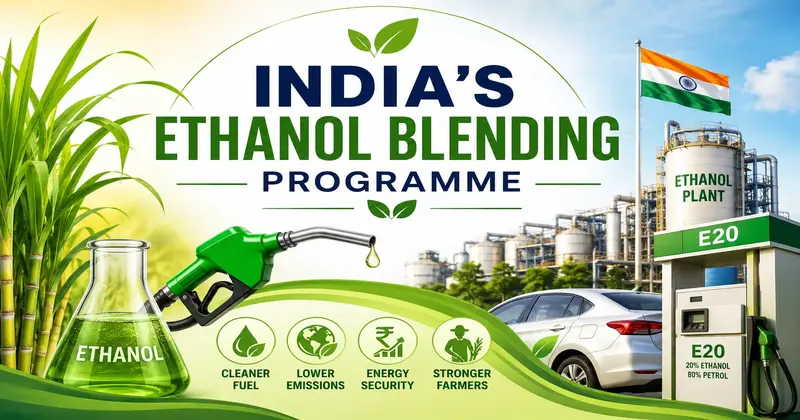
E20 is not a new fuel and this is not a new decision. Ethanol blending has been built up over twenty-five years, in a phased, consultative and technically validated manner. Over 20 crore two-wheelers and over 3 crore petrol cars have been running on E15-plus fuel for over three and a half years and on E19–E20 fuel for over two and a half years, without a single verified case of widespread engine failure. The blending percentage has not been raised recently. The recent surge in adverse content is therefore not explained by anything that has changed in the fuel — but it does coincide closely with India moving decisively beyond E20.
A twenty-five year, phased journey(2001–2026)
India did not rush to E20. Ethanol as a fuel was settled globally a century ago. The constraint India faced was never technology — it was the ability to produce ethanol at scale. Once feedstocks were diversified, pricing made remunerative and investment de-risked, blending rose in calibrated steps.
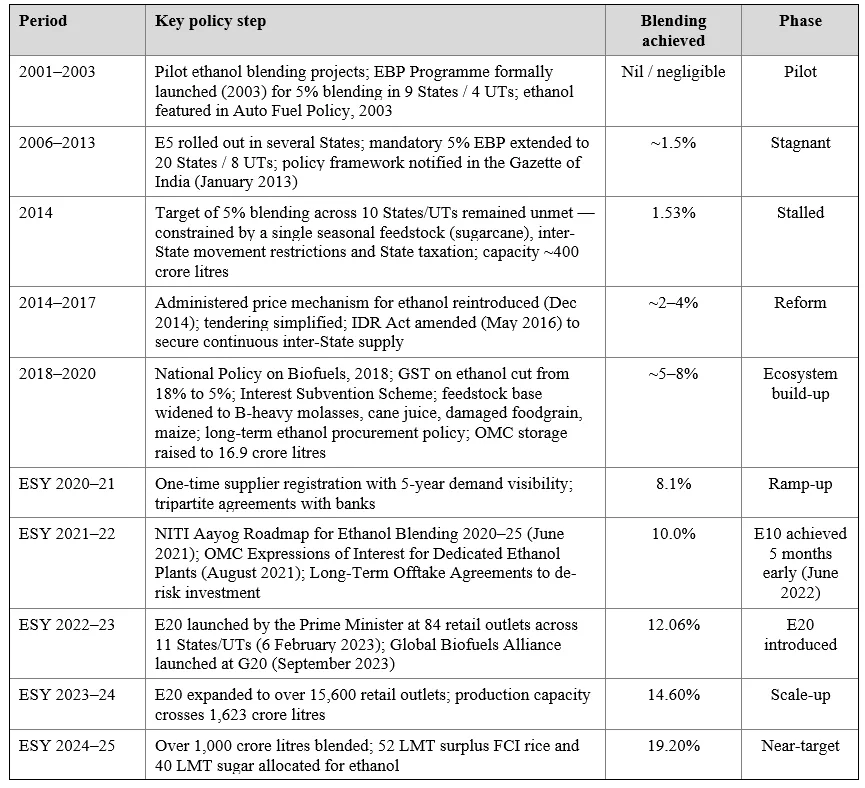
 The single most important fact in this table: blending remained at 1.5% for the thirteen years to 2014, and rose from 1.5% to 20% in the eleven years since — a thirteen-fold increase achieved feedstock by feedstock, plant by plant, and step by step.
The Evidence: The fleet has already answered this question
- Scale and duration of real-world use: E15-plus fuel has been in use across India for over three and a half years and E19–E20 for over two and a half years. Over 20 crore two-wheelers and over 3 crore petrol cars have run on it. If ethanol were corroding fuel lines or damaging engines, the country would have seen lakhs of warranty claims. It has not.
- Manufacturer service data: Maruti Suzuki serviced 2.84 crore vehicles in FY 2025–26, including 1.5 crore vehicles never originally certified as E20-compatible, and reported no E20-linked corrosion, abnormal wear or reduction in component life. Hero MotoCorp has reported the same field experience.
- Independent academic validation — IIT Kanpur (14 July 2026): The Engine Research Laboratory at IIT Kanpur, headed by Prof. Avinash Kumar Agarwal, has reported that extensive testing found no evidence of engine damage, corrosion or technical fault from E20 in either newer or older vehicles, and no significant fall in fuel efficiency — the drop being under 5 per cent and not attributable to ethanol alone, since a similar variation appears even on repeated back-to-back tests with pure petrol. Its scientists have described the social-media damage claims as scientifically unfounded. This is independent of both the Government and the industry, and is the most recent evidence available.
- The industry was a party to the decision, not a bystander: Automobile manufacturers, component suppliers, ARAI, SIAM, testing agencies and the OMCs were consulted at every stage. E20 was rolled out only after material compatibility, engine calibration, fuel systems, drivability, durability and emissions had each been examined and cleared, and only once domestic ethanol capacity was assured.
- Warranties are the proof: Virtually every manufacturer is today honouring warranties on all vehicles, old and new, running on E20. No manufacturer would carry that commercial liability on a fuel it did not trust. That, and not any government assertion, is the decisive evidence.
- On the “E10 compatible” label: A vehicle manual records the fuel specification prevailing when the vehicle was homologated. It is not a safety ceiling. If it were, no country on earth could ever upgrade a fuel standard.
- On mileage: A 3–5 per cent reduction in fuel economy is acknowledged in some vehicles. Against it: higher octane, better anti-knock performance, cleaner combustion, negligible particulate emissions, and roughly 40% lower lifecycle carbon.
Why Now? The timing is the answer
The blending percentage has not increased. The fuel has not changed. The fleet has been running on it for years. The one thing that did change is that India began moving decisively beyond E20:
- BIS specifications for E22, E25 and E27 were released, following the supply confidence gained during the Strait of Hormuz disruption.
- A phased move to E25 was placed in the public domain, alongside work on isobutanol blending in diesel.
- June 5, 2026 — the decisive event: E85 was launched at ₹80 per litre, together with flex-fuel vehicles capable of running on it: the Hero Splendor+ — the world’s largest-selling two-wheeler — and the Maruti Suzuki WagonR flex-fuel variant. A fuel that requires no new infrastructure, has no import component, is made entirely in India, and puts money directly into the hands of Indian farmers, became commercially real. The Government has since pressed this agenda further, with the Minister writing to all Chief Ministers and to the Union Finance Minister for a more favourable taxation regime for flex-fuel vehicles, to bring down their cost to the consumer.
Two sets of interests are materially exposed by that development:
- Crude oil exporters: India is the fastest-growing crude demand centre in the world, accounting for about 30 per cent of the global increase in oil demand (IEA). A serious Indian shift towards domestically produced ethanol removes the single largest source of future demand growth — with direct consequences for global crude prices and for exporting economies.
- Battery and EV supply chains: A flex-fuel pathway that needs no charging infrastructure, no fresh capital outlay by the consumer and no imported cell chemistry is a credible competitor to the imported-battery route to clean mobility.
The surge in fabricated videos and coordinated misinformation begins after June 5, 2026 — not after any change in the fuel Indians actually put in their tanks. The sequence speaks for itself.
Steps taken to assure consumers
1. Joint industry clarification, August 11-12, 2025: When these concerns first surfaced, a joint clarification was placed on record by the EBP stakeholders — SIAM, the Automotive Research Association of India (ARAI), the oil marketing companies and vehicle manufacturers — together with the insurers, affirming that E20 is safe for older vehicles, that manufacturer warranties continue to be honoured, and that motor insurance cover is unaffected by the use of E20.
2. Ministry press release, June 23, 2026: A detailed rebuttal was issued addressing each circulating claim — the hygroscopicity claim, the fabricated “sugarcane juice in petrol” videos, the ants-at-the-fuel-cap video (rebutted by BPCL: distillation removes residual sugars and fuel ethanol is denatured to repel insects), and the false claim that E20 voids motor insurance.
3. Joint manufacturers’ press conference, July 4, 2026: A rare joint press conference of automobile manufacturers — Maruti Suzuki, Toyota, Hyundai, Hero MotoCorp, TVS Motor and Bajaj Auto — was organised by the Ministry, together with the Ministry of Heavy Industries and the Ministry of Road Transport & Highways, at which the industry rejected claims of E20-related engine or component damage in its own name. Maruti Suzuki placed on record that data from 1.4 crore E20-run vehicles tracked over fifteen years showed no evidence of ethanol-induced corrosion, and that the mileage impact is limited to about 3–3.5%. Recordings of the interaction were very widely circulated.
4. ARAI reaffirmation, July 4, 2026: The Automotive Research Association of India publicly reaffirmed that all E20-compatible vehicles undergo structured, international-standard validation for durability, performance and reliability before reaching the market.
5. Detailed FAQ, July 10, 2026: A point-by-point, evidence-based FAQ was issued by the Ministry, with a full annexed chronology of the programme and its sources.
6. PIB fact-checks against fabricated content: The PIB Fact Check unit (Ministry of Information & Broadcasting) has issued a series of fact-checks debunking coordinated misinformation, including: the false claim that Bhutan had cancelled imports of E20 fuel from India; the fabricated “ants swarming the fuel tank” video; a video falsely alleging pollution caused by an ethanol plant in Meghalaya; and the misleading claim that ethanol blending consumes thousands of litres of water — clarified on the ground that the programme uses surplus rice already procured under the MSP regime, with no incremental foodgrain cultivation, making such water calculations baseless.
7. Clarifications by insurers: Motor insurers, including ICICI Lombard, Acko and others, have clarified that the use of E20 fuel does not affect the validity of a motor insurance policy or any claim under it — laying to rest one of the most damaging false claims in circulation.
8. Point-of-sale communication — standees: Standees have been placed at retail outlets across the country explaining the science of E20 and rebutting the specific myths in circulation, and similar standees have been placed across automobile dealerships setting out the scientific basis of the programme — taking the clarification directly to the consumer at the pump and at the showroom.
9. Quality enforcement — over 30,000 checks: Ethanol and blended petrol conform to BIS specifications and are tested at the distillery, the depot and the retail outlet. The oil marketing companies have themselves carried out over 30,000 checks at retail outlets to detect adulteration and confirm fuel quality — over and above the directive to Chief Secretaries to enforce a zero-tolerance approach to any adulteration.
What the programme has delivered
- Foreign exchange saved: Over ₹1.97 lakh crore (since ESY 2014–15)
- Crude oil substituted: Nearly 316 lakh metric tonnes
- CO₂ emissions avoided: Approximately 952 lakh metric tonnes
- Paid directly to Indian farmers: Over ₹1.66 lakh crore
- Price stability: One-fifth of every litre of petrol is domestically produced and insulated from Brent, shipping disruption and geopolitical shock. Over the last four years, petrol in Delhi rose 5.58 per cent and diesel 6.23 per cent — against 39.77 per cent and 63.18 per cent in Pakistan, 42.69 per cent and 26 per cent in Bangladesh, and 18–19 per cebt across Italy, Germany and France
The Indian farmer is no longer only the Annadata. He is now also the Urjadata
Key messages
The facts are settled and the record is complete. What is required now is not fresh proof but sustained, visible communication: consistent messaging with OEMs and insurers, rapid takedown and rebuttal of fabricated content and firm enforcement against adulteration at the retail outlet — which is the one genuine risk that could give the campaign a real grievance to feed on.
India will not retreat from a cleaner, domestically produced, farmer-funded fuel because of a coordinated campaign that began the week we proved we could go further.