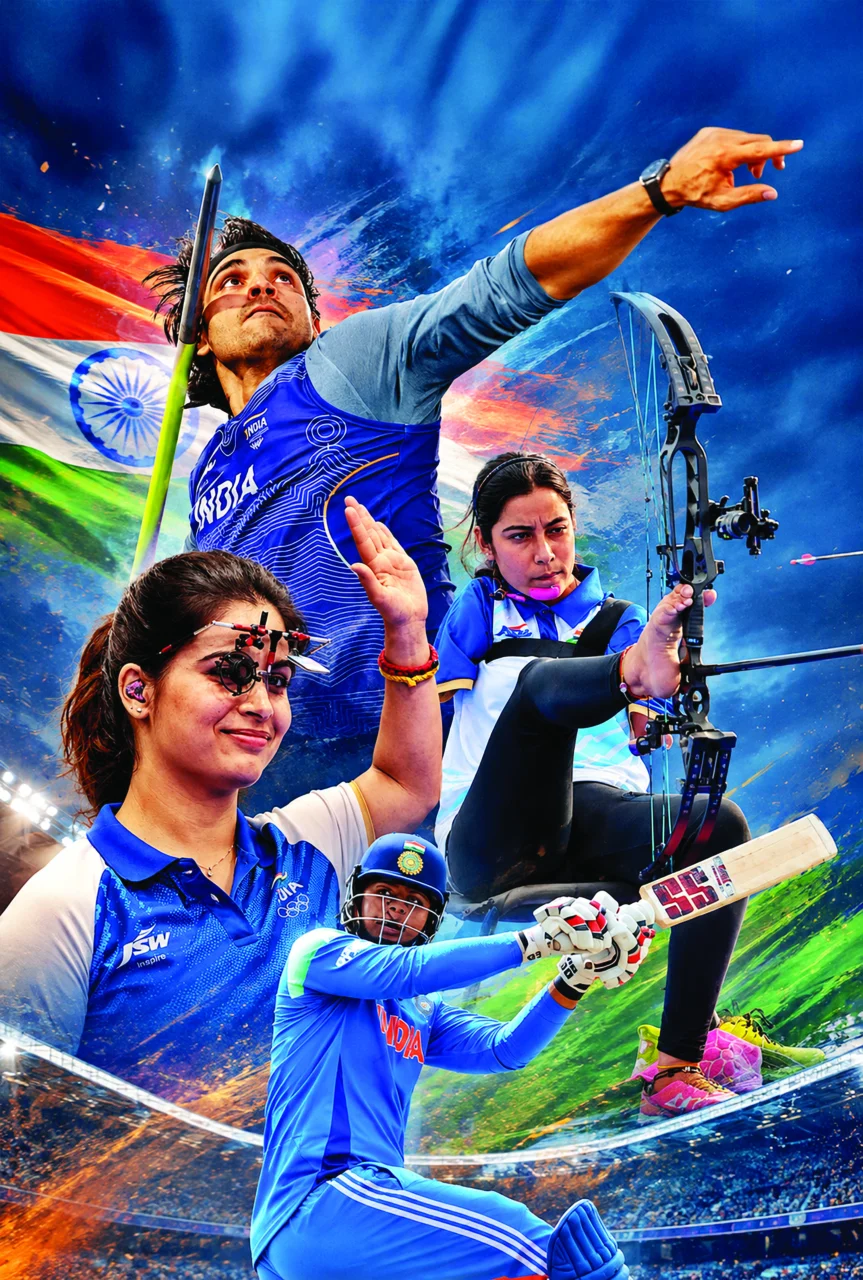
Gen-Z today lives in an age where reels, influencers and celebrity culture shape aspirations. Fame and money are often presented as the ultimate measures of success, sometimes through vulgarity, controversy, abusive language or a display of artificial luxury. In contrast, many young Indian athletes of the same generation are earning recognition through hard work, representing their country, displaying discipline and achievement while remaining away from unnecessary controversy. They represent a different idea of success.
Their journeys also show that success does not have a single background. Some come from farming families, some from small towns and villages, some overcome physical challenges, while some begin their careers under uncertain circumstances. Yet they share qualities that strongly resonate with Gen-Z: ambition, resilience, focus, self-belief and the ability to handle pressure. They are not simply winning medals or breaking records; they are demonstrating what sustained effort can achieve.
Effortlessly crossing milestones
Indian javelin thrower Neeraj Chopra is one such personality who bridges the gap between traditional values and modern times. Born in 1997 into a farming family in Khandra, Haryana, Chopra did not become a sporting icon through social-media hype. He began training as a teenager after taking up athletics to become fitter and gradually discovered his natural ability in javelin. His journey took him from a young athlete to India’s first Olympic champion in athletics, winning gold at the Tokyo 2020 Games with a throw of 87.58 metres. At Paris 2024, he won silver with 89.45 metres, becoming the first Indian track-and-field athlete to win medals at consecutive Olympics.
His achievements extend beyond the Olympics. He won the World Athletics Championships in 2023, Asian Games gold in 2018 and 2022, Commonwealth Games gold in 2018 and silver in 2026. In 2025, he crossed another major milestone by becoming the first Indian to breach the 90-metre barrier, recording a national record of 90.23 metres at the Doha Diamond League. His career demonstrates how discipline, consistency and humility can coexist with international fame.
Remarkable Resilience
A 22 years old girl named Manu Bhaker created history at the Paris 2024 Olympics by winning bronze in the women’s 10-metre air pistol event. Two days later, she won another bronze with Sarabjot Singh in the mixed team 10-metre air pistol event. She became the first Indian athlete from independent India to win two medals at a single Olympic Games and the first Indian woman shooter to win an Olympic medal.
Her journey also reflects resilience. Having faced disappointment at the Tokyo Olympics, Bhaker returned to the highest stage and converted pressure into performance. Before Paris, she had already established herself internationally, including becoming the youngest Indian to win a gold medal at an ISSF World Cup.
Cricketing Icon from Bihar
Another young name setting a new benchmark is Vaibhav Sooryavanshi. Born in Tajpur, Bihar, he represents a generation of athletes emerging from places that have traditionally received less attention in India’s sporting narrative. His early journey involved travelling long distances for practice and developing his cricket despite limited access to the facilities associated with major sporting centres. His rise has been remarkably rapid. He made his first-class debut for Bihar in January 2024 and later became the youngest player to make an IPL debut in 2025 when he appeared for Rajasthan Royals. In the IPL, he announced himself with a 35-ball century, becoming the youngest player to score an IPL hundred and recording the fastest century by an Indian in the tournament.
In 2026, he was also named the Player of the Tournament in IPL 2026. In July 2026, Sooryavanshi took another historic step when he made his senior international debut for India against England in a T20I at Old Trafford. At 15 years and 99 days, he became India’s youngest international cricketer, breaking Sachin Tendulkar’s long-standing record. His journey from Bihar to international cricket illustrates how talent, determination and opportunity can transform the sporting landscape.
Wonder Para-Archer
Whenever people think of archery, the image of an archer intensely focused on the target comes naturally. Sheetal Devi has given that image an entirely new meaning. Born without arms, the young para-archer refused to let her physical circumstances determine her future. She took up archery after being identified by the Indian Army and learned to shoot using her feet and specially adapted techniques.
At the 2022 Asian Para Games in Hangzhou, she won gold in the women’s individual compound event and another gold in the mixed team event alongside Rakesh Kumar, as well as silver in the women’s doubles compound event. She continued to establish herself on the international stage, including winning silver at the 2023 World Para Archery Championships.
Her journey is a powerful reminder that physical limitations do not necessarily define the limits of human potential.
For a generation constantly exposed to the pressure of being visible, these emerging sports athletes provide a reminder that it is more important to build substance than simply create an image. Their stories also show that one can remain connected to family, discipline, one’s cultural roots and national identity while succeeding in a modern, competitive world.
To pick them as our ideals is to recognise that memorability does not require a hashtag, and success does not require controversy. For Gen-Z, these athletes represent not merely sporting excellence, but a meaningful way of pursuing success.