Yastu sarvāṇi bhūtāni ātmanyevānupaśyati,
sarvabhūteṣu chātmānaṁ tato na vijugupsate.
One who sees all beings in the self and the self in all beings feels no hatred or revulsion toward any creature.
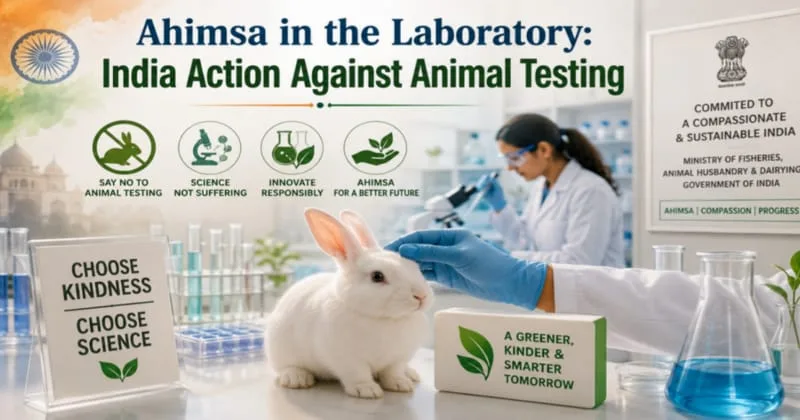
Long before the word “bioethics” entered any scientific vocabulary, India had already given the world a founding principle for how living beings ought to treat one another: ahimsa. Mahavira preached it as the highest duty. The Buddha built an entire path of liberation around it. Ashoka, after Kalinga, carved it into stone and sent it across an empire as state policy. Compassion for all sentient life, karuna, was never a sentiment reserved for the temple or the sermon in this civilisation; it was meant to be lived, legislated and practised. Two and a half millennia later, in laboratories from Bengaluru to Faridabad to Hyderabad, that same ancient conviction is quietly reshaping the frontiers of Indian science, not through renunciation of progress but through the invention of it.
The question of how India tests new medicines has long carried an uncomfortable answer through animals. Rats, rabbits, guinea pigs and primates have for decades borne the first burden of humanity’s search for cures, absorbing toxicity that might otherwise fall on human patients. It is a practice the world still leans on, India included, because complex biological systems have been notoriously difficult to replicate outside a living body. But that difficulty is no longer the final word. Across three of India’s premier scientific establishments, the Indian Council of Medical Research, the Council of Scientific and Industrial Research, and the Department of Biotechnology, a quiet scientific movement is under way to build human-relevant alternatives that spare the animal without slowing the science, an effort that reads like ahimsa translated into the language of biotechnology.
A Civilisational Ethic Meets the Microchip
At the heart of this movement sits a set of technologies with names that would have sounded like fiction a generation ago organ-on-chip platforms that mimic the function of a human lung or kidney on a device no larger than a memory stick, three-dimensional tissue models and organoids that grow miniature, functioning replicas of human organs in a dish and computational, in-silico approaches that simulate biological response through data rather than dissection. Collectively termed New Approach Methodologies, these tools promise something India’s ancient ethical imagination would have recognised instantly: that progress and non-violence need not stand opposed.
The numbers tell the scale of this quiet transformation. The Indian Council of Medical Research alone has backed 109 research projects built around non-animal testing methods, spanning organ-on-chip devices, three-dimensional tissue models and computer-based approaches. These projects are not confined to a handful of showcase laboratories; they are spread across 71 institutes and laboratories nationwide, a footprint that speaks to how deeply the philosophy has been absorbed into India’s research establishment rather than kept as an isolated experiment.
The Council of Scientific and Industrial Research has moved in step. Eight CSIR laboratories now report active capabilities in one or more alternative approaches, whether advanced in-vitro and cell-based systems, three-dimensional organoids, organ-on-chip platforms or in-silico modelling, each contributing distinct strengths to a shared national capability rather than duplicating effort.
This is not merely a story of technical substitution, chip for cage, dish for animal house. It is a story of harmony, of samanvaya, between two traditions that Indian civilisation has always insisted were never truly separate: the pursuit of knowledge and the preservation of life. The Vedic vision of Prakriti never placed the human being above the animal in a hierarchy of worth, but alongside it, bound within the same web of dependence and duty. Modern regulatory science, arriving at similar conclusions through its own disciplined logic of ethics committees and human-relevance data, has simply given that old harmony a laboratory address.
Institutions of Innovation Under DBT
Nowhere is the marriage of infrastructure and intent clearer than at the autonomous institutions of the Department of Biotechnology. At BRIC-Institute for Stem Cell Science and Regenerative Medicine, inStem, in Bengaluru, an entire ecosystem has been built for this purpose, from two-dimensional and three-dimensional culture laboratories and co-culture facilities to micro-physiological systems and bioreactors, high-throughput screening and automation, and computational resources for integrative data analysis. Institutional programmes such as the Programme in Women’s Reproductive Health and the Platform Enabling Stem Cell and Organoid Research and Training exist specifically to grow expertise in this space. Perhaps most striking, inStem researchers are now developing early embryonic models to test the developmental toxicity of potential drug candidates in vitro, a line of research that removes animal testing from one of the most ethically sensitive stages of drug development altogether.
At BRIC-Translational Health Science and Technology Institute in Faridabad, scientists have recently developed an organoid platform capable of supporting drug screening, disease modelling and therapeutic development for liver disease, offering researchers a human-relevant alternative precisely where animal models have often fallen short in predicting human response. In Hyderabad, the Biotechnology Industry Research Assistance Council supports the Centre for Predictive Human Model Systems at the Centre for Cellular and Molecular Biology, which is advancing organoids, stem-cell-based models and other cell-based platforms as tools of predictive, human-relevant science.
From Compassion to Capability
What distinguishes this moment is that compassion has not been allowed to remain an abstraction; it has been engineered into capability. Several DBT-backed projects are already under development, including a lung-on-chip platform designed to assess monoclonal antibodies and a lab-on-chip device engineered to mimic human kidney function, both offering researchers a way to study drug response without a single animal subject. The Biotechnology Industry Research Assistance Council has gone further, opening a dedicated funding call for the Establishment of Preclinical Models for Drug Discovery, inviting proposals to build robust organoid and organ-on-chip platforms alongside other innovative in-vitro approaches, a signal that this is now a funded national priority rather than a scattered academic pursuit.
Knowledge-sharing, too, has been institutionalised. BRIC-inStem in Bengaluru conducts regular stem cell workshops to train researchers from across the country, while the Centre for Predictive Human Model Systems at CCMB maintains a publicly accessible database mapping every researcher in India working on organoids, organ-on-chip systems, three-dimensional tissues and related technologies, binding a dispersed community of scientists into a single, navigable network.
It would be premature and inaccurate to declare that animal testing in India has been replaced. These non-animal methodologies still complement rather than substitute conventional animal studies, particularly for the most complex biological questions where no dish or chip can yet fully replicate the intricacy of a living organism. But the direction of travel is unmistakable, and it carries a distinctly Indian signature. This is Atmanirbhar Bharat expressed not merely in economic self-reliance but in ethical self-definition, a nation building its own scientific future on the foundations of its own philosophical inheritance.
There is something fitting in the image of a scientist in Bengaluru or Faridabad growing a liver organoid in a petri dish so that no rabbit need suffer for a new medicine to reach a patient in Varanasi or Vijayawada. It is Vasudhaiva Kutumbakam, the world as one family, extended at last to the animal kingdom that has silently served human medicine for centuries. Ahimsa was never meant to be a relic of scripture; in the hands of India’s scientists today, it has become a research protocol, a funding priority and a working reality of the modern Indian laboratory, a civilisation that never forgot the debt every act of healing owes to compassion.