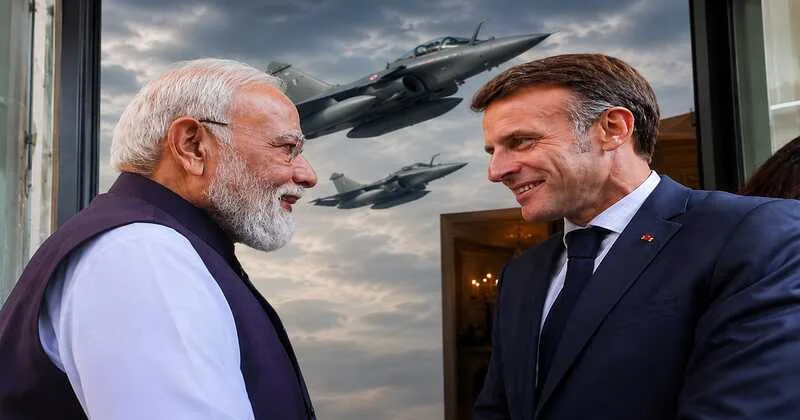
India’s proposed acquisition of 114 Rafale fighter aircraft from France is increasingly being viewed not merely as a military procurement programme, but as a transformative industrial project that could redefine the country’s defence manufacturing ecosystem. Valued at approximately rs 3.25 lakh crore (around US$39 billion), the deal is set to become the largest fighter aircraft acquisition in the history of the Indian Air Force (IAF) and potentially the most ambitious Make-in-India defence programme undertaken so far.
Unlike previous fighter purchases, New Delhi is seeking to anchor the deal around local manufacturing, technology transfer, indigenous systems integration and long-term industrial capability building. The underlying message from Prime Minister Narendra Modi’s discussions with French President Emmanuel Macron in Nice on June 20 was clear that future defence cooperation must move beyond a buyer-seller relationship and be structured around co-development, co-design, co-production and co-manufacturing.
If negotiations proceed as envisaged, India could become the first country outside France to manufacture Rafale fighter aircraft, marking a significant milestone in the evolution of its aerospace sector.
From fighter acquisition to industrial transformation
The significance of the proposed Rafale programme lies in its structure. India is no longer interested in importing large numbers of fully built combat aircraft. Instead, it wants the majority of the 114 jets to be manufactured domestically through a partnership between France’s Dassault Aviation and the Indian industry.
Foreign Secretary Vikram Misri, briefing journalists after the Modi-Macron meeting in Nice, said the Prime Minister had reiterated India’s consistent position that defence cooperation should maximise local content and local manufacturing. According to Misri, this principle applies not only to Rafale but to any future defence platform under consideration.
𝐑𝐚𝐟𝐚𝐥𝐞 𝐦𝐚𝐧𝐮𝐟𝐚𝐜𝐭𝐮𝐫𝐢𝐧𝐠 𝐢𝐧 𝐈𝐧𝐝𝐢𝐚 𝐠𝐞𝐭𝐬 𝐚 𝐛𝐨𝐨𝐬𝐭.
Foreign Secretary Vikram Misri says India and France are committed to advancing Make in India with maximum co-manufacturing during PM Modi's France visit.#IndiaFrance #MakeInIndia pic.twitter.com/55BeUYpSLP
— VARTA WORLD (@varta24news) June 14, 2026
New Delhi’s preferred model envisages most of the aircraft being built in India. While some discussions have referred to 96 aircraft being manufactured domestically and 18 arriving in fly-away condition, other official and industry assessments indicate that approximately 94 aircraft could be produced in India, with around 20 delivered directly from France. Regardless of the final configuration, the core objective remains unchanged: that the overwhelming majority of production should occur on Indian soil. This represents a fundamental shift from earlier procurement models, where India primarily imported military platforms and assembled only limited components locally.
Why India wants the deal now
The Rafale programme is also driven by operational necessity. The Indian Air Force currently operates around 30–32 fighter squadrons against a sanctioned strength of 42 squadrons. The retirement of ageing MiG aircraft and delays in the induction of indigenous and imported replacements have created significant capability gaps.
India already operates 36 Rafale fighter jets procured from France under an earlier agreement. In addition, the Indian Navy has ordered 26 Rafale-Marine aircraft, with deliveries expected to begin in 2028. If the proposed 114-aircraft programme materialises, India’s Rafale fleet would rise to 176 aircraft. The Navy has also expressed interest in acquiring an additional 31 Rafale-Marine fighters in the future, potentially taking the total Rafale inventory in Indian service beyond 200 aircraft.
The acquisition would provide the IAF with a combat-proven 4.5-generation-plus platform equipped with advanced capabilities, including the Meteor beyond-visual-range missile, SPECTRA electronic warfare suite, network-centric warfare architecture and long-range precision strike capability.
For India, the Rafale offers an immediate solution to squadron shortages while simultaneously creating an industrial base capable of supporting future aerospace ambitions.
The Make-in-India dimension
The most consequential aspect of the programme is the proposed localisation framework. Defence Ministry sources have indicated that the project could achieve approximately 50 per cent localisation, an unprecedented level for a sophisticated Western fighter aircraft programme in India.
Defence Secretary Rajesh Kumar Singh earlier described several defining features of the proposal, government-to-government execution, absence of intermediaries, significant localisation, authority to integrate Indian weapons and systems, and domestic manufacturing of Rafales outside France for the first time in the aircraft’s history. This would make the programme one of the largest aerospace manufacturing initiatives ever undertaken in India.
Unlike conventional licence-production arrangements, New Delhi is pushing for deeper industrial participation. The emphasis is not merely on assembling aircraft but on acquiring manufacturing expertise, production know-how, supply-chain capabilities and engineering competencies that can strengthen India’s long-term defence industrial base.
The government views this approach as consistent with the broader objectives of Make in India and Atmanirbhar Bharat, both of which seek to reduce dependence on foreign suppliers while enhancing domestic manufacturing capabilities. The model also aligns with the Prime Minister’s repeated emphasis on moving from simple procurement towards co-development, co-design and co-production arrangements.
Technology transfer and indigenous integration
A major attraction of the Rafale proposal is the possibility of extensive integration of Indian systems and weapons. According to the reports, the programme would provide India with substantial authority to incorporate indigenous technologies into the platform. This could include Indian sensors, communication systems, electronic warfare components and weapons packages. Such flexibility is strategically important because it reduces long-term dependence on external suppliers while increasing operational autonomy.
#WATCH | Nice, France: At 'Bharat Innovates' inauguration event, PM Narendra Modi says, "During his visit to India, President Macron had said that for the solutions to challenges of this century, India and France will have to step forward together. I can proudly say today that… pic.twitter.com/ZFLXWYV8oR
— ANI (@ANI) June 14, 2026
The localisation agenda extends beyond aircraft production. India is seeking access to advanced manufacturing processes and technologies that can contribute to future domestic programmes.
The issue assumes added significance because India is simultaneously pursuing the Advanced Medium Combat Aircraft (AMCA), its indigenous fifth-generation fighter project. Experience gained through large-scale Rafale production could help strengthen domestic capabilities in areas such as aerostructures, avionics integration, systems engineering, maintenance ecosystems and supply-chain management.
France has also reportedly shown willingness to discuss advanced propulsion technologies and broader aerospace cooperation. The result could be a gradual transition from licensed manufacturing towards genuine technological absorption and indigenous capability creation.
Beyond Rafale: The road to future combat aircraft
The strategic implications extend far beyond the current fighter purchase. Recent developments in Europe have created new opportunities for India-France aerospace collaboration. The difficulties faced by the Franco-German-Spanish Future Combat Air System (FCAS) programme, particularly disagreements over leadership and industrial work-sharing arrangements, have encouraged Paris to explore alternative partnerships.
Against this backdrop, India and France have intensified discussions on potential cooperation in next-generation fighter aircraft development. Ministerial-level discussions have reportedly explored possibilities for an equal-partnership model in the development of sixth-generation combat aircraft technologies.
For India, this comes at a critical time. China is rapidly advancing its fifth- and sixth-generation combat aviation capabilities. The United States, Russia and several European powers are investing heavily in next-generation platforms. India’s AMCA programme remains central to its future plans but faces the technological challenges inherent in developing advanced combat aircraft.
A successful Rafale manufacturing ecosystem could therefore become a bridge between India’s current requirements and its future aerospace ambitions. The project would create skilled manpower, industrial infrastructure, specialised suppliers and technological expertise that could eventually support indigenous next-generation programmes.
A Broader strategic partnership
The Rafale discussions formed part of a much wider expansion in India-France relations during Modi’s visit to Nice. The two leaders agreed to elevate bilateral ties to a “Special Global Strategic Partnership”, signalling the growing importance of the relationship in both countries’ strategic calculations.
Several agreements announced during the visit reflected the expanding scope of cooperation. India and France signed a General Security Agreement covering the exchange and protection of classified information. ISRO and CNES exchanged a Letter of Intent on cooperation in microgravity research and human space exploration.
Merci France!
PM @narendramodi wrapped up a productive visit to France, marked by wide-ranging engagements.
The visit added fresh momentum to the India-France Special Global Strategic Partnership and reinforced the shared commitment to advancing cooperation across key sectors. pic.twitter.com/QHm2zXjCPR
— Randhir Jaiswal (@MEAIndia) June 18, 2026
The two sides also agreed to deepen cooperation in space situational awareness, an increasingly important area given the growing militarisation and strategic competition in outer space. Enhanced collaboration will help both countries track orbital activities, protect critical satellite infrastructure and strengthen space security coordination.
France also expressed interest in participating in India’s high-speed rail expansion, while both countries agreed to establish an Economic Security Dialogue and a high-level mechanism aimed at doubling bilateral trade within five years.
Bilateral trade has already more than doubled over the past decade, reaching US$15.81 billion in 2025-26.
Discussions also covered expanding the use of India’s Unified Payments Interface (UPI) in France, particularly at airports in Paris and Nice, and exploring new opportunities in civil nuclear cooperation under India’s SHANTI Act, including small and advanced modular reactors.
More than a defence deal
The proposed 114-Rafale programme represents a departure from India’s traditional approach to defence acquisitions. Historically, military purchases were judged primarily by operational capability. Today, industrial value is becoming equally important. The government increasingly views major defence contracts as instruments for technological advancement, industrial development and strategic autonomy.
The Rafale project embodies this philosophy. It addresses an urgent military requirement by helping rebuild fighter squadron strength. It supports Make in India by bringing advanced aerospace manufacturing to the country. It strengthens Atmanirbhar Bharat by promoting localisation and indigenous systems integration. It deepens India-France strategic cooperation across defence, space, technology and economic security.
Priye mitr @NarendraModi. pic.twitter.com/BXPVenkrXi
— Emmanuel Macron (@EmmanuelMacron) June 18, 2026
Most importantly, it could establish India as a major aerospace manufacturing hub capable of producing one of the world’s most sophisticated combat aircraft. That is why the proposed Rs 3.25 lakh crore agreement is attracting attention far beyond defence circles. For New Delhi, the real significance of the Rafale programme may ultimately lie not in the number of aircraft acquired, but in the industrial capabilities created, the technologies absorbed, and the foundations laid for India’s future as a leading aerospace power.
If negotiations conclude successfully over the coming year, the deal could be remembered not simply as the Indian Air Force’s largest fighter acquisition, but as the moment when India’s defence manufacturing ambitions entered an entirely new phase.