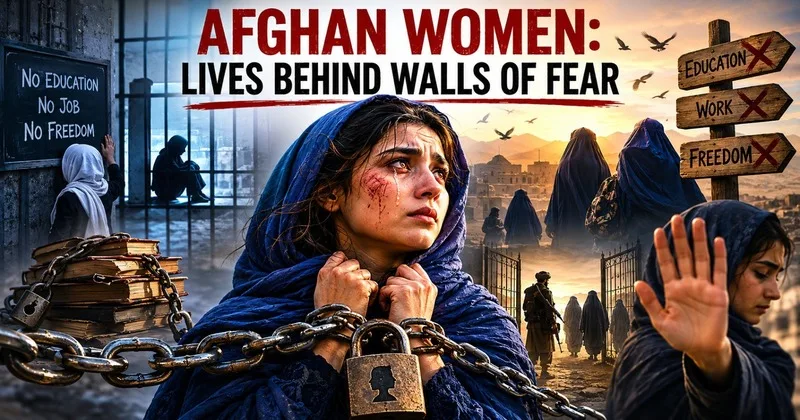
The land of Afghanistan was once known for its education, culture and women’s participation. In the classrooms of Kabul University, young women dreamed of becoming doctors, engineers and journalists; however, following the Taliban’s return to power in August 2021, this dream gradually dissolved into a terrifying darkness. Today, Afghanistan has become a nation where women’s rights are being systematically crushed more thoroughly than anywhere else in the world.
The new 31-article family law, implemented by the Taliban on May 17, 2026, stands as the latest example of this repressive ideology. Under this law, a young woman’s “silence following puberty is deemed as consent to marriage” and fathers and grandfathers have been granted the authority to arrange child marriages. This legislation serves as an overt ideological declaration aimed at erasing women’s independent identities.
Indeed, numerous events unfolding between 2021 and 2026 clearly demonstrate that the Taliban regime, while curtailing women’s freedoms, is also systematically excluding them from public life, education, employment, culture and even basic human dignity.
The Greatest Assault on Education
The Taliban first targeted women’s education. In December 2022, a ban was imposed on women’s admission to universities. Armed guards turned female students away at the university gates. Subsequently, these restrictions became progressively more severe. In December 2024, in the province of Herat, girls above the sixth grade were barred from attending private educational centres. Even the final remaining avenues for medical and professional education were sealed off.
On December 8, 2024, a ban was further imposed on women’s admission to medical institutions. In retrospect, this decision has precipitated a severe health crisis within the country. In a conservative society like Afghanistan, there is a critical need for female doctors, as many families do not permit male physicians to treat their female relatives. Consequently, the cessation of medical education for women constitutes a direct assault on the health rights of millions of women.
Attempt to Erase Women from the Intellectual Sphere
The Taliban’s objective is not merely to confine women to their homes, but also to eradicate their ideas and intellectual presence. On September 18, 2025, a ban was imposed on 140 books authored by women. Furthermore, 18 academic courses, such as “Women’s Studies,” “Human Rights,” “Gender Development”, and “Sexual Harassment Studies”, were removed from university curricula.
The banned books included significant texts related to sociology, law and journalism. The message was clear: the Taliban seeks to eliminate any form of education or ideology that inspires women toward rights, equality, or independent thought.
Assault on Employment and Economic Independence
Economic independence serves as the bedrock of any individual’s self-reliance. The Taliban has stripped this away from women as well. In December 2024, a ban was imposed on national and international non-governmental organisations (NGOs) that employed women. Orders were issued to dismiss female staff members, accompanied by warnings that licenses would be revoked in the event of non-compliance.
During this same period, measures were initiated to remove female administrative staff from universities. Many female employees were coerced into tendering their resignations. The salaries of female educators were drastically slashed, capping their earnings at a mere 5,000 Afghanis. Consequently, thousands of families were plunged into economic crisis.
Exclusion of Women from Public Life
The Taliban regime has all but obliterated women’s presence in public life. Women were barred from entering gyms and public parks. Cafés previously designated exclusively for women were shut down. Restrictions were even imposed on windows in private homes, specifically those through which women could be glimpsed from the outside. The government asserted that the sight of women could give rise to “obscenity.”
Under a 35-article moral code enacted on August 24, 2024, it became mandatory for women to cover their faces, and they were prohibited from travelling without a male guardian. This policy- ostensibly a dress code- is, in reality, a strategy designed to exert absolute control over women’s mobility and social existence.
Silencing Women’s Voices Under the Guise of Religion
The Taliban has restricted even fundamental Islamic religious freedoms on the basis of gender. In October 2024, women were prohibited from reciting the Quran aloud and from performing the ‘Takbir’. The irony lies in the fact that, within Islam, the recitation of the Quran and religious expression are considered the right of every Muslim; yet, under the Taliban’s interpretation, even the sound of a woman’s voice has been deemed “indecent.” This demonstrates that the Taliban’s primary objective is to consolidate patriarchal control.
Discrimination Against Women Even Amidst Disasters
The most brutal impact of the Taliban’s policies has been witnessed during natural disasters. During the earthquake of 2025, due to the “prohibition on physical contact” rule, male rescue workers refrained from touching women. Many women remained trapped in the rubble for hours while men and children were evacuated first, a delay that resulted in the deaths of numerous women who could otherwise have been saved in time. The shortage of female doctors and rescue workers further exacerbated the crisis. Many injured women were denied access to hospitals unless accompanied by a male relative. The most critical point here is that all of this is being perpetrated in the name of Islam.
Is This ‘Gender Apartheid’?
The United Nations and international human rights organisations have characterised the situation in Afghanistan as “gender apartheid.” Just as people in South Africa were segregated on the basis of race, women in Afghanistan are being systematically excluded from education, employment, travel, culture and public life. This is not merely a matter of a few draconian rules; rather, it must be recognised as a calculated, organised political project, purportedly Islamic in nature, aimed at controlling the very existence of women.
It is evident from this that whenever power falls into the hands of religious fundamentalists, the freedom of women is the first casualty to be crushed. From schools to workplaces, from libraries to the very windows of their homes, everywhere, a concerted effort is underway to render women invisible. Now, if the international community fails to take serious and concrete action against this “gender apartheid,” Afghanistan is poised to become the symbol of the greatest humanitarian crisis regarding women’s rights in the times to come.
The silence of other Muslim nations, as well as that of the United States and Europe, raises several questions here, particularly at a time when attempts are being made to portray Islam as being in favour of women’s rights. The events currently unfolding against women in Afghanistan are raising profound questions today regarding both Islam and Sharia law.