Saudi-Pakistan-Turkey pact faces question over Islamic divide
August 10, 2026
  • Read Ecopy
  • Circulation
  • Advertise
  • Careers
  • About Us
  • Contact Us
Android AppiPhone AppArattai
Organiser
  • ‌
  • Bharat
    • Assam
    • Bihar
    • Chhattisgarh
    • Jharkhand
    • Maharashtra
    • View All States
  • World
    • Asia
    • Europe
    • North America
    • South America
    • Africa
    • Australia
  • Editorial
  • International
  • Opinion
  • RSS @ 100
  • More
    • Op Sindoor
    • Analysis
    • Sports
    • Defence
    • Politics
    • Business
    • Economy
    • Culture
    • Special Report
    • Sci & Tech
    • Entertainment
    • G20
    • Azadi Ka Amrit Mahotsav
    • Vocal4Local
    • Web Stories
    • Education
    • Employment
    • Books
    • Interviews
    • Travel
    • Law
    • Health
    • Obituary
  • Subscribe
    • Subscribe Print Edition
    • Subscribe Ecopy
    • Read Ecopy
  • ‌
  • Bharat
    • Assam
    • Bihar
    • Chhattisgarh
    • Jharkhand
    • Maharashtra
    • View All States
  • World
    • Asia
    • Europe
    • North America
    • South America
    • Africa
    • Australia
  • Editorial
  • International
  • Opinion
  • RSS @ 100
  • More
    • Op Sindoor
    • Analysis
    • Sports
    • Defence
    • Politics
    • Business
    • Economy
    • Culture
    • Special Report
    • Sci & Tech
    • Entertainment
    • G20
    • Azadi Ka Amrit Mahotsav
    • Vocal4Local
    • Web Stories
    • Education
    • Employment
    • Books
    • Interviews
    • Travel
    • Law
    • Health
    • Obituary
  • Subscribe
    • Subscribe Print Edition
    • Subscribe Ecopy
    • Read Ecopy
Organiser
  • Home
  • Bharat
  • World
  • Operation Sindoor
  • Editorial
  • Analysis
  • Opinion
  • Culture
  • Defence
  • International Edition
  • RSS @ 100
  • Magazine
  • Read Ecopy
Home World

Islamic NATO or Sunni Bloc? Saudi-Pakistan-Turkey pact faces question over Islam and sectarian divide

The Saudi-Pakistan-Turkey defence pact, dubbed an “Islamic NATO”, is drawing criticism as a Sunni bloc aimed at countering Iran rather than promoting genuine pan-Islamic unity

Dr Vishnu AravindDr Vishnu Aravind
Aug 10, 2026, 07:00 pm IST
inWorld, West Asia, Analysis, Asia, International Edition
Follow on Google News
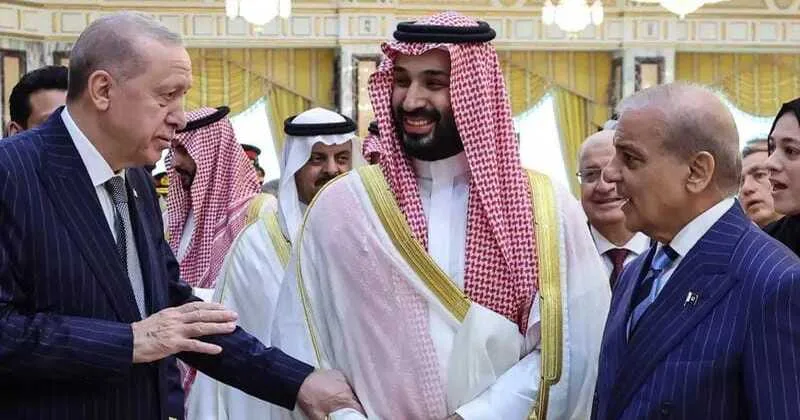
Turkey’s President Recep Tayyip Erdogan, Saudi Crown Prince Mohammed bin Salman, and Pakistan Prime Minister Shehbaz Sharif

Turkey’s President Recep Tayyip Erdogan, Saudi Crown Prince Mohammed bin Salman, and Pakistan Prime Minister Shehbaz Sharif

Facebook
Twitter
WhatsAppTelegramEmail

New Delhi: The recently signed Mecca Joint Defense Agreement linking Saudi Arabia, Pakistan, and Turkey has been touted by its architects as a milestone for pan-Islamic collective security. However, regional analysts and political figures across the West Asia and South Asia are increasingly questioning the validity of the pact. Rather than representing a unified, trans-regional “Islamic NATO,” critics argue that the accord is little more than a sectarian-tinged Sunni bloc directed against Shia Iran, further entrenching the deep-seated divisions that prevent any genuine solidarity across the Islamic world.

Sectarian alignments masked as collective security

While officials in Riyadh, Islamabad, and Ankara insist the trilateral arrangement is intended purely for “collective deterrence” and regional stability, the geopolitical realities on the ground suggest a far more partisan objective. By bringing together the West Asia’s richest Sunni monarchy, South Asia’s terror Sunni power, and NATO’s Sunni military force, the treaty effectively draws a tight security perimeter around Tehran.

Rather than transcending historic sectarian fractures, critics contend that the alliance formalizes them. Political commentators argue that calling the arrangement an “Islamic NATO” ignores the exclusion of major non-Sunni powers in the Muslim world, most notably Iran.

The narrative of a united Islamic defense front crumbles under the weight of historic theological and political rivalry, revealing a coalition driven by sectarian balancing and realpolitik rather than broad-based religious alignment.

Denunciations from Tehran to Islamabad

Reactions against the tri-nation pact were swift, highlighting how the pact deepens mistrust rather than fostering unity. Speaking out against the treaty, Ebrahim Rezaei, a member of the Iranian Parliament’s National Security and Foreign Policy Commission, sharply dismissed the strategic utility of the alignment for Riyadh. “The Saudis should know that a paper agreement with Turkey and Pakistan will not bring them security, just as years of one-sided ‘milking’ by the Americans did not bring them security,” Rezaei stated publicly, urging Riyadh to stop trying to “beg for security from others”.

Iran's FM Spox. Esmail Baghaei on the Mecca Agreement:

There is no reason for us to be concerned that this pact between the two neighboring countries of Türkiye and Pakistan, as well as Saudi Arabia—three countries with which we share deep religious, historical, and… pic.twitter.com/L0I6tJzb9b

— Clash Report (@clashreport) August 10, 2026

Criticism was not restricted to Tehran. Prominent diplomatic voices within the member nations themselves expressed deep skepticism regarding the pact’s substance. Husain Haqqani, former Pakistani Ambassador to the United States and a high-ranking diplomat, dismantled the concept of a grand military alliance, characterizing the deal as fundamentally flawed. “The Saudi-Turkiye-Pakistan Mutual Defence Agreement is more symbolic than substantive,” Haqqani noted. “A shared enemy is the first element of a mutual defence agreement and that is absent here. It might enhance intelligence sharing and joint munitions production, but it will not be the ‘Muslim NATO’ some people are talking about”.

Also Read: Trump Restricts Birthright Citizenship: US constitution & SC rulings vs President’s protectionism amid fierce backlash

Haqqani further stressed that the divergent national security priorities of Islamabad, Ankara, and Riyadh make a unified defense architecture virtually impossible, stating that “joint defense is generally against a common enemy. If there is no common enemy, then defensive cooperation may exist, but not joint defense.”

Strategic divergence and the illusion of unity

The fundamental flaw in viewing the tri-nation pact as an overarching military bloc lies in the starkly conflicting agendas of its signatories. Pakistan remains consumed by its border disputes with India and internal instability. Turkey’s defense policy remains bound to its commitments to Western partners in NATO and Saudi Arabia remains primarily focused on countering Iranian influence and protecting its critical infrastructure.

This absence of a shared global strategy illustrates why pan-Islamic security concepts consistently collapse into narrow self-interest. Rather than creating a stable, self-reliant defense network, the Mecca agreement highlights the structural instability of coalition-building along sectarian lines. As long as regional powers prioritize containment of their neighbors over genuine regional integration, the notion of a single, unified “Islamic NATO” will remain a geopolitical myth, replaced instead by fragile, transactional pacts that aggravate existing fault lines.


Topics: Saudi ArabiaWest Asia ConflictShia-Sunni divideSaudi-Pakistan-Turkey Security PactIslamic NATOPakistanIranTurkey
Share
Tweet
SendShareSend
✮ Subscribe Organiser YouTube Channel. ✮
✮ Join Organiser's WhatsApp channel for Nationalist views beyond the news. ✮
Previous News

India condemns attack on Embassy in Slovenia; MEA invokes Vienna Convention, affirms diplomatic premises as inviolable

Next News

Commonwealth Games 2026: Over to Amdavad

Related News

Armed Security Personnel

Khyber Pakhtunkhwa Violence: Policemen killed in Lakki Marwat; two tribal elders shot dead in South Waziristan

UN raises concern over poll violence in PoJK

PoJK: UN flags concern over poll violence amid Pakistan’s crackdown on peaceful protesters in the occupied territory

PoJK: The call for unfinished justice and India’s unwavering resolve to secure sovereignty

Sarsanghchalak Dr Mohan Bhagwat addresses Gen Z students

Sarsanghchalak Dr Mohan Bhagwat on Pak, China ties: Conflict may halt relations, but permanent hatred isn’t a solution

MEA slams Pakistan over its Youm-e-Istehsal campaign as a propoganda machine

MEA slams Pakistan’s Youm-e-Istehsal campaign as “malicious propaganda”; Echoes Kashmir as integral to India

Pakistan Tightens Media Censorship: Foreign Journalists Need NOC to Report Beyond Major Cities (This image is generated by AI)

Pakistan moves to silence global media after PoJK crackdown: NOCs mandatory for foreign journalists

Load More

Latest News

President of the Indian Olympic Association President P. T. Usha holds the Commonwealth Games flag alongside Gujarat Deputy Chief Minister Harsh Sanghavi and Neeraj Chopra during the closing ceremony of the Commonwealth Games 2026 at the OVO Hydro in Glasgow

Commonwealth Games 2026: Over to Amdavad

Turkey’s President Recep Tayyip Erdogan, Saudi Crown Prince Mohammed bin Salman, and Pakistan Prime Minister Shehbaz Sharif

Islamic NATO or Sunni Bloc? Saudi-Pakistan-Turkey pact faces question over Islam and sectarian divide

MEA condemns defacement of the Indian Embassy premises in Slovenia

India condemns attack on Embassy in Slovenia; MEA invokes Vienna Convention, affirms diplomatic premises as inviolable

(Left) RSS Sarsanghchalak Dr Mohan Bhagwat (Right) RSS Sarkaryavah Dattatreya Hosabale

RSS Akhil Bharatiya Samanvay Baithak to be held in Visakhapatnam from August 19–21, 2026

US President Donald Trump seals executive order restricting birthright citizenship

Trump Restricts Birthright Citizenship: US constitution & SC rulings vs President’s protectionism amid fierce backlash

Kerala's Left-Liberals Manufactured 'Rape Call' Lie Against TG Mohandas: What He Actually Said About CJP NEET Protest?

Kerala’s Left-Liberals Manufactured ‘Rape Call’ Lie Against TG Mohandas: What He Actually Said About CJP NEET Protest

Two decades after Mamata Banerjee drove Tata out of Singur, Bengal is now seeking the industrial giant's return. (AI-generated Image)

From ‘Tata go back’ to ‘Tata come back’: Bengal begins undoing Mamata’s Singur disaster

T G Mohandas

Keralam’s Witch Hunt Against TG Mohandas? Weekend arrest, media drama & Congress’ political spectacle

Ex-JPSC Chairman L Khiangte arrested as students intensify protest

JPSC-JSSC Exam Row: Ex-JPSC Chairman L Khiangte arrested as students intensify protest

Former MP Shahid Siddiqui

RSS School Controversy: Shahid Siddiqui faces backlash over claims that Northeast girls are trained to hate minorities

Load More
  • Privacy
  • Terms
  • Cookie Policy
  • Refund and Cancellation
  • Delivery and Shipping

© Bharat Prakashan (Delhi) Limited.
Tech-enabled by Ananthapuri Technologies

  • Home
  • Search Organiser
  • Bharat
    • Assam
    • Bihar
    • Chhattisgarh
    • Jharkhand
    • Maharashtra
    • View All States
  • World
    • Asia
    • Africa
    • North America
    • South America
    • Europe
    • Australia
  • Editorial
  • Operation Sindoor
  • Opinion
  • Analysis
  • Defence
  • Culture
  • Sports
  • Business
  • RSS @ 100
  • Entertainment
  • More ..
    • Sci & Tech
    • Vocal4Local
    • Special Report
    • Education
    • Employment
    • Books
    • Interviews
    • Travel
    • Health
    • Politics
    • Law
    • Economy
    • Obituary
  • Subscribe Magazine
  • Read Ecopy
  • Advertise
  • Circulation
  • Careers
  • About Us
  • Contact Us
  • Policies & Terms
    • Privacy Policy
    • Cookie Policy
    • Refund and Cancellation
    • Terms of Use

© Bharat Prakashan (Delhi) Limited.
Tech-enabled by Ananthapuri Technologies