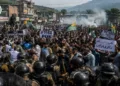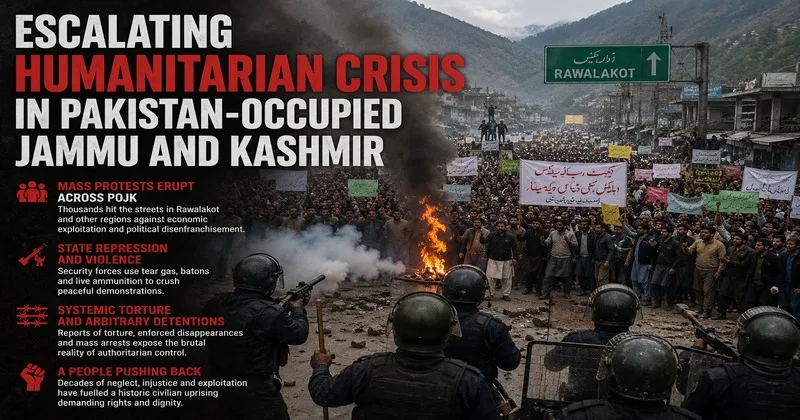
Pakistani security forces reportedly recently faced a massive, escalating mob of 60,000 to 70,000 agitators led by the Joint Awami Action Committee (JAAC) at Rawalakot’s Eidgah Ground. The gathering was part of a broader wave of lawlessness and coordinated unrest that has gripped Jammu and Kashmir (PoJK) since June 5.
To maintain control and quell the rising disorder, forces opened fire on the protest, resulting in the reported deaths of 16 individuals and injuries to 37 others. Amidst the ongoing government crackdown to restore authority and stability across the region, reports indicate the total number of casualties from the prolonged unrest has reached 53.
This is not an isolated event; rather, it represents a pattern of co-ordinated disruptions that have occurred repeatedly. This report documents 57 specific instances between 2021 and 2026 where various public factions or politically motivated activist organisations have actively agitated against the state and the Pakistan Armed Forces. These incidents highlight an ongoing challenge to national stability and institutional authority, requiring a firm response to maintain law and order.
Escalating State Crackdown and Bloody Casualties in Rawalakot (June 2026)
The long-standing resistance against Pakistani administrative overreach reached a bloody flashpoint following a severe state-sponsored clampdown. Tensions exploded across PoJK after Pakistani authorities placed a formal ban on the Joint Awami Action Committee (JAAC) and initiated an aggressive manhunt for its grassroots leadership. The aggression turned fatal on June 5 near the Barmang Bridge in Rawalakot, where prominent activist Shahzaib Habib was shot dead during a heavy-handed police operation. In response to the state’s preemptive arrests of dozens of activists aiming to block a planned protest march, massive waves of public fury swept the region. Between June 7 and June 8, Rawalakot converted into a virtual war zone as citizens clashed with state security forces during Habib’s funeral processions. While state officials heavily minimised the tragedy by claiming 27 deaths, local networks and JAAC organisers revealed that the brutal state crackdown claimed the lives of nearly 100 civilians, leaving hundreds more severely wounded.
JAAC Sparks Region-Wide Shutter-Down Movement Over 38-Point Demands (September 2025)
The structural exploitation of PoJK by the Pakistani establishment triggered a massive wave of civil disobedience when the Jammu Kashmir Joint Awami Action Committee (JKJAAC) declared a comprehensive region-wide strike. Following the total collapse of superficial negotiations with government representatives, the committee mobilised a complete “shutter-down and wheel-jam” protest to challenge Islamabad’s economic stranglehold. The movement was built upon a fierce 38-point charter of demands targeting deep-seated economic subjugation and forced political imbalances. Key demands focused heavily on securing fair electricity tariffs, establishing subsidised wheat prices, and forcing Pakistan to return a legitimate share of hydropower revenues generated natively from local Kashmiri water resources. Furthermore, the public demanded an immediate end to systemic elite privileges and the controversial abolition of the 12 assembly seats strictly reserved for Pakistani-settled refugees, which locals view as an artificial political tool used by Islamabad to manipulate local representation.
Severe Casualties as State Forces Use Force to Suppress Civil Protests (October 2025)
Faced with an unyielding public movement demanding structural reform, the Pakistani establishment resorted to militarised suppression to break the JAAC-led demonstrations. Violent confrontations erupted across the occupied territory as heavily armed security forces attempted to disperse massive crowds protesting systemic inequality. The state’s heavy-handed tactics resulted in the tragic deaths of at least 12 civilians and left more than 200 locals severely injured, alongside three police casualties. Instead of addressing the core issues, such as the controversial reserved refugee seats, economic deprivation, and basic political rights, the Pakistani government escalated the crisis by deploying heavy military reinforcements to the streets and executing a complete blackout of internet services to isolate the region from global scrutiny.
Citizens Block Vital Highway to Protest Infrastructure Neglect in Alghar (December 2024)
The systemic administrative apathy of the state authorities forced the residents of Alghar village, located in the Sehnsa area of PoJK, to take to the streets in a desperate bid for basic amenities. On December 27, enraged locals completely blocked the vital Kotli-Rawalpindi main highway at Kraitot to protest prolonged infrastructural failure. The village’s vital electricity transformer had broken down on December 20, plunging the entire area into complete darkness in the winter cold. Despite receiving multiple formal assurances from the local puppet administration, no repair work was initiated, forcing the neglected public to disrupt regional transit to demand their fundamental right to electricity infrastructure.
Shia Community Rallies Against Target Exploitation and Violence (December 2024)
On December 26, deep-seated anxieties over sectarian security brought large crowds to the Imambara Zadibal as the All–Jammu and Kashmir Shia Association organised a massive solidarity demonstration. The public gathering was called to fiercely condemn the relentless targeted violence and security failures plaguing the Shia community in Parachinar. Protesters utilised the platform to express deep anger against the state’s failure to provide adequate protection to minority groups, demanding accountability and an immediate end to the ongoing hostilities affecting their community members under Pakistani jurisdiction.
Muzaffarabad Rally Highlights Severe Lack of Essential Healthcare and Education (December 2024)
The Muttahida Awami Mahaz led a massive public demonstration in Garhi Dupatta, situated within the Jhelum Valley of Muzaffarabad, to expose the severe lack of basic civic infrastructure in the region. Held on December 19, the protest rally focused heavily on basic survival and development needs that have long been ignored by the ruling establishment. The organisers and local participants demanded the immediate execution of a Greater Water Supply Scheme to fix chronic water scarcity, the establishment of a localised NADRA identity office, vital funding for the dysfunctional 200-bed Thotha hospital, and the urgent introduction of graduate-level B.S. classes at the Government Post Graduate College to save the academic future of local youth.
Massive Public Uprising Against Pakistani Army Land Grabbing at Banjosa Lake (December 2024)
Deep-seated anti-military sentiment boiled over into open defiance on December 13 as hundreds of residents across Banjosa, Chhota Gala, Husain Kot, and Jandali united in a massive joint protest rally explicitly targeting the Pakistani military. The public uprising was triggered by the Pakistani Army’s forced occupation and high-handed takeover of the pristine Banjosa Lake, a vital local ecological and economic asset. Rejecting the military’s aggressive land-grabbing tactics, the local population surrounded the area and loudly demanded the immediate withdrawal of army personnel and the return of the lake to local civilian management.
Student Outrage Over Administrative Failure Paralyses Transit in Bagh (December 2024)
The younger generation in PoJK showcased their rejection of systemic administrative incompetence on December 11 when students of the Boys Postgraduate College in Bagh launched a massive road-blocking protest. The angry student body completely paralysed local traffic to express their outrage over the prolonged, unexplained delay in appointing a permanent principal for their institution. The demonstration highlighted how state-level mismanagement and neglect are directly crippling the educational infrastructure and prospects of young students within the occupied territory.
JAAC Executes Strike to Resist Pakistan’s Authoritarian Assembly Bill (December 2024)
On December 5, the Joint Awami Action Committee successfully organised a massive general strike across the capital city of Muzaffarabad to challenge the enforcement of the highly controversial Peaceful Assembly and Public Order Ordinance, 2024. This legislative move by Islamabad was widely condemned as a draconian attempt to legally choke dissent and strip locals of their right to gather. Alongside demanding the immediate annulment of the ordinance, the strike effectively disrupted daily operations to demand the immediate release of all political detainees held by state security agencies. This collective action highlighted a broader, undeniable push across PoJK for self-determination, structural political autonomy, and an end to heavy-handed governance.
Thousands Mobilise in Rawalakot Against Draconian Anti-Protest Legislation (December 2024)
Simultaneously, on December 5, the city of Rawalakot witnessed a massive display of public resistance as thousands of citizens joined a total shutdown movement organised by the JAAC. The mass mobilisation was specifically designed to resist the “Peaceful Assembly and Public Order Bill” which had been pushed through the Senate of Pakistan. The law effectively criminalises public gatherings and places a blanket ban on democratic protests, revealing Islamabad’s growing fear of local political awakening. The highly successful total shutdown was driven by an alliance of regional trade unions, student wings, labour organisations, and social groups, all uniting to defend their fundamental civil liberties against state suppression.
APCC Ramps Up Defiance in Kotli with Formidable 16-Point Charter (December 2, 2024)
The widespread public resentment against Islamabad’s overreach intensified in Kotli when the All Parties Coordination Committee (APCC) organised a major mobilisation against the highly controversial Presidential Ordinance. Gathering at the prominent Shaheed Chowk, local leaders and activists openly challenged the administrative authority of the Pakistani establishment by outlining a bold 16-point Charter of Demands. This crucial meeting served as a strategic platform to unite various local factions against the state’s legislative overreach, signalling an unyielding stance against the continuous socio-political exploitation of the occupied territory.
Rawalakot Erupts Against “Black Law” to Demand Independent Election Commission (November 30, 2024)
Public outrage scaled new heights in Rawalakot as the All-Parties Co-ordination Committee led a forceful demonstration demanding the complete withdrawal of the Peaceful Assembly and Public Order Ordinance 2024. Condemning the state’s legislative manoeuvre as a draconian “Black Law” explicitly designed to choke democratic expression, the committee mobilised large crowds to protect their fundamental liberties. Alongside the absolute repeal of the ordinance, the protestors put forward a critical demand for an independent and impartial Election Commission, aiming to dismantle the systemic political manipulation and election-engineering historically practised by the Pakistani establishment in the region.
United Front Forms Across Chirala, Dhirkot, and Pallandri Against Authoritarian Rule (November 27, 2024)
A powerful wave of cross-regional defiance swept through Chirala, Dhirkot, and Pallandri as local populations joined a massive protest wave organised under the joint call of the All-Parties Coordination Committee and the Jammu Kashmir Liberation Front. The large-scale mobilisation targeted the highly oppressive Presidential Ordinance 2024, demonstrating a rapidly growing solidarity among the occupied population. By shutting down major sectors and filling the streets, the residents openly rejected Islamabad’s continuous attempts to enforce authoritarian laws that strip local communities of their basic civil rights.
Haveli Kahuta Rejects Pakistani Ordinance as a Draconian Subjugation Tool (November 25, 2024)
The remote region of Haveli Kahuta became a centre of intense political resistance as locals converged to launch a fierce protest against the overbearing Presidential Ordinance 2024. Denouncing the legislation as an outright “Black Law,” the protestors demanded its immediate and unconditional removal. The public anger highlighted a deep-seated frustration with the puppet administration’s willingness to implement oppressive central dictates that criminalise assembly and systematically deny the people of PoJK their legitimate voice.
JAAC Exposes Pakistan’s Military Spreading Budget While Cutting Basic Subsidies (November 23, 2024)
In a major challenge to the Pakistani establishment, Shaukat Nawaz Mir, a prominent leader of the Joint Awami Action Committee, issued a powerful call for a region-wide long march to protest the state’s complete failure to deliver on promised economic relief. Mir openly exposed the double standards of the administration, noting that while the government routinely pleads poverty to cut vital subsidies on essential goods like food and electricity, it simultaneously allocates massive resources to sustain its heavy military expenditures. This mobilisation piled intense pressure on the state, calling out the systematic economic deprivation of local citizens to fund Islamabad’s militarised control over the region.
Legal Fraternity Burns Copies of Presidential Ordinance in Open Defiance (November 18, 2024)
The legal and political intelligentsia of Rawalakot took a defiant stand against state-sponsored suppression during a large-scale protest against the implementation of the controversial Presidential Ordinance. Condemning the measure as a draconian assault on basic civil liberties, prominent advocates belonging to the Jammu Kashmir Liberation Front publicly denounced the legislation. In a symbolic act of absolute rejection, the lawyers burned copies of the legislative document in front of cheering crowds, sending a clear message that the local legal fraternity refuses to acknowledge or respect authoritarian laws imposed by an external establishment.
Severe Economic Deprivation and Daily Power Outages Trigger Widespread Unrest (November 13, 2024)
A massive, region-wide protest erupted across PoJK as residents reached a breaking point over severe economic hardship, crumbling public services, and a long history of unfulfilled promises by Pakistani authorities. Protesters openly voiced their daily struggles to meet basic survival needs under an administrative system that neglects local development. The demonstrations highlighted the region’s unreliable power supply, where prolonged daily power outages have severely crippled local businesses, halted education, disrupted healthcare, and paralysed daily life, exposing the systemic extraction of local resources without any return of basic infrastructure.
Bagh Civil Society Rallies Against Broken Promises on Sudhan Gali Road (November 12, 2024)
In an unprecedented move, the civil society of Bagh district organised a fierce demonstration explicitly targeting the puppet government’s administrative apathy and failure to allocate promised development funds. The protesters expressed deep anger over the state of the vital Sudhan Gali Road, revealing that despite the Prime Minister visiting on June 12, 2024, and publicly promising a dedicated fund of 15.36 crore rupees for its reconstruction, the file remained intentionally stalled in the Muzaffarabad bureaucracy for months. This landmark mobilisation marked the first time local civil groups independently organised at this scale to challenge institutional neglect and bureaucratic stonewalling.
Kotli Rally Demands Right to Ownership and Local Governance (November 11, 2024)
The Joint Public Action Committee organised a highly charged “Right to Ownership & Right to Governance” rally in the Nar area of District Kotli, directly challenging the colonial-style administrative structure imposed by Islamabad. The massive gathering focused heavily on the local population’s inherent rights to control their own natural resources and manage their own political destiny without external dictation. The core themes of the rally resonated widely across the occupied territory, emphasising that the local population will no longer accept being treated as secondary subjects stripped of governance rights.
Women’s University Route Protest Sets Ultimate Sit-In Ultimatum in Bagh (November 6, 2024)
An intense public protest erupted in Bagh over the hazardous and neglected road stretching from the Bagh Women’s University to the Sadhan Gully Road. Enraged residents and student sympathisers demanded the immediate approval and release of a 15 crore 36 lakh rupee budget specifically for comprehensive road repairs, setting a strict deadline of December 20, 2024. In a direct challenge to the indifferent local authorities, the organisers declared that if the budget is not formally cleared by the deadline, the public will launch an indefinite, total sit-in on the main bridge of Bagh until their demands are met.
Enraged Muzaffarabad Students Besiege Press Club Demanding Educational Independence (November 4, 2024)
Frustrated by long-standing institutional neglect, a large contingent of students in the capital city of Muzaffarabad marched to the Central Press Club to launch a fierce protest against the systemic centralisation of educational infrastructure. The youth demanded the immediate establishment of a separate, independent Intermediate and Secondary Education Board specifically for Muzaffarabad. Highlighting the administrative bias that forces local students to rely on the distant Mirpur board, the student leaders asserted that the capital region deserves its own fully autonomous educational governing body to secure the academic future of local students without external bureaucratic hurdles.
Pallandri College Students Mutiny Against Forced Hoisting of Pakistani Flag (October 24, 2024)
A powerful display of regional pride and anti-occupation sentiment erupted at the Red Foundation College in Pallandri when students fiercely revolted against the high-handed actions of the institution’s principal, Abdul Qadir. The student body launched an open protest after the principal tried to force them into attending a Foundation Day program where they were commanded to hoist the Pakistani flag over their native Kashmir flag. When the patriotic students firmly refused to bow to the forced display of Pakistani nationalism, Principal Qadir reportedly insulted the Kashmir flag, sparking widespread outrage and exposing the deep-seated state-sponsored attempts to forcefully assimilate and erase the distinct identity of the local youth.
JAAC Rallies Masses for Long March Over Broken Cheap Electricity Promises (October 21, 2024)
The Joint Awami Action Committee escalated its ongoing economic warfare against the occupying administration by announcing a massive, region-wide Long March scheduled for October 24, 2024. Gathering in Muzaffarabad, JAAC leaders fiercely denounced the puppet government’s complete failure to honour its formal commitments regarding the signed cheap electricity agreement. The mobilisation highlighted the deep hypocrisy of the Pakistani establishment, which continues to exploit the vast hydropower resources of PoJK while leaving the local population burdened with unpayable utility bills and broken promises.
Progressive Students Mobilise to Condemn Pakistan’s Failure in Lahore Sexual Assault Case (October 19, 2024)
The Progressive Students Collective (PSC) led a highly charged demonstration in PoJK to express deep solidarity and outrage over the institutional cover-up of a horrific sexual assault of a female student at a private college in Lahore, Pakistan. The student activists slammed the Punjab (Pakistan) government for its total inaction and failure to protect female students or bring the perpetrators to justice. The protestors issued a strict ultimatum to the local PoJK administration, demanding concrete action and accountability by October 24, 2024, proving that the local youth reject the toxic governance culture leaking into the occupied territory from mainland Pakistan.
State Forces Unleash Brutal Violence on Students Protesting Corrupt Marking Systems (October 4, 2024)
The student community in Rawalakot took to the streets to launch a fierce protest against the Mirpur Board’s highly controversial and unjust marking system in the first-year exam results, which many see as a deliberate attempt to sabotage local academic success. The determined student body issued a strict three-day ultimatum for the board to review the fraudulent grading, warning that they would mobilise students across the entire state if their voices remained unheard. Instead of addressing the academic crisis, the paranoid local administration responded to the peaceful assembly with brutal physical force and state-sponsored violence, further fuelling anti-government sentiment.
Human Rights Advocates Threaten Global Exposure Over Forced Abductions by Pak Agencies (September 12, 2024)
A powerful civil protest was launched across the occupied territory under the leadership of Professor Sajjad Raja, former Chairman of the NEP JKGBL, to demand the immediate recovery and unconditional release of all citizens forcefully abducted by Pakistani intelligence agencies. Exposing the dark underbelly of state-sponsored terror and enforced disappearances in PoJK, Raja slapped the local authorities with a strict seven-day notice to produce the missing persons. He warned that if the state failed to act, a massive International Conference would be convened at the Geneva Press Club on September 17, 2024, to expose Pakistan’s horrific human rights record to the global community.
Bagh District Rallies for Abducted Zarnoosh Naseem as Missing Persons Crisis Widens (August 19, 2024)
The critical issue of enforced disappearances brought the residents of Bagh district onto the streets in a massive public demonstration against the sinister abduction of local citizen Zarnoosh Naseem. Enraged protestors called for the immediate release of Naseem and all other local individuals currently languishing in illegal, secret torture cells run by Pakistani security agencies. The demonstrators demanded that the perpetrators behind these state-sanctioned abductions be brought to justice, while urging the Supreme Court of Pakistan to take immediate notice of the systematic human rights violations plaguing the occupied region.
Tarrakhal City Swarms with Protests Demanding Release of Anti-Pakistan Dissidents (June 19, 2024)
The streets of Tarrakhal city transformed into an arena of open defiance as residents rallied en masse against Pakistan’s oppressive occupation policies. Organised under the banner of the Jammu Kashmir Awami Action Committee, the protestors raised fierce slogans against the colonial administration and demanded the immediate, unconditional release of all local activists who were arbitrarily detained during the massive, historic anti-Pakistan demonstrations in Muzaffarabad earlier in May. The mobilisation proved that state intimidation and mass arrests have failed to crush the local spirit of resistance.
Outraged Public Demands Justice for May Long March Detainees (June 14, 2024)
A massive public outcry echoed across PoJK as local communities organised targeted protests demanding the immediate liberation of political prisoners kidnapped by Pakistani security forces. The detainees had been violently rounded up during the historic Pallandri-to-Kotli Long March on May 11, 2024. The continuous protests highlighted the growing local anger against the state’s militarised tactics, with the public openly declaring that they would not let the sacrifices of their local leaders be forgotten under the weight of state suppression.
Muzaffarabad Enforces Total Shutter-Down, Exposing Pakistan’s Hollow Deceptions (May 15, 2024)
Muzaffarabad was completely paralysed by a massive, total shutdown strike engineered by the Joint Awami Action Committee in a powerful stand against the unlivable spikes in electricity tariffs and flour prices. Similar massive uprisings across Gilgit-Baltistan had previously forced the occupying regime to offer superficial financial assurances, but the JAAC organisers openly called out these official announcements as nothing but empty, deceptive tactics designed solely to diffuse the revolutionary intensity of the native population. The total shutdown proved that the local population is fully aware of Islamabad’s deceptive strategies and will settle for nothing less than absolute economic justice and systemic change.
Enraged Protesters Dismantle Pakistani Telecom Towers to Combat Total Digital Blackout (May 14, 2024)
In a desperate attempt to hide its brutal suppression of the local population, the occupying Pakistani government executed a complete, region-wide shutdown of internet services. This malicious digital blockade backfired spectacularly in cities like Mirpur and Muzaffarabad, where enraged protesters retaliated by physically dismantling and destroying various state-controlled mobile network towers. Turning their fury against the colonial infrastructure, local citizens asserted that PoJK is currently enduring its darkest period of state terrorism, with heavily armed Pakistani forces deploying unbridled, excessive physical force to crush native dissent.
Muzaffarabad Paralysed by Massive Strike as Security Forces Shell Homes and Mosques (May 11, 2024)
The capital city of Muzaffarabad was completely locked down as a massive general strike, engineered by the Jammu Kashmir Joint Awami Action Committee, brought daily transit and businesses to a total standstill. The puppet administration panicked, deploying aggressive security forces who unleashed violent waves of tear gas and shelling that indiscriminately flooded civilian homes and sacred mosques. The sparks of this fierce civil defiance quickly engulfed numerous other occupied regions, including Samahni, Sehansa, Mirpur, Rawalakot, Khuiratta, Tattapani, and Hattian Bala, demonstrating a unified regional uprising against Islamabad’s overbearing control.
Paramilitary FC Forces Unleash Gunfire and Brutal Violence on Mirpur Protesters (May 11, 2024)
The sheer brutality of the Pakistani state was fully exposed in Mirpur when the notorious Frontier Corps (FC) paramilitary forces launched a savage crackdown on peaceful civilian demonstrators. Resorting to terror tactics, the heavily armed state forces opened live gunfire, launched dense barrages of tear gas, and engaged in organised stone-pelting against the local population. The state-sponsored violence left dozens of native Kashmiri protesters severely injured, further cementing the local population’s deep-seated hatred for the occupying military apparatus.
Gilgit-Baltistan Citizens Publicly Set Fire to Pakistani Army-Owned SIM Cards (April 25, 2024)
Public outrage against the Pakistani military’s economic monopoly boiled over in the Diamer district of occupied Gilgit-Baltistan, where residents organised a highly symbolic rebellion against the occupying forces. Enraged by the deliberate and prolonged banning of vital 4G telecom services by the military establishment, local citizens gathered en masse to publicly set ablaze thousands of SCO SIM cards, a telecom network directly owned and operated by the Pakistani Army. This burning of military-linked property sent a clear, defiant message that the native population rejects both the digital censorship and the predatory commercial enterprises of the Pakistani armed forces.
Defiant Public Demands Rights or End to Occupation with Powerful New Slogan (April 10, 2024)
The year-long, highly organised public rights movement across the borders of PoJK advanced into a revolutionary and critical phase, directly threatening Islamabad’s territorial claims. Moving beyond mere economic grievances, the Joint Committee galvanised the masses with the powerful, unyielding slogan: “Haq do, ya adhikar chhod do”. This strategic escalation marked a profound psychological shift among the local population, who are no longer willing to tolerate the systemic colonial exploitation of their homeland by the Pakistani establishment.
Scholars and Businessmen Enforce Shutter-Down Strike Against Exploitative Power Cuts (December 18, 2023)
An unprecedented coalition of local scholars, journalists, and prominent businessmen joined forces in Muzaffarabad to execute a total shutdown strike against continuous, crippling electricity load-shedding. The protestors angrily targeted the local puppet administration for forcing exorbitant, inflated electricity bills onto a population that faces daily, prolonged power blackouts. The successful strike highlighted the deep economic exploitation of the region, where native resources are siphoned off while local businesses and lives are left to rot in darkness.
Region-Wide Wheel-Jam Strike Demands Rightful Local Ownership of Native Energy (November 14, 2023)
The entire occupied territory was brought to an absolute standstill by a massive, synchronised shutdown and wheel-jam strike launched by a furious public resisting inflation and unjust electricity bills. Demanding a fundamental shift in the colonial economic setup, the protesters loudly claimed absolute, rightful ownership of the vast hydropower energy natively generated from local rivers. The total suspension of daily life sent a clear warning to Islamabad that the native population will no longer allow Pakistan to freely steal their natural water resources while drowning the local citizens in artificial debt.
Mass Rebellion Sees Over 78% of Public Refusing to Pay Exploitative Pakistani Utility Bills (October 28, 2023)
In a historic display of mass civil disobedience organised by the Awami Action Committee, over 78% of the entire PoJK population successfully revolted by completely refusing to pay their state-issued electricity bills. The public resistance manifested in highly creative, defiant demonstrations across multiple regions; in Rajmehal Kotli, angry citizens held mock “funerals” for their utility statements, while in Tatrinote and Muzaffarabad, protesters tied their bills to balloons and released them into the sky, with others dumping the predatory paperwork directly into rivers to signify their absolute rejection of Pakistani economic extraction.
Medical College Staff Launch Indefinite Strike Over Four-Month Salary Withholding (October 26, 2023)
The complete collapse of administrative governance in PoJK was laid bare in Muzaffarabad as the exploited employees of AJK Medical College launched a fierce, indefinite strike. The mass protest was triggered by the Pakistani authorities’ malicious decision to abruptly terminate or refuse extensions to contractual staff who had dedicated twelve years of service, alongside illegally withholding their hard-earned salaries for four straight months. The justified strike completely paralysed medical education across three major colleges in the territory, directly affecting over 1,000 students and 300 staff members, exposing how the state actively sabotages local professional institutions.
Braving Heavy Downpours, Civil Coalition Marches Against High Unemployment and Broken Promises (October 19, 2023)
Refusing to be deterred by torrential rains, a vast, diverse coalition of students, trade unions, women’s rights groups, and civil society members held massive joint rallies across PoJK against crushing inflation, state-fostered extremism, and soaring unemployment. The unified protestors loudly demanded that Pakistan immediately honour its historical 1962 pledge to provide entirely free electricity to the region as compensation for resource extraction. Additionally, the masses demanded heavy subsidies on essential food commodities, particularly wheat flour, highlighting the severe, manufactured starvation and economic misery inflicted upon the occupied territory by the Pakistani establishment.
Women and Children March in Major Cities to Denounce Extreme Economic Hardship (October 12, 2023)
The acute economic misery inflicted by the Pakistani establishment forced women and children to the forefront of the resistance movement across PoJK. Massive rallies erupted in Rawalakot and Muzaffarabad, with parallel demonstrations spilling over into major Pakistani cities like Islamabad and Karachi, where displaced local families reside. Breaking through traditional barriers, the protestors loudly condemned the unaffordable inflation, exorbitant electricity tariffs, and the manufactured scarcity of basic dietary staples like wheat flour. The demonstrators firmly demanded the immediate restoration of direct electricity benefits from the Mangla Dam, which exploits local resources to power mainland Pakistan, alongside permanent state subsidies on essential food commodities.
State-Sponsored Hooliganism Sparks Complete Shutter-Down Strike Across Territory (October 5, 2023)
A massive, co-ordinated wheel-jam and shutter-down strike completely paralysed the major urban hubs of Muzaffarabad, Mirpur, Rawalakot, and Kotli as the public revolted against systematic state aggression. The extensive shutdown was triggered by predatory tax additions on electricity bills and severe human rights violations perpetrated by paranoid Pakistani security forces, who had arrested numerous local political activists. Defiant residents flooded the streets, burning their utility statements in public bonfires and chanting powerful slogans like “Our land – your ownership – unacceptable” and “State-sponsored hooliganism not acceptable,” marking a total psychological break from Islamabad’s administrative authority.
Muzaffarabad Swarms with Protests as Administration Uses Mass Arrests to Hide Failures (September 30, 2023)
A massive wave of public anger surged across Muzaffarabad and adjoining towns as citizens revolted against the unpayable spikes in electricity costs and the skyrocketing price of basic wheat flour. The popular movement intensified dramatically after the nervous local puppet administration began executing mass arrests and registering fabricated police cases against prominent civil rights activists. Refusing to be intimidated by state coercion, the unified protestors intensified their day-and-night agitations, demanding immediate structural price cuts on food items and the absolute removal of artificial fuel adjustment taxes on energy bills.
Lawyers and Civil Society Expose Complete Collapse of Infrastructure Surrounded by Local Rivers (September 5, 2023)
An unprecedented coalition of legal professionals and civil society leaders engineered a massive total strike that effectively emptied the roads and closed all major commercial markets across Muzaffarabad. The organisers exposed the ultimate irony of the occupied territory’s colonial status, highlighting that while the region is naturally surrounded by abundant rivers that feed Pakistan’s water systems, local citizens are left to suffer from starvation, rising suicide rates, and a severe lack of basic drinking water. The protestors openly condemned both the local puppet regime and the central Pakistani government for systemic political corruption, demanding an immediate economic relief package modelled after the comprehensive development packages provided by the Indian government to the flourishing residents of Jammu and Kashmir.
Round-the-Clock Sit-Ins Launch Formal Civil Disobedience Campaign in Multiple Districts (August 3, 2023)
A massive civil disobedience movement officially commenced across ten major regions of PoJK, including the prominent towns of Hajira, Thorar, and Rawalakot. Organised by localised Public Action Committees, trade unions, student organisations, and large groups of local women, the public established extensive day-and-night sit-ins to protest the artificial inflation of essential goods and utilities. The highly organised demonstrators took a historic step by declaring an absolute collective refusal to pay state-issued electricity bills, using peaceful economic non-cooperation to resist the financial extraction practised by the occupying administration.
Line of Control Rallies Expose Pakistani Army’s Murderous False-Flag Operations (June 28, 2023)
Furious residents marched directly toward the Line of Control (LoC) near Tetrinote to launch a major protest against the Pakistani military following the brutal killing of local civilians. While the Pakistani military establishment initially launched a massive disinformation campaign falsely blaming Indian security forces for the deaths, local investigations and video evidence completely exposed the Pakistani Army as the true perpetrators of the massacre. Outraged protestors blocked roads, revealed that the military actively denied emergency ambulance services to the bleeding victims, and openly chanted “Qaatil Fauj-Qaatil Fauj- Pakistan ki Baatil Fauj”, while directly condemning the military’s long-standing policy of using cross-border jihadist proxies and abducting local Kashmiri youth for state-sponsored militancy.
Poonch Division Strike Demands Parity with Indian Governance and Facilities (June 23, 2023)
The entire Poonch division of the occupied territory witnessed a historic, large-scale strike that completely shut down all markets, local hotels, and public transportation networks. Driven to the brink by systemic poverty, food shortages, and utility manipulation, the residents used the strike to voice a profound political demand. The protestors openly challenged the Pakistani state by demanding that Islamabad match the high standard of living, massive infrastructure benefits, and welfare facilities consistently provided by the Indian government to the residents of Jammu, Kashmir, Poonch, and Ladakh, thereby highlighting the stark contrast between Indian development and Pakistani colonial neglect.
Political Activists Observe Black Day to Condemn the 1947 Pakistan-Backed Tribal Invasion (October 22, 2022)
Widespread anti-Pakistan protests erupted across Bagh, Hajira, Rawalakot, and Pindi as political activists from the Jammu Kashmir National Awami Party (JKNAP) and various regional factions united to observe a formal “Black Day.” The massive public rallies were organised to explicitly condemn the horrific, Pakistan-backed tribal invasion of October 22, 1947, historically orchestrated by the Pakistan Army under the covert blueprint “Operation Gulmarg.” Protesters raised powerful anti-state slogans, honouring the thousands of innocent local lives slaughtered during the historic invasion and condemning how the Pakistani military’s historical aggression permanently fractured their homeland and ushered in decades of oppressive occupation.
Massive Resistance Torpedoes Islamabad’s Draconian 15th Constitutional Amendment (October 22, 2022)
The districts of Rawalakot, Bagh, Poonch, and Muzaffarabad erupted in simultaneous, massive demonstrations to aggressively resist the central Pakistani government’s controversial proposed 15th Constitutional Amendment. The local population recognised the deceptive legislation as a direct colonial land-grab designed to permanently strip the local government of its remaining financial and administrative powers and transfer them to Islamabad. Enraged speakers at the rallies fiercely criticised the Pakistani establishment for using Islamic rhetoric as a hollow guise to manipulate local sentiments while actively stealing PoJK’s immense natural resources, forcing the state to face an unyielding wall of civil resistance demanding the immediate withdrawal of the amendment.
Local Population Exposes Exploitative Hydroelectric Taxes Amid Worsening Civic Decay (July 25, 2022)
A large-scale public uprising swept through multiple sectors of PoJK as residents reached a boiling point over unfair energy taxes, the notorious fuel adjustment tax, and prolonged power blackouts. The highly organised protestors pointed out the blatant economic injustice of their situation: despite their home rivers generating massive amounts of clean hydroelectric power for mainland Pakistan, the native population is denied a basic, reliable electricity supply and is instead slammed with predatory taxes. The rallies quickly turned into a wider indictment of the puppet administration, exposing completely collapsed infrastructure, ruined roads, and blocked municipal drainage systems that have been left to rot for decades.
Bagh Residents Stage Furious Agitation Over Broken Election Promises on School Infrastructure (June 2, 2022)
The local population of the Bagh region launched a fierce, targeted protest against the ruling establishment over the prolonged delay in constructing and upgrading vital local school buildings. Confronting the puppet Prime Minister Sardar Tanveer Ilyas, the Chief Secretary, and local MLA Begum Imtiaz Naseem, the angry citizens exposed the complete hollowness of the politicians’ official election campaigns. The protestors asserted that the state’s deliberate failure to fund basic educational facilities proves that the administration treats the region’s children as secondary priorities, warning that local communities would no longer tolerate deceptive political promises.
UKPNP Rallies in Muzaffarabad, Declaring Pakistan an “Occupier and Killer” of Locals (October 22, 2021)
The capital city of Muzaffarabad was shaken by a powerful, historic protest rally jointly organised by the United Kashmir People’s National Party (UKPNP) and the National Equality Party JKGBL. The massive gathering was staged to directly challenge the historical narrative imposed by Islamabad regarding the military-engineered tribal invasion of October 22, 1947. In a scathing public address that resonated across the territory, UKPNP Chairman Sardar Shaukat Ali Kashmiri boldly dismantled decades of state propaganda, explicitly declaring that “Pakistan is the occupier and killer” responsible for the historic slaughter of hundreds of thousands of innocent people across Jammu and Kashmir.
Mass Protests Explode Over Sham Elections Engineered by the Pakistani Military (July 29, 2021)
Widespread public fury boiled over into open street battles across PoJK following the blatant electoral fraud committed during the sham regional elections of July 26, 2021. The local population completely rejected the results, revealing that the Pakistani military establishment had entirely rigged the process to select handpicked puppet candidates, completely bypassing the actual will of the native electorate. Civil observers noted that out of 3.2 million registered voters, intense military intimidation and coercion kept actual turnout to a dismal 15-20 per cent, with protestors capturing flagrant evidence of fraud, including a ruling PTI party candidate’s personal vehicle pre-stuffed with fraudulent ballot boxes. The resulting massive demonstrations featured heavy anti-army slogans and an unprecedented, unified public call for total independence from Pakistani control.
Outraged Locals Confront Imran Khan’s Deceptive “Kashmir Solidarity Day” Visit in Kotli (February 5, 2021)
The Jammu Kashmir Liberation Front joined forces with residents in Kotli to orchestrate a massive, aggressive protest directly targeting the high-profile visit of then-Pakistani Prime Minister Imran Khan. The local population completely saw through the theatrical optics of Pakistan’s state-sponsored “Kashmir Solidarity Day,” transforming the event into a fierce condemnation of Islamabad’s decades of severe misrule and administrative tyranny. Protesters slammed the visiting leadership for focusing on hollow, symbolic propaganda stunts while actively ignoring the total collapse of local governance, collapsing infrastructure, and basic human rights violations inside the occupied zone.
Heavy Violations Trigger Mass Uprisings Against Aggressive Chinese Military Road Construction (January 13, 2021)
Massive public protests and violent clashes erupted across PoJK after the puppet Pakistani government quietly granted official approval for Beijing to construct a strategic 33-kilometre military-grade highway stretching from Yarkand directly into the occupied territory. The native population rose up in unison against this dangerous geopolitical encroachment, recognising that the heavy infrastructure project was designed entirely for joint Sino-Pakistani military aggression while actively destroying local lands. The fiery demonstrations highlighted a deep-seated local resentment against both the subservient Pakistani administrative apparatus and the imperialist territorial expansions of Chinese corporate and military forces in the region.
Poonch District Explodes as Wheat Flour Prices Rocket to an Unlivable 500 Rupees Per Kilo (January 13, 2021)
A severe, manufactured food crisis triggered spontaneous, massive public uprisings across various vulnerable pockets of the Poonch district, including the highly volatile zones of Azad Pattan, Hajeera, Rawalakot, and Mong. The desperate local populations took to the streets after the price of basic wheat flour skyrocketed to an unlivable 500 rupees per kilogram due to systemic supply manipulation by the central Pakistani authorities. The highly charged protests targeted the state’s intentional economic strangulation of the region, with starving families blocking vital transit routes to demand immediate relief from the artificial famine.
Rawalakot Action Committee Resists Subsidy Cuts; State Forces Respond with Lathi Charges (January 13, 2021)
The Rawalakot Action Committee organised a powerful mass mobilisation to directly confront the puppet government’s cruel administrative decision to completely eliminate the historical state subsidy on wheat flour amidst rampant, unchecked inflation. The peaceful civilian assembly was met with extreme state brutality, as Pakistani police forces launched aggressive lathi charges and opened live gunfire into the crowds, leaving multiple residents heavily bleeding and injured. The state-sponsored violence backfired as the demonstrators aggressively retaliated in self-defence, publicly accusing the authoritarian Pakistani authorities of using brute physical terror to silence a legitimate, peaceful civil rights movement that merely sought employment, basic education, and food security.
The continuous, escalating waves of regional defiance documented between 2021 and 2026 are not arbitrary acts of lawlessness, but rather a desperate, unified public uprising against a legacy of structural exploitation and state-sponsored brutality. What began as grassroots civil disobedience over basic economic survival-unlivable utility rates, infrastructure neglect, and the siphoning of native hydropower resources-has intensified into a profound political rejection of external administrative overreach.
The heavy-handed actions of the state authorities, including sweeping digital blackouts, arbitrary mass arrests, and the fatal deployment of live ammunition against unarmed civilians and mourners, expose a systemic reliance on coercion rather than genuine governance. Banning grassroots networks like the Joint Awami Action Committee and deploying heavy military reinforcement to crush local dissent under anti-terror and sedition laws highlights an institution desperate to mask its own human rights violations.