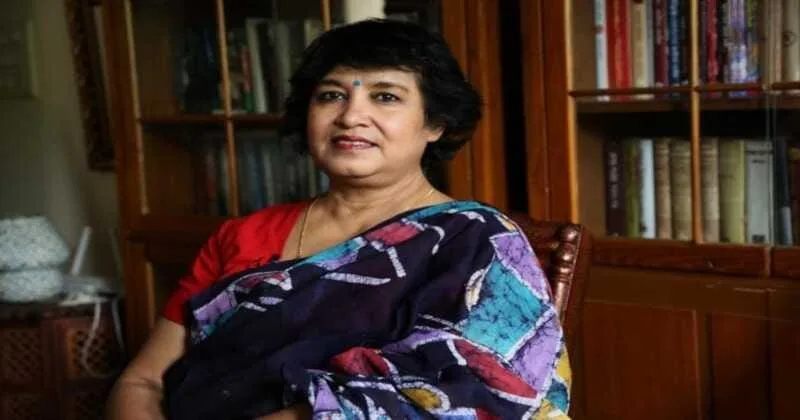
One may appreciate Taslima Nasrin’s writings, or one may disagree with many of her views. But there should be no ambiguity about a writer’s right to freedom of expression and the right to return to the people who speak her own language. Unfortunately, in Bengal, both politics and a section of the intellectual class have repeatedly viewed this issue through political and ideological lenses. It is therefore fair to ask today: are those who speak the loudest about secularism truly secular? Or is secularism, for them, merely a political tool to be applied selectively?
As an internationally acclaimed Bengali-language writer, Taslima Nasrin needs no introduction. Her writings have sparked controversy, attracted criticism, and many have disagreed with her opinions. Yet it is equally true that relentless threats and fatwas issued by fundamentalist forces compelled her to leave her homeland, Bangladesh. She left the country, but she never surrendered her convictions under pressure—something that should remain a defining characteristic of any writer. Although she later found refuge in Kolkata, political and fundamentalist pressure forced her to leave West Bengal as well after 2007. What greater irony can there be than the fact that a Bengali-language writer could not continue to live in West Bengal itself?
The time has now come to correct that mistake. Taslima Nasrin is returning to Kolkata. In this context, a remark by the eminent poet Joy Goswami deserves special mention. In an interview, he said, “Those who are bringing Taslima back have my deepest respect.” Recalling his memories from 1986, he added, “I first met Taslima when she was only twenty-four years old. At that time, she had written, ‘I have broken the chains; I have shaken off the lime of convention from the betel leaf.’ For me, those words did not remain merely poetry. Taslima Nasrin has lived every word she has written.” In other words, Taslima Nasrin has paid the price for her convictions not only through her writings but also through her life. That price was exile. The terrible cost she had to bear simply for speaking what she believed to be the truth becomes evident when one looks at newspaper reports from that period. A report published in Sunday magazine (21–27 August) stated: “She emplaned when Dhaka slept. Taslima Nasreen, the 32-year-old Bangladeshi writer who faced fundamentalist fatwas and carried a price on her head, left the country for Sweden in the early hours of 9 August.”
That, of course, was the story of Taslima Nasrin’s expulsion from Bangladesh. What is even more striking, however, is that when she was eventually forced to leave West Bengal, the state was under Left Front rule. In other words, those who today invoke freedom of speech at every opportunity—and often present themselves as its foremost custodians—failed to guarantee even the basic right of a writer to live safely during their own tenure. Listening to some of these voices today, one might assume that the very idea of freedom of expression was nurtured under their stewardship. Yet history tells a different story. When the moment arrived to stand firmly beside an internationally recognised writer facing threats from religious fundamentalists, electoral calculations, political expediency, and the politics of appeasement took precedence over principle. There were no impassioned speeches about free speech then—only an uneasy silence. Many who now passionately defend freedom of expression on social media, literary platforms, university seminars, and television debates were conspicuously absent when Taslima needed that support the most. When a writer was effectively prevented from living in West Bengal because of pressure from religious fundamentalist groups, a significant section of the state’s intellectual and political establishment chose silence over solidarity.
This silence is not new. Such double standards have surfaced repeatedly in the history of the Indian Left. There was a time when Vande Mataram—the song that inspired India’s freedom struggle and is now recognised as the National Song—was fiercely opposed by sections of the Left. Rabindranath Tagore, one of India’s greatest literary figures, was at times dismissed as a “bourgeois poet.” History shows that, in the name of ideological purity, expressions of national consciousness and cultural heritage have often been viewed with suspicion or rejected altogether. A similar mindset appears to have resurfaced in the case of Taslima Nasrin. The real issue is not Taslima herself; it is that she wrote openly and fearlessly against Islamic fundamentalism. Had her writings instead been directed primarily against Sanatan Hinduism, many who now remain silent might well have celebrated her as a champion of free expression and rallied publicly in her defence. This pattern has been observed repeatedly. The Hindu community, which has not been associated with practices such as beheading in the name of religion, has nevertheless often been portrayed as inherently communal by sections of Left-leaning scholarship. Yet when criticism is directed at Islamic fundamentalism, many among the self-described progressive intelligentsia become noticeably hesitant. At such moments, silence seems to emerge as the most convenient response.
In this context, the programme scheduled for 1 August under the initiative of the Secular Mission, with Taslima Nasrin in attendance, is undoubtedly a significant development. The Secular Mission and all the organisations associated with this initiative deserve sincere appreciation. The courage they have shown in standing up for freedom of expression is commendable. At the same time, the Government of West Bengal also deserves recognition for extending the necessary administrative support and adopting an inclusive approach in facilitating the event, irrespective of religion, caste, or political affiliation. Such cooperation represents a welcome step in upholding democratic values.
However, this episode has also brought an uncomfortable reality into sharp focus. A considerable section of those who regularly invoke the language of “secularism,” while criticising Hindu society and portraying Hindu traditions as inherently regressive, have remained conspicuously silent in the case of Taslima Nasrin. Criticism of any religion or social practice is entirely legitimate in a democratic society. But if such criticism is directed exclusively at one religion while avoiding another, can it genuinely be described as secularism? The more pertinent question is this: when a Bengali-language writer was prevented from returning to Kolkata for years because of threats from religious fundamentalists, where were the voices of these self-proclaimed secularists? Did they state with equal conviction that no writer should be forced into exile for expressing her views? Did they demand that the doors of Kolkata should always remain open to a writer whose literary identity is rooted in the Bengali language?
Their silence has inevitably raised questions about the consistency of their commitment to secular principles. Secularism cannot mean criticising one religion while remaining silent, out of fear or political convenience, in the face of fundamentalism associated with another. Genuine secularism requires the consistent application of the same standards to every religion, equal respect for the rights of all citizens, and an unwavering commitment to defending freedom of expression, regardless of whose sentiments are challenged.