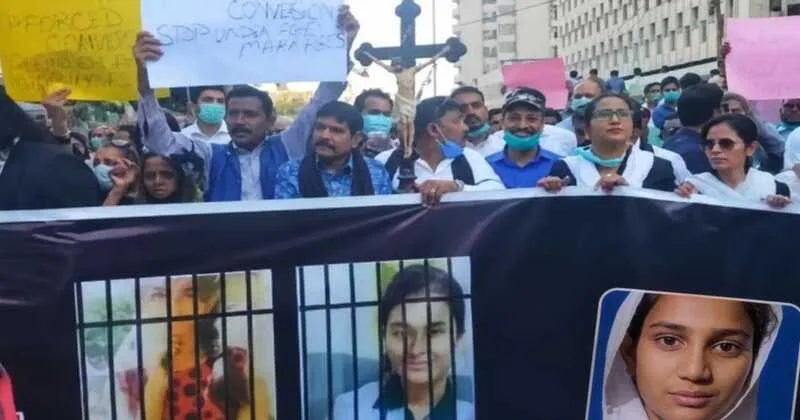
New Delhi: A fresh legal battle involving a 13-year-old Christian girl in Pakistan has reignited international concerns over the country’s handling of forced conversions, child marriages and the protection of religious minorities. Rights advocates argue that the case highlights deep-rooted failures within Pakistan’s justice system, where underage girls from minority communities continue to face abduction, coerced religious conversion and forced marriages despite legal safeguards.
Maria Shahbaz, a Christian minor from Pakistan, is currently fighting to return to her family after a court decision placed her back into the custody of the 30-year-old Muslim man accused of abducting her. Human rights organisations say the ruling has intensified fears among minority communities, who increasingly view the justice system as incapable of protecting vulnerable children from exploitation.
According to legal advocacy organisation Alliance Defending Freedom (ADF), Maria was abducted from her Christian home in July 2025 by Shehryar Ahmad, who compelled her to convert to Islam before forcing her into marriage. Since the abduction, ADF says the young girl has been subjected to severe abuse and exploitation while being kept away from her family.
The case has drawn widespread criticism because previous investigations established that Maria was a minor and that documents used to legitimise the marriage had been forged. Despite these findings, Pakistan’s Federal Constitutional Court ruled in February that she should remain in Ahmad’s custody without first conclusively determining her age.
Legal observers argue that the judgment directly conflicts with Pakistani law, which does not permit minors to consent either to marriage or to changing their religion. Critics contend that the decision reflects broader institutional shortcomings in dealing with cases involving religious minorities and underage girls.
Questions raised over Pakistan’s judicial response
As Maria awaits another hearing, her legal representatives believe the judiciary still has an opportunity to reverse what they describe as a serious miscarriage of justice. Local lawyer Lazar Allah Rakha, who is involved in the case, said the upcoming proceedings offer the court an opportunity to correct an error that has left a child in the custody of the very man accused of abducting her.
Rakha stressed that Maria’s age, the forged marriage documents and the circumstances surrounding her disappearance should have been sufficient grounds to invalidate the earlier ruling. He argued that returning a minor to her abductor without properly verifying her age undermines both justice and the rule of law. He also warned that the consequences extend far beyond a single case. According to Rakha, if the previous ruling is allowed to stand, confidence among Pakistan’s minority communities in the judicial system will continue to deteriorate. He described the review petition as an important opportunity for the court to enforce existing laws and restore public trust.
The controversy has once again focused attention on allegations that Pakistani authorities frequently fail to protect Christian and Hindu girls from forced conversions and coerced marriages, despite repeated domestic and international criticism.
International Bodies Condemn Forced Conversions and Child Marriages
The case comes at a time when Pakistan has attempted to strengthen legal protections against child marriage. Following intense debate among legislators, Punjab, the country’s largest province, approved revised legislation this year, reinforcing the minimum legal marriage age at 18 years. The amended law also directs courts to place the best interests of children at the centre of judicial decisions involving marriage.
The new legislation replaces provisions contained in the Punjab Child Marriage Restraint Act of 1929, which had previously permitted girls to marry at 16 while boys were required to be 18.
Although the legal reform has been welcomed, critics argue that enforcement remains inconsistent, particularly in cases involving minority girls who are abducted and converted.
International institutions have repeatedly raised concerns over these practices. United Nations experts, members of the European Parliament, and lawmakers in the United Kingdom have all expressed alarm over reports that more than 1,000 underage girls in Pakistan are subjected annually to forced conversions and coerced marriages.
The European Parliament recently adopted a resolution specifically referring to Maria Shahbaz’s case. The resolution criticised the treatment she has received and urged Pakistani authorities to ensure that she has access to legal counsel, contact with her family and psychological support.
European lawmakers further described Maria’s experience as symbolic of wider human rights abuses affecting Pakistan’s religious minorities and condemned similar cases involving underage girls from minority communities.
Pattern of abuse against minority girls under scrutiny
ADF, which has provided legal assistance in Maria’s case, says her ordeal is not an isolated incident but part of a recurring pattern across Pakistan. Tehmina Arora, ADF’s Asia Director of Advocacy, said the organisation continues to witness numerous cases in which underage girls are abducted, pressured into converting to Islam and compelled to marry significantly older men.
According to Arora, hundreds of girls every year become victims of marriages arranged through coercion rather than consent, resulting in the loss of their freedom and exposing them to exploitation and abuse.
She described Maria’s experience as particularly heartbreaking, noting that no 13-year-old child should endure such suffering. Arora expressed hope that the court would ultimately restore the girl’s freedom while establishing an important legal precedent capable of protecting other vulnerable girls facing similar circumstances.
ADF has previously represented several Pakistani Christian girls who endured comparable experiences. One such case involved Reeha Saleem, who was 16 years old when she was abducted near her school in Punjab in 2019 by four men. She was subjected to violence and forced into marriage before managing to escape approximately two months later.
Even after her escape, Saleem encountered further obstacles when local police declined to assist because authorities continued to regard her as legally married. It was only after judicial intervention that the forced marriage was annulled.
Another widely reported case concerned 14-year-old Maira, who was abducted, compelled to convert to Islam and forced into marriage against her wishes. Although she later escaped from her captor, a court initially ordered that she be returned to him. Following sustained legal efforts supported by ADF, Maira was eventually freed and reunited with her family.
Human rights advocates argue that these recurring cases reveal a troubling pattern in which minority girls frequently face not only abduction and forced conversion but also prolonged legal battles before securing justice.
They contend that Maria Shahbaz’s ongoing struggle has become emblematic of broader concerns regarding religious freedom, child protection and equal access to justice in Pakistan.
As Maria’s review petition moves forward, international attention remains focused on whether Pakistan’s judiciary will overturn its earlier decision or reinforce a ruling that critics say has become a symbol of systemic failures affecting the country’s most vulnerable religious minorities.