Sabarimala Case: Centre backs Temple autonomy
August 30, 2026
  • Read Ecopy
  • Circulation
  • Advertise
  • Careers
  • About Us
  • Contact Us
Android AppiPhone AppArattai
Organiser
  • ‌
  • Bharat
    • Assam
    • Bihar
    • Chhattisgarh
    • Jharkhand
    • Maharashtra
    • View All States
  • World
    • Asia
    • Europe
    • North America
    • South America
    • Africa
    • Australia
  • Editorial
  • International
  • Opinion
  • RSS @ 100
  • More
    • Op Sindoor
    • Analysis
    • Sports
    • Defence
    • Politics
    • Business
    • Economy
    • Culture
    • Special Report
    • Sci & Tech
    • Entertainment
    • G20
    • Azadi Ka Amrit Mahotsav
    • Vocal4Local
    • Web Stories
    • Education
    • Employment
    • Books
    • Interviews
    • Travel
    • Law
    • Health
    • Obituary
  • Subscribe
    • Subscribe Print Edition
    • Subscribe Ecopy
    • Read Ecopy
  • ‌
  • Bharat
    • Assam
    • Bihar
    • Chhattisgarh
    • Jharkhand
    • Maharashtra
    • View All States
  • World
    • Asia
    • Europe
    • North America
    • South America
    • Africa
    • Australia
  • Editorial
  • International
  • Opinion
  • RSS @ 100
  • More
    • Op Sindoor
    • Analysis
    • Sports
    • Defence
    • Politics
    • Business
    • Economy
    • Culture
    • Special Report
    • Sci & Tech
    • Entertainment
    • G20
    • Azadi Ka Amrit Mahotsav
    • Vocal4Local
    • Web Stories
    • Education
    • Employment
    • Books
    • Interviews
    • Travel
    • Law
    • Health
    • Obituary
  • Subscribe
    • Subscribe Print Edition
    • Subscribe Ecopy
    • Read Ecopy
Organiser
  • Home
  • Bharat
  • World
  • Operation Sindoor
  • Editorial
  • Analysis
  • Opinion
  • Culture
  • Defence
  • International Edition
  • RSS @ 100
  • Magazine
  • Read Ecopy
Home Bharat

Sabarimala Case: Centre tells Supreme Court it opposes state control of Mandirs, backs autonomy

The Centre told the Supreme Court it does not support direct government control over mandirs, stressing a clear divide between secular regulation and religious autonomy under Articles 25 and 26. The submission, made by Tushar Mehta before a Bench led by Surya Kant, comes amid concerns over state-managed mandirs and debates on access, reform, and institutional independence

Dr Vishnu AravindDr Vishnu Aravind
Apr 24, 2026, 09:30 am IST
inBharat, Kerala
Follow on Google News
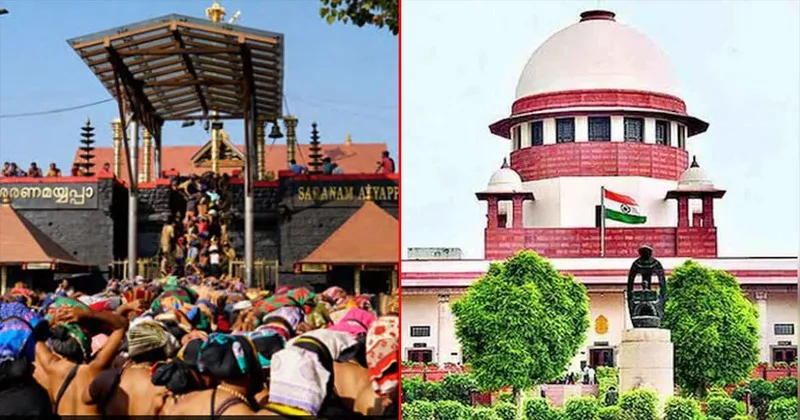
Centre backs mandir autonomy, stresses limited state role and respect for diverse religious practices

Centre backs mandir autonomy, stresses limited state role and respect for diverse religious practices

Facebook
Twitter
WhatsAppTelegramEmail

New Delhi: The central government told the Supreme Court  that it does not support government control over mandirs, asserting that religious institutions should not be directly managed by the state. The submission was made by Solicitor General Tushar Mehta before a nine-judge Constitution Bench led by Chief Justice Surya Kant. The bench is examining the scope of state authority under Article 25 of the Constitution of India and Article 26 of the Constitution of India, a reference arising from the Sabarimala review petitions.

The Centre’s position stresses a strict distinction between secular management and religious autonomy. It explicitly stated that it does not advocate direct management of religious bodies by the government. While Article 25(2) of the Constitution of India permits state intervention in secular aspects such as financial and political activities, the government argued this should not translate into permanent state takeover of shrines. The Solicitor General further emphasised that constitutional interpretation must remain uniform across all faiths and cannot be shaped by the practices of any single religion. The Centre also highlighted that many Hindu traditions are inherently pluralistic, including practices where certain mandirs restrict entry based on custom, and cautioned against imposing a uniform framework that disregards such diversity.

Also Read: From Kenopanishad to Nyaya Darshan: Ancient Rishi texts that transform mind, logic & consciousness

Court flags concerns over exclusion and access

While advocating autonomy, the nine-judge Bench raised concerns about the implications of granting complete independence to denominations. The court observed that absolute powers to exclude could fragment society and undermine the inclusive character of Hindu traditions. Justice B. V. Nagarathna remarked that “everybody must have access to every temple and matha,” underlining that the state can intervene under Article 25(2)(b) to ensure social reform and prevent discrimination. In related rulings, the court has consistently maintained that mandir funds “belong to the deity” and must be utilised solely for the interests of the shrine, rather than diverted for unrelated state expenditure or commercial use.

The issue remains contentious, with many arguing that Hindu mandirs are uniquely subject to state control, unlike mosques, churches and gurdwaras, which are largely self-managed. Devotees frequently object to mandir revenues being channelled into non-religious state projects or general welfare programmes instead of maintenance and religious activities. Concerns have also been raised that government-appointed administrators may lack the requisite religious understanding or devotion to manage sacred institutions. Additionally, critics argue that such control risks turning mandir boards into “political parking lots,” where appointments are influenced by electoral considerations rather than merit.

The debate unfolds against a backdrop of extensive state involvement in mandir administration across India. In Keralam, multiple state-supervised bodies, including the Travancore, Cochin, Malabar, Guruvayur and Koodalmanikyam Devaswom Boards, oversee around 3,000 mandirs. In Tamil Nadu, the Hindu Religious and Charitable Endowments Department administers over 30,000 mandirs. In Andhra Pradesh, the Tirumala Tirupati Devasthanam Trust Board manages the Tirupati Balaji shrine. Similar frameworks exist in Karnataka under the Hindu Religious Institutions and Charitable Endowments Department, while the Chardham Devasthanam Board administers the Badrinath and Kedarnath shrines in Uttarakhand.


Topics: Hindu temples governanceState control debateSabarimala caseArticle-25Temple AutonomySupreme Court IndiaDevaswom boards
Dr Vishnu Aravind
Dr Vishnu Aravind
Dr Vishnu Aravind is a researcher, political commentator and writer based in New Delhi, with a PhD from Jawaharlal Nehru University (JNU). His areas of interest include international politics, Indian foreign policy, electoral politics, election analysis, political developments, and cultural affairs. [Read more]
Share
Tweet
SendShareSend
✮ Subscribe Organiser YouTube Channel. ✮
✮ Join Organiser's WhatsApp channel for Nationalist views beyond the news. ✮
Previous News

UP: ATS arrests Hizbullah Ali Khan and Sameer Khan in Noida for alleged Pakistan ISI-linked terror plot

Next News

Bulldozer Action in Gujarat’s Jamnagar: Illegal farmhouse of Congress leader Altaf Khafi on govt land razed

Related News

Madras High Court

Madras HC stays Church near temple in Coimbatore; petitioner alleges post-TVK govt push, flags malafide intentions

Nine Member Constitution Bench questions the legitimacy of PIL-driven intervention in Sabarimala traditions, raising sharp observations on faith, locus standi and judicial process.

Sabarimala Case: ‘Mind your business’, SC slams petitioner Naushad Khan of Young Lawyers Association

Representative image

No dispute on women entering Mosques since Prophet’s time: Justice Amanullah during SC hearing

Supreme Court of India bench hears Sabarimala review pleas as Justice B. V. Nagarathna questions non-devotee challenges to rituals

Sabarimala Case: “Believers don’t question rituals; non-believers can’t challenge them,” says Justice B. V. Nagarathna

National anti-conversion law demand sparks debate on rights & social harmony

Growing demand for a strict national anti-conversion law sparks debate on constitutional rights & social harmony

During Sabarimala review hearings, Supreme Court underscores limits of reform and cautions against diluting core religious beliefs

Religion cannot be “Hollowed Out” in the name of social reform, says Supreme Court in Sabarimala case

Load More

Latest News

‘Dimagi Naxals’ romanticising Mao, Stalin and Pol Pot

The Swadeshi movement turned Indian enterprise into a powerful force for economic self-reliance, national pride and the struggle for Swaraj

Building Economic Swaraj: How Indian enterprises fought foreign rule and reclaimed national pride

Prime Minsiter Narendra Modi and Uzbekistan President Shavkat Mirziyoyev

India-Uzbekistan Herald New Chapter: Uranium deal, 30-day visa-free entry to Indians & $5bn trade propel bilateral ties

The new FCRA rules seek to curb unchecked foreign funding, strengthen financial accountability, and protect Bharat’s national security

Stopping Unchecked Foreign Money: How new FCRA rules protect Bharat’s security and financial sovereignty

Keralam CM VD Satheeshan, DCC member Chembil Anil (Left to Right)

Keralam Congress infighting surfaces in CM VD Satheeshan’s vehicle blockade; DCC member Chembil Anil arrested, remanded

Indian Logistics Data Bank tracks ten crore containers, transforming freight visibility and strengthening the nation’s logistics network

From Lothal Dockyard to Ten Crore Containers: India’s Logistics Data Bank transforms EXIM freight tracking

Former Union Minister Dharmendra Pradhan and BJD President Naveen Patnaik

Odisha: Dharmendra Pradhan hits back at Naveen Patnaik over MMDR bill; Slams for concealing facts & misleading people

Representative Image

The Battle for the Narrative: Bharat and the Politics of Perception

When Faith Becomes Data: What the Joshua Project reveals about missionary targeting in India!

The demolition of Shri Guru Singh Sabha Gurdwara has intensified fears over the disappearance of Pakistan’s Sikh religious heritage

Pakistan demolishes 200-year-old Sikh Gurdwara in Quetta; Historic minority heritage land sold for commercial project!

Load More
  • Privacy
  • Terms
  • Cookie Policy
  • Refund and Cancellation
  • Delivery and Shipping

© Bharat Prakashan (Delhi) Limited.
Tech-enabled by Ananthapuri Technologies

  • Home
  • Search Organiser
  • Bharat
    • Assam
    • Bihar
    • Chhattisgarh
    • Jharkhand
    • Maharashtra
    • View All States
  • World
    • Asia
    • Africa
    • North America
    • South America
    • Europe
    • Australia
  • Editorial
  • Operation Sindoor
  • Opinion
  • Analysis
  • Defence
  • Culture
  • Sports
  • Business
  • RSS @ 100
  • Entertainment
  • More ..
    • Sci & Tech
    • Vocal4Local
    • Special Report
    • Education
    • Employment
    • Books
    • Interviews
    • Travel
    • Health
    • Politics
    • Law
    • Economy
    • Obituary
  • Subscribe Magazine
  • Read Ecopy
  • Advertise
  • Circulation
  • Careers
  • About Us
  • Contact Us
  • Policies & Terms
    • Privacy Policy
    • Cookie Policy
    • Refund and Cancellation
    • Terms of Use

© Bharat Prakashan (Delhi) Limited.
Tech-enabled by Ananthapuri Technologies