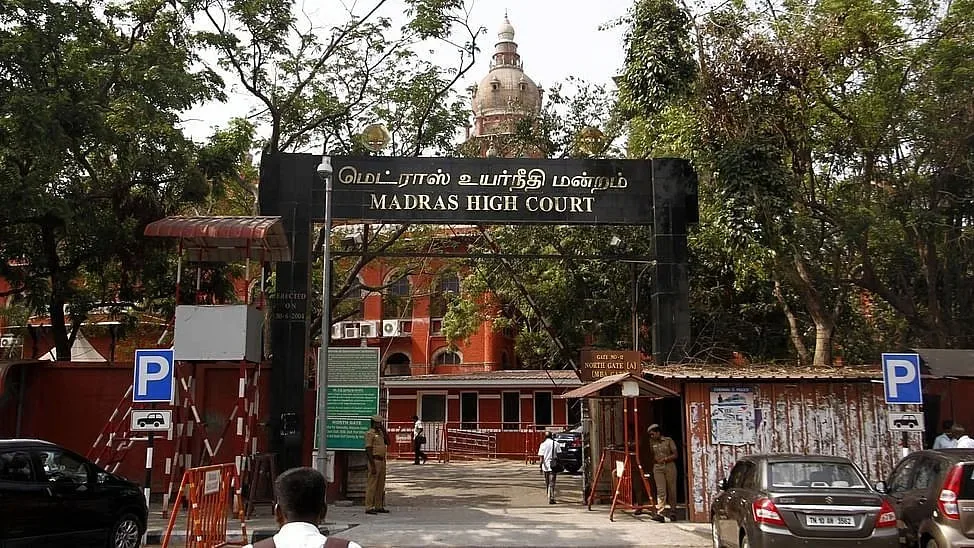
The Madras High Court has granted an interim injunction restraining the proposed construction of a church near an existing Mariyamman Temple in Coimbatore, observing that the site identified for the structure is recorded as a public road in revenue records and that the matter is already the subject of a pending civil suit. The move was hailed by Hindus.
A Division Bench comprising Justice G. R. Swaminathan and Justice V. Lakshminarayanan, while hearing a writ petition filed by N. Balasubramanyam of Coimbatore challenging communications issued by the District Collector and Revenue Divisional Officer granting police protection for the construction of a church at Kalapatti, Coimbatore, observed that religious rights under Article 25 of the Constitution of India are subject to public order.
In the order issued on May 29, but made public on June 17, dated, the Bench further said that the authorities cannot mechanically ignore strong objections, revenue records showing the land as a public road, and the sensitive nature of the location.
The respondents are the District Collector (DM), Revenue Divisional Officer (RDO), Coimbatore North, Tahsildar, Coimbatore North Taluk, the Superintendent of Police, Joint Commissioner, HR&CE, President, CSI Christ King Church, and Mary Balan @ Balraj, Kalapatty.
The petitioner filed this writ petition challenging the impugned communications issued by the DM and RDO providing police protection to enable the respondent to construct a church at the petition-mentioned site.
The Bench noted that the petitioner had approached the Court contending that permission granted in 2010 for the church had remained unimplemented for more than a decade due to local opposition and ongoing litigation.
According to the Court record, a suit challenging the original permission granted by the District Collector is still pending before the District Munsif Court, Coimbatore.
In their order, the Bench, in 12-page order, said: “When it was listed for admission on May 21, 2026, the counsel for the petitioner insisted on issuance of short notice. Even though urgency had been set out in the affidavit filed in support of this writ petition, we called upon the petitioner’s counsel to impress upon us as to why we should do so.”
The counsel submitted that following the change of Government headed by Chief Minister C. Joseph Vijay, certain fundamentalist organisations have become emboldened.
He pointed out that Speaker JCD Prabhakar, who proclaims that he had distributed thousands of free copies of the Bible, quoted Biblical verses in his inaugural address to the Legislative Assembly.
He also added that when Udhayanidhi Stalin, LoP, called for the annihilation of Sanatana Dharma in his address in the Assembly, it was not condemned or even objected to by the ruling party.
He drew our attention to the statement of V.M.S. Mustafa, the recently elected MLA from the temple town of Madurai, that the annihilation of Sanatana Dharma is indeed a policy of the ruling party. He placed on record the fact that posters have appeared in some parts of Tamil Nadu calling for the construction of churches in every village.”
According to the petitioner’s counsel, the construction of a church which was put on hold has been resumed recently and they had to rush to this Court seeking relief during its vacation sitting.
The Court said, “When the matter was listed, the counsel for the sixth respondent/church sought time. In fact, we could have disposed of the writ petition itself as the issue had already been concluded. But we decided to give due opportunity to the contesting respondent to file his counter.”
The Court said, “It is not in dispute that in Survey No.155/1, a Mariyamman Temple is located. Admittedly, it has been in existence for more than a hundred years. According to the petitioner, in the village, there were originally about 350 families, out of which just 3 families professed Christianity.
Now, there are a thousand families; out of them, 950 families profess Hinduism, 15 profess Islam, and very few families profess Christianity.
Yet, vide order dated 30.01.2010, the then DM granted permission for construction of a church in Survey No.155/2 in the face of vehement opposition from the Hindus.
Hence, O.S. No.1378 of 2011 was instituted by the worshippers of the temple before the District Munsif Court, Coimbatore.”
The Court said, “The suit is still pending. Notwithstanding the grant of permission, since there was severe opposition in the locality, the construction could not take place. While so, some thirteen years later, the private respondents tried to resume construction and obtained orders to that effect.
Aggrieved by the same, the Church of South India filed a writ petition in 2024. It was disposed of on 28.04.2026.
In view of these, this Court, without expressing any opinion on the merits of the case, since expressing any opinion will adversely affect the interests of the parties in the suit of 2011, and without interfering with the impugned letter of the first respondent dated 16.06.2023, grants liberty to the petitioner to make a fresh application for construction after disposal of the suit of 2011 on the file of the District Munsif Court, Coimbatore,” the court added.
The counsel for the petitioner herein asserts that no church was ever in existence. Therefore, the question of putting up any additional building does not arise. Admittedly, the church is proposed to be put up in Old Survey No.155/2. We perused the revenue records. It is clearly mentioned that S.No.155/2 is a tar road.
Again, law and order problems arose. Peace meetings were conducted. In order to ensure peace, the District Collector appears to have called upon the private respondents to stop work and discontinue the construction.”
The judges said, “Admittedly, the church is proposed to be put up in Old Survey No.155/2. We perused the revenue records. It is clearly mentioned that S.No.155/2 is a tar road. The Supreme Court had made it clear that religious structures cannot be allowed to come up on roads and road margins.”
The judges pointed out, “Coimbatore is a communally sensitive city. It witnessed bomb blasts and bloody religious riots. The proposed church would come up within a stone’s throw of the existing Mariyamman Temple. There are only a handful of Christian families. If a large church is proposed to be constructed in the vicinity of the Mariyamman Temple, mala fide intentions cannot be ruled out. The counsel for the petitioner hints at the possibility of the new building being a centre of conversion activity.”
Church construction activities by CSI Coimbatore reportedly began immediately after the new Chief Minister Mr. Joseph Vijay assumed office, with a temporary shed being erected on the very same night.
The Kalapatti Mariamman Temple is believed to be more than 100 years old and is… pic.twitter.com/6YhIq0Psn0
— Selva Kumar (@Selvakumar_IN) June 18, 2026
The Court said, “Irreparable hardship and loss will be caused to social amity if an interim order is not granted. The balance of convenience is also against the private respondents, more so because of the earlier order made in WP No.8128 of 2024. The political scenario may change. But so long as the position of law remains what it is, it is our duty to give effect to the same… Hence, there shall be an order of interim injunction.”
The Bench held that the requirement of obtaining a NoC from the DM for religious structures under the Tamil Nadu Combined Development and Building Rules, 2019, cannot be treated as a mechanical formality, particularly where there is strong opposition.
The Court said, “Considerations could have been different if the construction is on a patta land whose title is beyond dispute and there is no religious structure belonging to other communities in the immediate vicinity, or if there is no opposition. In the case on hand, the revenue record indicates that the site is a public road. The location is too close to an old temple. There is also vigorous opposition.”