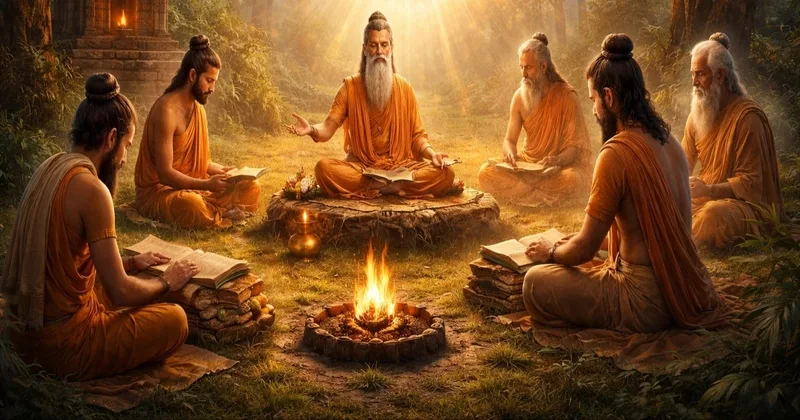
The Indian knowledge tradition, rooted in the wisdom of ancient sants, offers a structured path not just for spiritual growth but for a complete transformation of human cognition. These texts are not isolated philosophies; they form an interconnected framework that refines perception, sharpens reasoning, and ultimately guides one toward self-realisation. Moving beyond the foundational Vedic Samhitas, several key works stand out for their ability to deeply rewire how one thinks, interprets reality, and experiences existence.
Ancient Scriptures by Rishis ऋषिगण that transformed my Cognitive Operating System पंचकोष
(except Veda Samhitas – the source code):1. Kenopanishad केनोपनिषद्
This is genius grade stuff. The choice of Yaksha यक्ष as metaphor itself meant a lot for me). Short, sharp, deep.
2.…
— Sanjeev Newar | सञ्जीव नेवर (@SanjeevSanskrit) April 4, 2026
Kenopanishad: The Shock of Pure Awareness
The Kenopanishad is one of the most concise yet intellectually powerful Upanishads. Its brilliance lies in its ability to destabilise the reader’s assumptions about knowledge and perception. Through the metaphor of the Yaksha, it demonstrates that even the gods, symbols of sensory and mental faculties, fail to comprehend the ultimate reality. This creates a profound cognitive shift: what we perceive, think, or intellectually grasp is not the ultimate truth. The text pushes the seeker toward direct awareness beyond mind and senses. Its sharp and minimal style makes it “genius-grade” philosophy, short in form, yet infinite in depth.
Nirukta: Decoding the DNA of Vedic Language
The Nirukta by Yaska is not just a linguistic treatise; it is a cognitive tool. It provides a systematic method to uncover the root meanings of Vedic words, allowing seekers to move beyond superficial translations. In doing so, it transforms the way one engages with Vedic mantras, from passive reading to active interpretation.
This deep engagement often leads to noticeable mental shifts. Practitioners report enhanced clarity, improved focus, and even subtle changes in breath patterns. The archaic nature of the language demands intense concentration, making the study itself a form of meditation. Nirukta reveals a crucial insight: language is not merely a communication tool, it is a gateway to consciousness.
Sankhya Sutra: The Science of Truth Through Elimination
The Sankhya Sutra, attributed to Kapila, stands as one of the most analytical and uncompromising philosophical systems ever developed. Sankhya operates through a rigorous process of elimination, separating truth from false identification. Through this logic, it dismantles attachment to the body, mind, emotions, and ego, leading to the realization that one is purely the Self.
Although often labeled atheistic due to its non-theistic framework, many find that Sankhya actually strengthens devotion by grounding it in clarity rather than blind belief. It removes illusion and establishes a stable foundation for both knowledge and devotion.
Yoga Sutras: The Practical Framework for Liberation
The Yoga Sutras of Patanjali, along with the commentary by Vyasa, build directly on Sankhya’s theoretical base. If Sankhya explains reality, Yoga provides the method to experience it.
The Yoga Sutras present a precise and actionable system for disciplining the mind. Every action, thought, and intention is evaluated based on whether it leads toward Kaivalya (liberation). Vyasa’s commentary intensifies this framework, categorising anything that distracts from liberation as an obstacle or even as a negative action. This uncompromising clarity can feel harsh in modern contexts, but it is designed to eliminate ambiguity. The result is a life governed by purpose, discipline, and inner stillness.
Bhagavad Gita Chapter 2: Philosophy in the Heat of Crisis
The second chapter of the Bhagavad Gita represents a powerful synthesis of Sankhya and Yoga, delivered in the battlefield setting of Kurukshetra. Unlike abstract philosophy, this teaching emerges in a moment of extreme crisis, when Arjuna faces moral collapse and existential confusion. The teachings are therefore not theoretical but deeply practical.
Chapter 2 introduces:
The immortality of the self
The importance of detached action (Nishkama Karma)
Mental steadiness in success and failure
The essence of this chapter lies in its urgency. It suggests that true understanding is not developed in comfort, but in moments where the stakes are high and decisions are immediate. In such states, philosophy transforms instinct into awareness, turning fear into clarity.
Nyaya Sutras: The Discipline of Pure Reason
The Nyaya Sutras by Gautama provide the logical backbone of this intellectual tradition. Nyaya focuses on valid means of knowledge and insists that truth must be established through rational inquiry. It rejects both blind faith and emotional reasoning, emphasizing clarity, debate, and logical consistency.
Key features include:
Systematic analysis of perception and inference
Rejection of illogical or contradictory beliefs
Emphasis on intellectual discipline in spiritual pursuit
Nyaya does not dismiss devotion but insists that it be grounded in reason. It ensures that the seeker’s path is free from illusion, superstition, and emotional bias.
The journey through these ancient works is not about accumulating knowledge but about transforming the very structure of thought and perception. They challenge assumptions, refine intellect, and guide the seeker toward direct experience of truth.