Nine-judge bench will revisit 2018 Sabarimala case
June 23, 2026
  • Read Ecopy
  • Circulation
  • Advertise
  • Careers
  • About Us
  • Contact Us
Android AppiPhone AppArattai
Organiser
  • ‌
  • Bharat
    • Assam
    • Bihar
    • Chhattisgarh
    • Jharkhand
    • Maharashtra
    • View All States
  • World
    • Asia
    • Europe
    • North America
    • South America
    • Africa
    • Australia
  • Editorial
  • International
  • Opinion
  • RSS @ 100
  • More
    • Op Sindoor
    • Analysis
    • Sports
    • Defence
    • Politics
    • Business
    • Economy
    • Culture
    • Special Report
    • Sci & Tech
    • Entertainment
    • G20
    • Azadi Ka Amrit Mahotsav
    • Vocal4Local
    • Web Stories
    • Education
    • Employment
    • Books
    • Interviews
    • Travel
    • Law
    • Health
    • Obituary
  • Subscribe
    • Subscribe Print Edition
    • Subscribe Ecopy
    • Read Ecopy
  • ‌
  • Bharat
    • Assam
    • Bihar
    • Chhattisgarh
    • Jharkhand
    • Maharashtra
    • View All States
  • World
    • Asia
    • Europe
    • North America
    • South America
    • Africa
    • Australia
  • Editorial
  • International
  • Opinion
  • RSS @ 100
  • More
    • Op Sindoor
    • Analysis
    • Sports
    • Defence
    • Politics
    • Business
    • Economy
    • Culture
    • Special Report
    • Sci & Tech
    • Entertainment
    • G20
    • Azadi Ka Amrit Mahotsav
    • Vocal4Local
    • Web Stories
    • Education
    • Employment
    • Books
    • Interviews
    • Travel
    • Law
    • Health
    • Obituary
  • Subscribe
    • Subscribe Print Edition
    • Subscribe Ecopy
    • Read Ecopy
Organiser
  • Home
  • Bharat
  • World
  • Operation Sindoor
  • Editorial
  • Analysis
  • Opinion
  • Culture
  • Defence
  • International Edition
  • RSS @ 100
  • Magazine
  • Read Ecopy
Home Bharat

Supreme Court nine-judge bench will revisit 2018 Sabarimala case verdict from April 7

The Supreme Court has ordered that a nine-judge Constitution Bench will begin hearing the Sabarimala review from April 7, 2026, setting a detailed schedule for submissions and arguments while noting that questions on maintainability have already been settled

Surender KumarSurender Kumar
Feb 16, 2026, 08:15 pm IST
in Bharat, Law
Follow on Google News
FacebookTwitterWhatsAppTelegramEmail

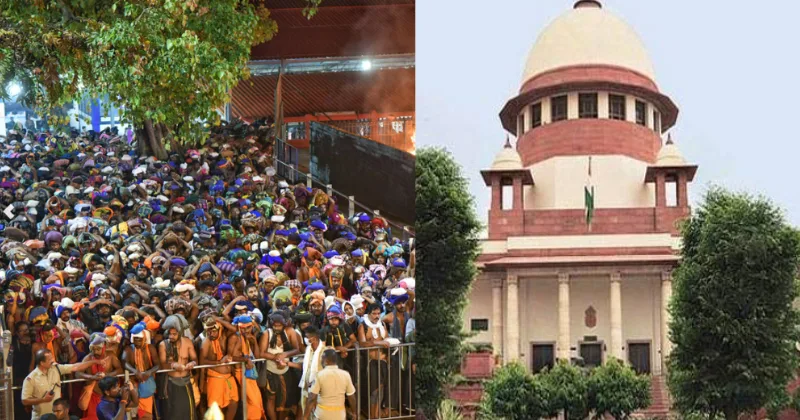
The Supreme Court on 16 February ordered that a 9 judge Constitution Bench will commence hearings on the issues arising from the review of the 2018 Sabarimala verdict from April 7, 2026. The matter concerns review petitions and connected writ petitions linked to the judgment that permitted women of all age groups to enter the Bhagwan Ayyappa temple in Kerala.

The proceedings before a bench led by Chief Justice Surya Kant, along with Justice Joymalya Bagchi and Justice Vipul M. Pancholi, addressed preliminary objections regarding the maintainability of the reference. The court noted that this question had already been settled in February 2020, when it held that questions could be referred to a larger bench even at the review stage. It observed that the issue had attained finality and would not delay further consideration.

The court directed all parties to file written submissions by March 14, 2026, and fixed a detailed schedule for oral arguments.

Petitioners supporting the review and related parties will be heard from April 7 to April 9.

Those opposing the review will present arguments from April 14 to April 16, followed by rejoinder submissions on April 21.

Final submissions by the amicus curiae are expected to conclude by April 22.

The court instructed counsel to adhere strictly to the timeline and asked nodal counsel to coordinate internal arrangements to ensure completion within the allotted period.

Chief Justice Kant emphasised that the nine-judge bench hearing takes precedence and asked lawyers to keep their calendars clear.

He also indicated that continuous hearings would be provided and that overlapping matters could be taken up together where necessary.

During the hearing, Solicitor General Tushar Mehta stated that the Union of India supports the review, a position echoed by Senior Advocate C.S. Vaidyanathan.

Senior Advocate Abhishek Manu Singhvi suggested grouping parties broadly into those supporting and those opposing women’s entry into the temple.

Senior advocates Abhishek Manu Singhvi and Menaka Guruswamy appeared for petitioners supporting entry of women, while Solicitor General Tushar Mehta represented the Union government and Senior Advocate Jaideep Gupta appeared for the State of Kerala.

The court appointed Krishan Kumar Singh as nodal counsel for the review petitioners and directed Advocate-on-Record Shivam Singh to assist amicus K. Parmeswar and prepare written submissions reflecting the positions of all parties. It clarified that the nine-judge bench will be formally constituted by the Chief Justice through an administrative order.

The case also encompasses broader constitutional questions raised in related petitions, including issues concerning entry of Muslim women into mosques and dargahs, the rights of Parsi women married outside the community to enter Fire Temples, and the legal validity of female genital mutilation within the Dawoodi Bohra community.

Background

The Sabarimala dispute revolves around the traditional restriction on women between the ages of 10 and 50 entering the Ayyappa shrine, a practice rooted in long-standing custom.

In 1991, the Kerala High Court upheld the restriction, finding it to be an established tradition consistent with law.

In 2006, the Indian Young Lawyers Association approached the Supreme Court, arguing that the practice violated constitutional guarantees of equality and freedom of worship. The matter was eventually referred to a Constitution Bench in 2017.

On September 28, 2018, a five-judge bench delivered a 4:1 ruling striking down the restriction. The majority held that exclusion based on biological factors could not override constitutional rights, while Justice Indu Malhotra dissented, cautioning against judicial interference in matters of faith.

On January 2, 2019, two women entered the shrine under police protection, triggering protests and subsequent purification rituals by temple authorities. Following more than 60 review petitions, the Supreme Court in 2019 decided to place the broader legal questions before a larger bench.

In January 2020, the court constituted a nine-judge bench to examine fundamental issues including the scope of religious freedom under Article 25, the relationship between individual rights and denominational rights under Article 26, the meaning of “morality” in the constitutional context, the extent of judicial review over religious practices, interpretation of “sections of Hindus” under Article 25(2)(b), and whether persons outside a denomination can challenge its practices through public interest litigation.
Topics: Supreme Court on religous rightsMuslims women entry into mosqueSabarimala caseWomen Entry Issue
ShareTweetSendShareSend
✮ Subscribe Organiser YouTube Channel. ✮
✮ Join Organiser's WhatsApp channel for Nationalist views beyond the news. ✮
Previous News

From red corridor to growth corridor, Chhattisgarh has emerged as a model of development: CM Vishnu Deo Sai

Next News

Pakistan-origin large balloon with Urdu text found at Agra Airforce Station; Intense investigations accelerated

Related News

Nine Member Constitution Bench questions the legitimacy of PIL-driven intervention in Sabarimala traditions, raising sharp observations on faith, locus standi and judicial process.

Sabarimala Case: ‘Mind your business’, SC slams petitioner Naushad Khan of Young Lawyers Association

Representative image

No dispute on women entering Mosques since Prophet’s time: Justice Amanullah during SC hearing

Centre backs mandir autonomy, stresses limited state role and respect for diverse religious practices

Sabarimala Case: Centre tells Supreme Court it opposes state control of Mandirs, backs autonomy

Supreme Court of India bench hears Sabarimala review pleas as Justice B. V. Nagarathna questions non-devotee challenges to rituals

Sabarimala Case: “Believers don’t question rituals; non-believers can’t challenge them,” says Justice B. V. Nagarathna

During Sabarimala review hearings, Supreme Court underscores limits of reform and cautions against diluting core religious beliefs

Religion cannot be “Hollowed Out” in the name of social reform, says Supreme Court in Sabarimala case

SC bench led by CJI Surya Kant hears Sabarimala case, flags PIL misuse and stresses stricter locus standi norms

SC flags PIL misuse, says Sabarimala plea would have been dismissed, backs stricter locus standi in faith cases

Load More

Latest News

Amazon in dock for mocking Hindu Gods

Amazon File: From Ganesha to Aryabhata-Has Amazon India become a platform for Anti-Hindu narratives?

The West Bengal Budget 2026–27 aims to drive growth through infrastructure, industry, innovation and welfare

Reimagining Bengal: How the West Bengal Budget 2026–27 seeks to balance growth, welfare & economic transformation

Pratiraksha is Gujarat Police's Aadhaar-based verification platform designed to identify illegal workers and prevent identity fraud in industrial sectors

Pratiraksha: How Gujarat police uses Aadhaar verification to secure industrial workforce against identity fraud

Israel-Iran crisis has highlighted not only shifting dynamics of West Asia but also growing confidence of India's foreign policy

India, Israel and the rise of strategic autonomy in an era of global geopolitical realignment

Saleem and Jaleel arrested in forced religious conversion case

Karnataka Conversion Case: Forced conversion of Hindu woman and minor son sparks outrage; Saleem and Jaleel arrested

Bareilly Cantonment Emerges as Model for Sustainable Urban Development in India (Image Source X)

Uttar Pradesh: Bareilly Cantonment becomes India’s first carbon-negative cantonment

CM Yogi Adityanath making industry, investment and the connectivity revolution in Eastern Uttar Pradesh

The Purvanchal Growth Story: How industry, infrastructure, tourism & exports are fueling development in eastern UP

(Left) Fire at the coaching centre in Lucknow (Right) Members of ABVP extending all possible help

Lucknow Coaching Centre Fire tragedy is heartbreaking and deeply unfortunate: ABVP seeks action against culprits

Andhra Pradesh Minister and TDP National General Secretary Nara Lokesh

Nara Lokesh dismisses rumours of TDP sabotaging Modi government, reaffirms unconditional NDA support

With new military deployments, export opportunities and potential Russian production, BrahMos is entering a new era of strategic relevance

BrahMos enters high-volume production as military demand and global export orders surge

Load More
  • Privacy
  • Terms
  • Cookie Policy
  • Refund and Cancellation
  • Delivery and Shipping

© Bharat Prakashan (Delhi) Limited.
Tech-enabled by Ananthapuri Technologies

  • Home
  • Search Organiser
  • Bharat
    • Assam
    • Bihar
    • Chhattisgarh
    • Jharkhand
    • Maharashtra
    • View All States
  • World
    • Asia
    • Africa
    • North America
    • South America
    • Europe
    • Australia
  • Editorial
  • Operation Sindoor
  • Opinion
  • Analysis
  • Defence
  • Culture
  • Sports
  • Business
  • RSS @ 100
  • Entertainment
  • More ..
    • Sci & Tech
    • Vocal4Local
    • Special Report
    • Education
    • Employment
    • Books
    • Interviews
    • Travel
    • Health
    • Politics
    • Law
    • Economy
    • Obituary
  • Subscribe Magazine
  • Read Ecopy
  • Advertise
  • Circulation
  • Careers
  • About Us
  • Contact Us
  • Policies & Terms
    • Privacy Policy
    • Cookie Policy
    • Refund and Cancellation
    • Terms of Use

© Bharat Prakashan (Delhi) Limited.
Tech-enabled by Ananthapuri Technologies