
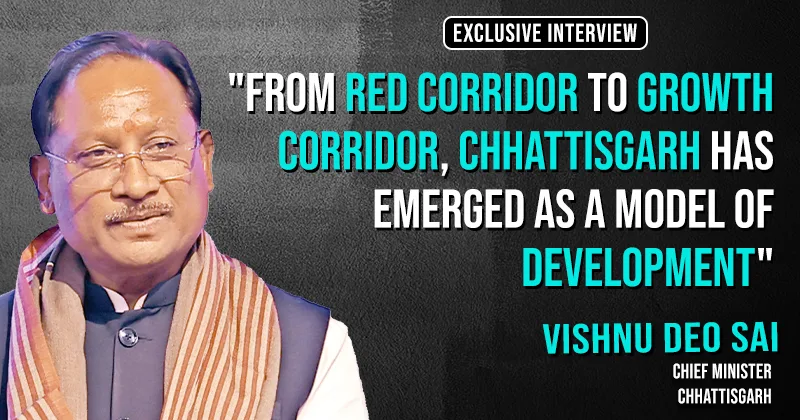
Chhattisgarh has completed 25 years since its formation. On this occasion, Organiser Weekly hosted a special conclave titled “Chhattisgarh @ 25: Shifting the Lens.” On the sidelines of this conclave, Chief Minister Vishnu Deo Sai spoke in an exclusive conversation with Organiser, Editor Prafulla Ketkar, reflecting on the State’s journey, achievements, and future roadmap. Excerpts:
Chhattisgarh was made out of Madhya Pradesh under the then Prime Minister Atal Bihari Vajpayee. After 25 years, how do you assess that decision in terms of fulfilling regional aspirations and development?
If we look back after 25 years, the decision to create Chhattisgarh in 2000 can be seen as both timely and necessary. Statehood allowed long-standing regional aspirations to be addressed through more focused governance. Since then, Chhattisgarh has emerged as a power-surplus state, significantly improved road and digital connectivity, and expanded access to health and education, particularly in janjati and remote areas.
At the same time, the State has built a strong economic base. It has recorded mineral revenues of more than Rs 12,000 crore in recent years and today contributes over 17 per cent of Bharat’s total mineral production. Industry now accounts for about 42 per cent of the State’s Gross State Value Added (GSVA), well above the national average. While certain regional challenges persist, which are addressed gradually – overall progress clearly reflects the benefits of dedicated administration and development aligned with local needs.
When you look back at Chhattisgarh’s 25-year journey, what do you consider the most transformative milestones in the State’s evolution?
When I reflect on Chhattisgarh’s 25-year journey, several transformative milestones stand out. Most significant is the scale of economic expansion achieved since statehood. Between 2000 and 2025, the State budget increased nearly 30 times—from Rs 5,471 crore to about Rs 1.65 lakh crore—while per capita income rose 17 times to Rs 1,81,343. Over the same period, Gross State Domestic Product (GSDP) expanded nearly 25 times to Rs 6.36 lakh crore, reflecting sustained growth and rising prosperity. Equally important milestones include achieving power-surplus status, expanding road and digital connectivity into remote and janjati areas, strengthening welfare delivery through focused governance, and emerging as a major centre for mining and industry.
Maoism has been described both as a law-and-order problem and as an ideological challenge for underdevelopment. How do you see these allegations?
Maoism in Chhattisgarh cannot be viewed solely as a law-and-order concern arising from underdevelopment; at its core, it represents an ideological challenge that rejects democratic processes and promotes armed conflict. As highlighted by the Union Home Minister Amit Shah, Left-Wing Extremism (LWE) is driven by an ideology that legitimises violence and cannot be explained only by socio-economic shortcomings. Insurgents deliberately choose confrontation over dialogue within the constitutional framework.
At the same time, focused development and governance measures have significantly reduced the influence of extremism. Integrated strategies combining security operations with infrastructure expansion, education, and healthcare in previously inaccessible regions have contributed to declining violent incidents and higher rates of surrender. These steps demonstrate that while socio-economic gaps may have been exploited in the past, the principal issue remains ideological, and addressing it effectively requires a combination of security action and inclusive development to reinforce public trust in democratic institutions.
Union Home Minister Amit Shah has said that Naxalism is on the verge of elimination. How close is Chhattisgarh to complete eradication, and what remains to be done?
Chhattisgarh has made significant progress in controlling Naxalism. Over the past decade, coordinated security operations, improved intelligence, and strengthened local policing have led to a sharp decline in violent incidents, while increased infrastructure, connectivity, education, and employment opportunities in affected regions have reduced the appeal of extremism.
The double-engine collaboration between the State and Central Governments has been particularly effective. More than 500 Naxals have been neutralised, over 2,500 have surrendered, and nearly 1,900 arrests have been made. Additionally, around 86 security camps have been established across five sensitive regions of Chhattisgarh. While these efforts have substantially weakened LWE, complete eradication requires continued focus on janjati development, rehabilitation of surrendered cadres, and sustained community engagement to prevent any resurgence.
Bastar was once the epicentre of Red Corridor violence. Today, infrastructure and welfare outreach are expanding. What structural and administrative shifts made this transformation possible?
The transformation of Bastar has been made possible through strategic structural and administrative reforms that link security measures with development and governance. A significant shift has been moving from a primarily conflict-focused approach to a comprehensive development model, emphasising improved connectivity, essential services, and active community participation. The Government has initiated infrastructure projects worth around Rs 52,000 crore, covering roads, railways, healthcare, education, tourism, and industrial development, aimed at enhancing accessibility and livelihoods. Notable among these is the Rs 3,513 crore Rowghat–Jagdalpur railway line, which connects remote districts to the national network and facilitates access to markets and public services.
Programmes like ‘Niyad Nella Nar’ bring welfare directly to janjati villages, while reopening schools, health centres, and enhancing digital and power access has restored public trust, moving Bastar from conflict to inclusive growth. By combining these administrative reforms with sustained security presence, Bastar has gradually transitioned from being a centre of conflict to a region characterised by peaceful development, social inclusion, and improved quality of life.
What is your plan to ensure economic growth, particularly for Janjati communities and remote regions by 2047?
Our plan for Chhattisgarh through 2047 focuses on inclusive and sustainable growth, ensuring that economic prosperity reaches janjati communities and remote regions. Key priorities include expanding infrastructure—roads, railways, digital connectivity, and power—to integrate isolated areas with markets and services. We aim to strengthen education, skill development, and healthcare, enabling janjati youth to access emerging opportunities. Targeted livelihood and entrepreneurship programs will support local industries, agriculture, and forest-based economies.
Bastar stands as a model of inclusive and culturally sensitive development in Chhattisgarh. A major milestone in this effort is the establishment of the Nagarnar steel plant, a Rs 23,800 crore project that not only boosts local industry but also creates meaningful employment opportunities for janjati communities. Complementing this, a 118-acre industrial area near Nagarnar is being developed to support small and medium enterprises in sectors like textiles, food processing, and furniture manufacturing.