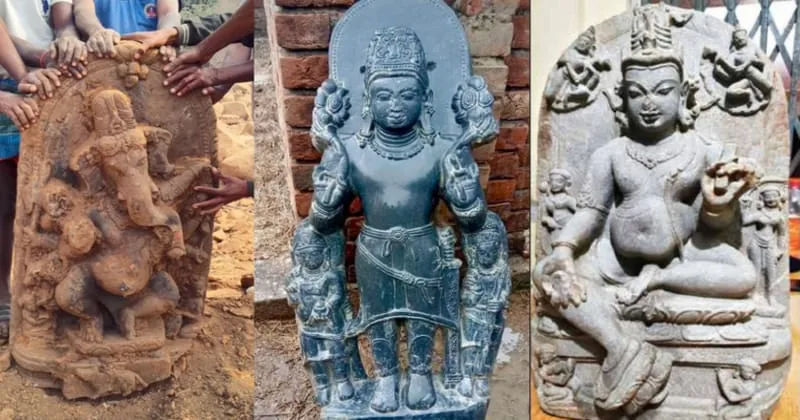
Several statues of Hindu deities have recently been unearthed across various parts of Bihar, shedding light on the state’s rich cultural heritage. These relics were discovered in districts including Nalanda, Gaya, Vaishali, and Jamui.
बिहार की मिट्टी आज भी अपना गौरवशाली इतिहास उगल रही है!
पिछले कुछ समय में नालंदा, गया, वैशाली और जमुई जैसे जिलों में जो प्राचीन प्रतिमाएं मिली हैं, वे अद्भुत हैं।कहीं 2000 साल पुरानी बुद्ध प्रतिमा, तो कहीं पाल काल के सूर्य देव और भगवान विष्णु। नगरजुनी की पहाड़ियों से लेकर… pic.twitter.com/8HjwVUzAJi
— Dr. Ashutosh Singh (@reach_ashutosh) January 14, 2026
The discoveries include Buddha statues dating back 1,200–2,000 years from Nalanda, Gaya, and Vaishali, along with a 1,500-year-old Ganesha murti unearthed at the Nagarjuni Hills in Jamui. Murtis of Vishnu and Surya from the 8th–10th century Pala period were found in Lakhisarai and Madhubani. Additionally, Jain Tirthankara statues over 1,000 years old were discovered in Nawada and Gaya. The findings also comprise Shaivite sculptures from Gopalganj and Rohtas, a 1,300-year-old Vishnu statue from Bhagalpur, and a Surya Dev statue from Jamui.
जमुई में मिली 1500 साल पुरानी गणेश प्रतिमा ने आज एक बहुत बड़े सच से पर्दा उठा दिया है। सोचिए, जिसे हम आज सिर्फ एक मिठाई 'पेड़किया' समझते हैं, वो असल में हमारी प्राचीन सभ्यता का प्रतीक है।
उस मूर्ति में गणेश जी के हाथ में कोई गोल लड्डू नहीं, बल्कि साफ तौर पर हमारा अपना… https://t.co/bWlKbqEwJx pic.twitter.com/68QyKa2WWb
— Dr. Ashutosh Singh (@reach_ashutosh) January 15, 2026
The 1,500-year-old Ganesha murti discovered in Jamui is depicted holding a sweet called ‘Pedakiya,’ believed to be the original form of the ‘Modak,’ the traditional Indian dumpling offered to Bhagwan Ganesha during Ganesh Chaturthi. Pedakiya is a crescent-shaped sweet, believed to symbolise the crescent moon on Bhagwan Shiva’s forehead.
Ancient sites discovered in Odisha and other states
Following the recent discoveries in Bihar, a rare archaeological find was reported at the Bhimmandali mountains in Redakhol, Sambalpur district of Odisha. The Archaeological Survey of India (ASI) conducted an extensive survey of the site, believed to hold traces of a 10,000-year-old civilisation. Researchers uncovered rock-cut paintings, tools, and other artefacts at 42 locations across Bhimmandali, Raila, Landimal, and Luhapanka panchayats, as well as in the protected forests of Chhatagada and Brahmani. The rock carvings, depicting animals and birds, offer a glimpse into the artistic expressions of early humans.
In June of last year, researchers from the Indian Institute of Technology Gandhinagar (IITGN), in collaboration with IIT Kanpur, IUAC Delhi, and PRL Ahmedabad, reported firm evidence of pre-Harappan human settlements in the Kachchh region of Gujarat. The study revealed that humans inhabited the area as early as 5,000 years before the emergence of the Harappan civilisation. Large heaps of discarded shells, identified as shell middens, indicated that prehistoric communities lived in mangrove-rich landscapes and consumed shell species like oysters and gastropods.
In July 2025, another significant discovery was made in Maski town, Raichur district, Karnataka. Evidence suggests that humans inhabited the region around 4,000 years ago. A collaborative team of 20 researchers from India, Canada, and the United States carried out excavations around Mallikarjun Hill, near the Mallikarjuna Mandir and the Anjaneya Swamy Mandir. The team unearthed a variety of artefacts and tools dating back four millennia, indicating that the area was once a thriving settlement.