China’s expanding interest in the Arctic is entering a more restrictive security environment as the United States, Denmark and Greenland deepen defence cooperation and introduce tighter controls on foreign military activity and investment.
The new framework gives the US a greater role in Greenland’s security while strengthening NATO’s position in the High North, areas that could complicate China’s Arctic ambitions in shipping, critical minerals, infrastructure and scientific activity.
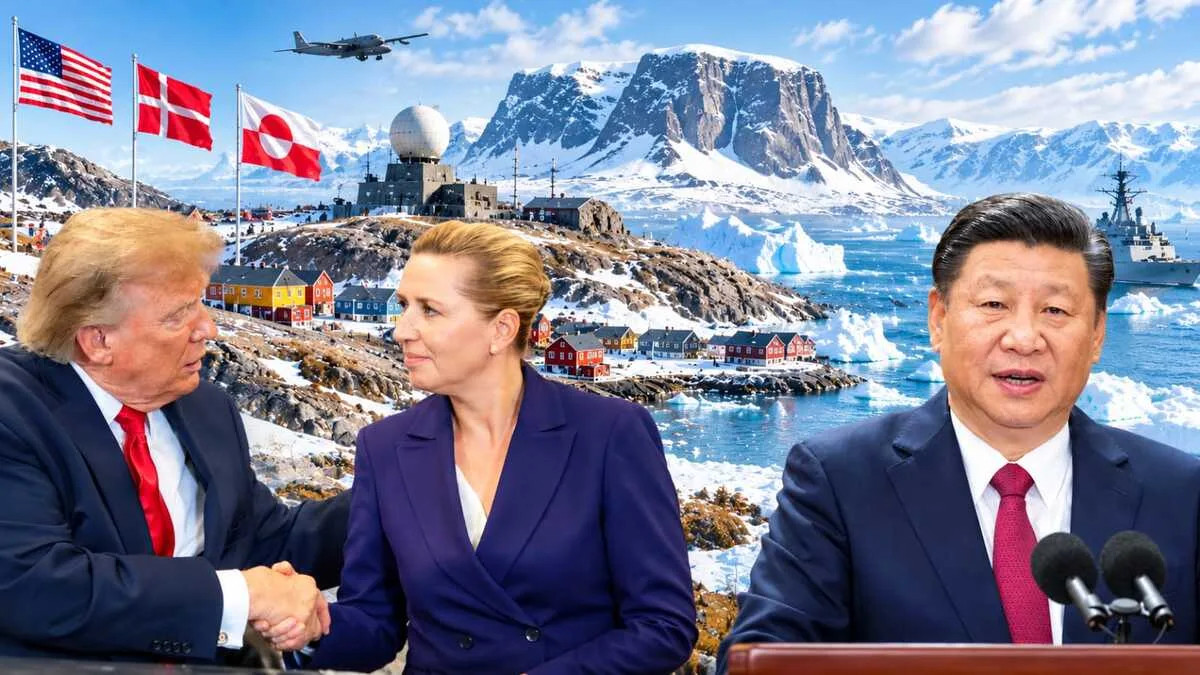
A trilateral agreement signed on Sept. 22 by US President Donald Trump, Danish Prime Minister Mette Frederiksen and Greenlandic Prime Minister Jens-Frederik Nielsen permits Washington to expand its activities at Pituffik Space Base and establish new defence areas at Narsarsuaq and Mestersvig. The agreement also supports stronger NATO planning, military presence, exercises and intelligence cooperation in the Arctic.
For China, the significance extends beyond military geography. Greenland’s location, mineral resources and potential infrastructure links make it relevant to Beijing’s long-term Arctic strategy. The new US and NATO arrangements could therefore make it harder for Chinese companies to obtain strategic assets or develop a sustained presence in sensitive sectors.
China’s Arctic strategy moves beyond scientific research
China’s Arctic ambitions have developed gradually over several decades. Beijing has invested heavily in polar scientific research, but its interests now encompass shipping, natural resources, infrastructure and wider participation in Arctic governance.
China formally described itself as a “near-Arctic state” in its 2018 China’s Arctic Policy white paper. The document stated that the Arctic had growing strategic, economic, scientific and transportation importance and outlined Beijing’s goals of understanding, protecting, developing and participating in the governance of the region.
BREAKING:
The leaders of USA, Denmark and Greenland just signed a new security agreement on Greenland
🇺🇸🇩🇰🇬🇱 pic.twitter.com/MiRnoU9vDn
— Visegrád 24 (@visegrad24) September 22, 2026
The same policy introduced the concept of a “Polar Silk Road”, linking China’s Arctic ambitions to the broader Belt and Road Initiative. Beijing encouraged Chinese enterprises to participate in Arctic infrastructure construction and commercial shipping while also pursuing cooperation in resource development.
China’s Arctic activities have therefore evolved from scientific expeditions into a broader combination of research, commercial engagement and maritime planning. That ambition is continuing under China’s 15th Five-Year Plan for 2026–2030.
The plan calls for stronger marine capabilities, support for deep-sea and polar exploration, long-distance meteorological and navigation services, and improved capabilities to enter, explore, develop and operate safely in deep-sea environments.
The plan also emphasises building China into a stronger maritime power and expanding its marine industries. For the Arctic, those priorities matter because improved polar research, navigation, shipping and marine engineering can provide capabilities with applications well beyond scientific activity.
US and NATO strengthen their Arctic position
The new Greenland agreement significantly expands the US role in the Arctic island’s defence arrangements. Under the agreement, the US can modernise and expand operations at Pituffik Space Base and establish additional defence areas at Narsarsuaq in southern Greenland and Mestersvig in eastern Greenland.
Washington is also given broad access for its military aircraft, vessels and forces across Greenland and its territorial waters, subject to the agreement’s provisions. The agreement explicitly calls for stronger NATO engagement in the Arctic, including planning, military presence, exercises and joint intelligence gathering. It also allows for additional defence areas to be established in Greenland through consultation among the parties.
The security provisions are particularly relevant to China because the agreement states that countries outside NATO cannot establish their own manned or unmanned military installations in Greenland or maintain a persistent military presence there unless otherwise agreed.
The restrictions are not limited to military activity. The agreement also introduces controls over foreign investment in particularly sensitive sectors. Investors from states outside NATO, NATO partner countries and the European Union cannot obtain control, significant influence or access to certain non-public information where this could threaten national security or public order, unless the parties agree otherwise.
Because China is outside NATO and the EU, these provisions could become significant for future Chinese investment proposals involving Greenland’s strategic infrastructure and resources.
Greenland’s minerals draw Chinese interest
Greenland has long attracted attention because of its substantial mineral potential. Its deposits include rare earth elements as well as graphite, tungsten, vanadium, copper and uranium.
Chinese companies have previously explored opportunities in Greenland’s mining sector.
One prominent case was the Isua iron ore project, where China’s General Nice Group became involved after acquiring development rights in 2015. The same company later sought to acquire the former naval facility at Gronnedal. Denmark rejected that proposal on national security grounds and decided to reopen the facility.
The Isua mining licence was eventually revoked in 2021 after the project remained undeveloped and required payments were not made. Chinese interests have also extended to Greenland’s rare-earth resources. Shenghe Resources, a Chinese rare-earth company with state connections, became a major shareholder in the Kvanefjeld rare-earth and uranium project and signed a 2018 memorandum of understanding concerning the processing and marketing of minerals from the project.
#WATCH | At the 81st session of the United Nations General Assembly (UNGA), US President Donald Trump says, "As I announced just days ago, the United States has also reached an unprecedented agreement regarding the northern frontier of North America, the large and strategically… pic.twitter.com/X7Z4z6nnCi
— ANI (@ANI) September 22, 2026
Kvanefjeld, however, never entered production. Greenland subsequently introduced legislation restricting uranium-related mining, preventing the project from proceeding. These episodes illustrate why Greenland’s mineral sector has become closely connected with broader questions of security and foreign investment.
For China’s Arctic strategy, access to minerals is important not only because of commercial value but also because rare earths and other critical minerals have strategic significance for advanced manufacturing and technology. The new investment provisions therefore create an additional layer of scrutiny for potential Chinese participation in Greenland’s resource economy.
The Arctic shipping route and China’s maritime dilemma
Shipping is another central element of China’s Arctic ambitions. Beijing has viewed the Arctic as a possible alternative to traditional maritime routes linking Asia with Europe. The Northern Sea Route, running along Russia’s Arctic coast, has attracted particular attention because it can potentially shorten some Asia-Europe voyages compared with routes through the Suez Canal.
China’s interest in the Northern Sea Route is closely connected to its Polar Silk Road concept. Beijing has sought cooperation with Russia in Arctic energy, shipping and infrastructure projects, while Russian territory provides the principal geographical corridor for the route. China’s wider maritime strategy is also influenced by its dependence on southern sea lanes.
The Strait of Malacca remains one of the world’s most important maritime chokepoints for Chinese trade and energy supplies. This dependence has long contributed to discussions in China about the so-called “Malacca Dilemma”, the vulnerability created by reliance on a narrow maritime passage.
An Arctic route cannot simply replace the Malacca Strait or other established routes. Harsh weather, seasonal ice, limited infrastructure and dependence on Russian-controlled Arctic waters remain significant constraints. Nevertheless, China’s Arctic ambitions reflect an effort to diversify its maritime options.
The US Department of Defense has identified China’s growing Arctic activity as part of a changing security environment. Its 2024 Arctic Strategy said Beijing was seeking greater influence and access in the region and noted that China operates three icebreakers supporting research activities with potential dual civilian-military applications. The Pentagon also highlighted growing China-Russia cooperation in the Arctic.
A more contested Arctic for China
The new Greenland agreement does not shut China out of the Arctic. Chinese vessels can still operate in waters where international law and applicable national jurisdictions permit them, and Beijing retains its scientific, commercial and diplomatic relationships across the region. China’s 2018 Arctic policy itself emphasises international cooperation, international law and participation in Arctic governance.
China is expanding its Arctic presence through scientific research, commercial shipping routes, and partnership with Russia to systematically build strategic leverage and operational capabilities in the region.
Link in thread. pic.twitter.com/ybv3NBjHJE— The Epoch Times – China Insider (@EpochTimesChina) September 30, 2026
However, the strategic environment around Greenland is changing. The US and NATO are increasing their emphasis on Arctic surveillance, military access, intelligence cooperation and infrastructure. The Greenland agreement adds another layer by restricting military installations by non-NATO states and subjecting sensitive investment from non-NATO and non-EU countries to security screening.
That matters because Greenland sits in a strategically important position between the Arctic and North Atlantic. Mestersvig, on the island’s east coast, is particularly relevant to wider North Atlantic security considerations, while Greenland as a whole occupies a crucial position between North America and Europe. For China, this means its Arctic ambitions will increasingly operate within a region where economic activity and national security are becoming more closely connected.
Beijing’s Polar Silk Road, its maritime-power programme, its cooperation with Russia and its interest in Arctic minerals all remain components of its broader Arctic strategy. But access to strategic infrastructure and sensitive resources in Greenland is becoming more difficult as the US, Denmark and NATO strengthen their security arrangements.
The Sept. 22 agreement consequently represents a significant change in the operating environment surrounding China’s Arctic ambitions. It does not eliminate Chinese commercial or scientific activity in the Arctic, nor does it end Beijing’s cooperation with Russia. Instead, it places Greenland’s military infrastructure and sensitive economic sectors behind stronger US, Danish and NATO security mechanisms.
As the Arctic becomes increasingly important for shipping, critical minerals, scientific research and strategic access, China’s Arctic ambitions will face a region where economic opportunity is increasingly shaped by security considerations. For the US and NATO, Greenland has become a central part of that security architecture. For China, it represents another example of the narrowing strategic space in which its Arctic strategy must operate.