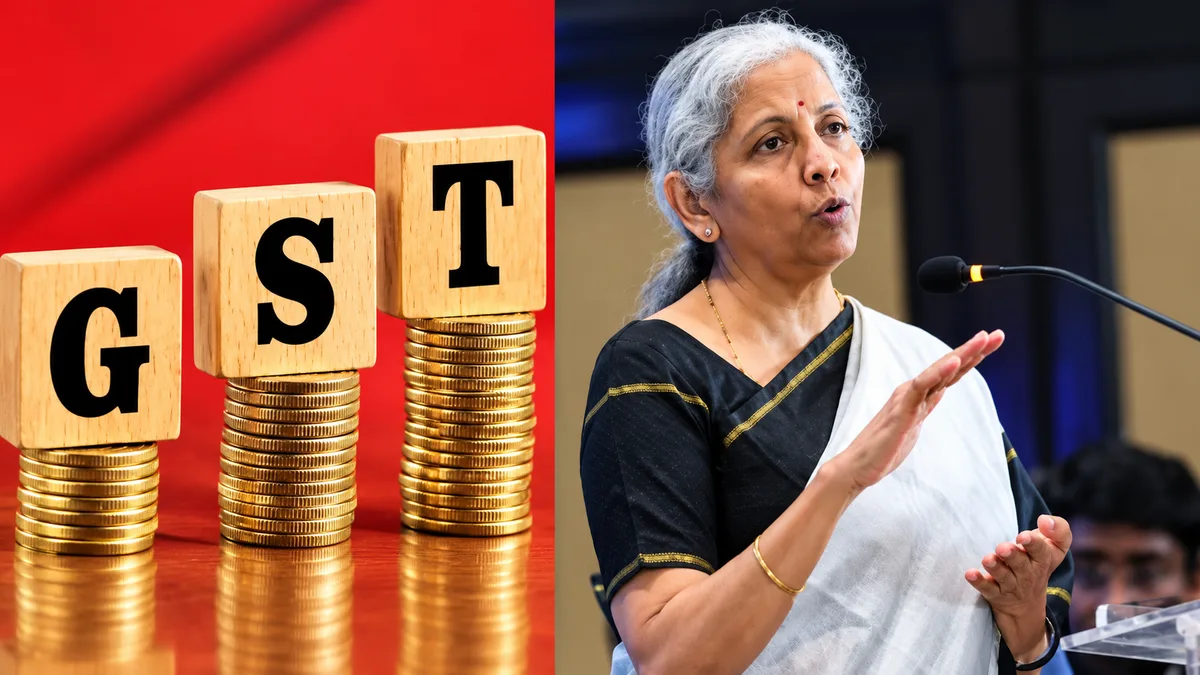
NEW DELHI: The 57th GST Council meeting, scheduled for October 8, is expected to mark the next phase of GST 2.0, with the focus shifting from tax-rate rationalisation to simpler compliance, faster refunds, reduced litigation and more proportionate enforcement.
Among the key proposals under consideration are curbs on GST arrest powers, raising the prosecution threshold from ₹1 crore to ₹5 crore, protecting genuine taxpayers’ input tax credit, simplifying registration and easing compliance for businesses and e-commerce sellers.
Chaired by Union Finance Minister Nirmala Sitharaman and comprising finance ministers of states and Union Territories, the Council is expected to consider a wide-ranging package of process and enforcement reforms.
The agenda comes after the major GST rate rationalisation undertaken in September 2025, when the tax structure was simplified around a 5 per cent merit rate and an 18 per cent standard rate, with a 40 per cent rate retained for select luxury and demerit goods.
The next phase is expected to focus less on rates and more on how GST is administered, with the government seeking to reduce compliance costs while using technology and data to detect deliberate tax evasion.
Next-Gen GST is delivering on its twin objectives of relief for taxpayers and greater momentum for our economy.
The next phase will focus on making compliance simpler across registration, returns, refunds, disputes and input tax credit.
A simpler, more predictable and…
— Nirmala Sitharaman Office (@nsitharamanoffc) October 5, 2026
Decriminalisation of GST offences; Arrest powers may be curbed
One of the most significant proposals concerns the power of GST authorities to arrest taxpayers. Under the existing framework, Section 69 of the Central GST Act allows the Commissioner, subject to statutory conditions and reasons to believe that specified serious offences have been committed, to authorise an officer to arrest a person.
The proposal under consideration could remove this standalone arrest route for GST officers. Any arrest would instead require judicial authorisation. The move is part of broader recommendations on decriminalisation of GST offences. The objective is to distinguish serious cases involving deliberate tax evasion, fake invoicing or fraudulent input tax credit from routine tax disputes involving interpretation, classification or valuation.
The proposed framework would not take away the government’s ability to recover tax, levy interest or impose financial penalties. Serious cases involving deliberate fraud or evasion could continue to face prosecution.
Prosecution threshold may rise from ₹1 crore to ₹5 crore
The Council may also consider raising the threshold for launching prosecution from the existing ₹1 crore to ₹5 crore. The proposal is aimed at reserving criminal proceedings for cases involving substantial tax evasion or fraud, while keeping relatively routine disputes outside the criminal process.
The proposals also seek to narrow the scope of prosecutable offences. Of the offences currently covered by prosecution provisions, some could be removed, while others may be retained or softened. Changes to sentencing provisions are also under consideration, including removal of the minimum sentence and reduction of the maximum sentence in one category from three years to two years.
Genuine Buyers could get greater input tax credit
Another major industry demand relates to input tax credit (ITC). At present, genuine taxpayers can face difficulties in claiming ITC where a supplier fails to deposit the tax collected with the authorities. Industry has sought protection for buyers who possess valid invoices and have acted in good faith.
Under the proposed framework, recovery action could instead be directed primarily towards the defaulting supplier, provided there is no evidence that the buyer participated in tax evasion. The measure could address a significant source of GST disputes and provide greater certainty to businesses dealing with large networks of vendors.
The Council may also consider allowing businesses to claim ITC on GST paid on life and health insurance premiums provided to employees. Employer-provided group insurance currently attracts 18 per cent GST, while businesses generally cannot claim the tax as credit.
GST registration set for major process overhaul
Registration reform is another key focus. The industry is seeking a guided, single-attempt application process, under which applicants would receive step-by-step assistance, see only sections relevant to their business and receive a customised list of documents required for registration.
Businesses could also be allowed to carry forward information from an existing GSTIN in another state. Applicants seeking registrations across multiple states may be permitted to submit applications simultaneously.
The proposed system could also automatically allocate the appropriate tax jurisdiction based on business details. For larger, low-risk businesses, approval could be made risk-based and time-bound, reducing unnecessary intervention by tax officials.
A unified documentation process, simpler annual returns and a quarterly tax-payment option for certain MSMEs supplying only to consumers are also under consideration.
E-Commerce sellers could get easier multi-state registration
The Council may consider changes to registration rules for small sellers operating through e-commerce platforms. Under the proposal, platform warehouses could potentially be used as registered places of business in states where sellers do not maintain their own premises.
A seller would first need to establish a genuine presence in at least one state, including physical verification and Aadhaar authentication. Registrations in other states could then potentially be obtained with the consent of the e-commerce platform.
The measure could benefit around 9.5 lakh small sellers by allowing them to access wider markets without maintaining separate physical premises in every state.
₹10,000 litigation threshold under consideration
The Council may also seek to reduce low-value litigation by restricting GST notices where the tax demand is below ₹10,000. Such cases reportedly account for around one-fifth of cases by number despite involving relatively small amounts of revenue. The proposal could also extend to pending adjudication and appeal matters.
For demands above the threshold, tax officers may first issue an intimation and give taxpayers an opportunity to respond before issuing a formal show-cause notice. The proposals also seek greater uniformity in drafting and serving notices, distinguishing fraud or suppression from bona fide short payment, providing personal hearings and issuing reasoned orders.
Faster refunds through risk-based processing
The Council may also consider greater automation in GST refunds. Although the system approved the release of 90 per cent of eligible refunds within seven days in September 2025, an officer currently has to determine whether a taxpayer qualifies as low-risk.
A proposed risk-scoring mechanism could automate this assessment. Claims matching available taxpayer records and filings could be classified as low-risk and released automatically, while mismatched claims could be subjected to further scrutiny.
The objective is to speed up genuine refunds while directing administrative resources towards higher-risk cases.
Export anomaly may be addressed
The Council may also address a GST anomaly affecting India’s services exporters, particularly global capability centres (GCCs). GCCs undertake engineering, product development and testing for overseas group companies and are generally paid in foreign exchange. However, certain services can attract 18 per cent GST because of rules determining where the service is considered to have been delivered.
Where an overseas group sends goods to its Indian centre for work to be performed on those goods, the service may currently be treated as supplied in India rather than abroad. A proposed amendment could allow such services to qualify as exports, potentially making them GST-free while allowing refunds of tax paid on inputs.
Goods movement, e-commerce delivery and precious metals
The Council may also examine intelligence-led checks on goods vehicles. Under the proposed system, vehicles could generally be stopped only with prior authorisation from a senior officer, reducing repeated checks during interstate movement.
Another proposal involves a uniform 5 per cent GST rate without ITC for delivery of goods ordered through e-commerce platforms. The Council is also expected to consider withdrawing the IGST exemption available to specified banks and nominated agencies importing gold, silver and platinum. These metals attract 3 per cent IGST, but specified entities currently enjoy an exemption at the import stage.
Gold imports rose 3.38 per cent to $17.47 billion during April-August 2026-27, while silver imports declined 8.81 per cent to $1.74 billion.
GST enters its next reform phase
The proposed changes come against the backdrop of stronger GST collections and expanding reported taxable activity. According to Finance Minister Nirmala Sitharaman, reported taxable supplies grew 25.8 per cent between October 2025 and July 2026 compared with the corresponding period a year earlier.
Gross GST collections reached ₹12.46 lakh crore during April-September 2026, registering 11.6 per cent growth over the corresponding period last year. Collections recorded double-digit annual growth in each of the four months from June through September.
Sitharaman has said that taxpayer experience must continue to guide GST implementation, with the tax system’s growing maturity providing a foundation for the next stage of reform. The proposed package therefore signals a shift from the initial task of building a unified indirect tax system and rationalising rates towards simpler registration to faster refunds, legitimate ITC protection, reduced litigation and technology-led enforcement.