आपो हि ष्ठा मयोभुवः
“O Waters, you are the bearers of well-being.” — Rigveda 10.9.1
When the Pradhan Mantri Matsya Sampada Yojana (PMMSY) completed six years on 10 September 2026, the figures it carried a economy of few sectors can match. India’s fish production climbed from 141.64 lakh tonnes in 2019-20 to a record 197.75 lakh tonnes in 2024-25, an addition of more than 56 lakh tonnes. Fisheries exports rose from Rs 46,663 crore to Rs 73,890 crore in 2025-26, a jump of nearly 58 per cent. The scheme has also opened direct and indirect work for 58 lakh people in fisheries and aquaculture.
For a sector that sustains nearly three crore livelihoods, a large share of them in marginalised coastal and inland communities, these are not abstract gains. They are boats that return with fresher catch, village ponds turned into productive assets and young people who now see a future in water rather than a reason to migrate. The Government has recognised fisheries as a Sunrise Sector, and PMMSY is the clearest expression of that conviction.
A civilisation that never turned its back on water
India’s relationship with its rivers and seas is older than any budget line. In Puranic tradition, Vishnu’s first avatar is Matsya, the fish who carries the seeds of life through the great deluge. Kautilya’s Arthashastra placed fishing under the oversight of the Navadhyaksha, the superintendent of shipping, who collected dues from those who worked the waters. The fisher has always been part of the Indian economic imagination.
What the sector lacked for decades was infrastructure and institutional focus matched to its scale. The creation of a dedicated Ministry of Fisheries, Animal Husbandry and Dairying in 2019 changed the conversation, and PMMSY, launched in 2020 as a successor to the Blue Revolution scheme, was designed to close the gaps that remained across the fisheries value chain, from seed and feed to harbour and market.
The money behind the mission
PMMSY has run since 2020-21 with a total outlay of ₹20,750 crore. In the Budget Estimates for 2026-27, the Government set aside a record ₹2,500 crore for the scheme, a signal that support is deepening rather than tapering. As of 11 August 2026, the Department of Fisheries had approved projects worth ₹21,394.88 crore for the period 2020-21 to 2025-26, carrying a Central share of ₹9,510.89 crore. These approvals rest on proposals from States, Union Territories and implementing agencies, which makes the scheme a genuinely cooperative federal effort.
The Central Sector component, fully funded by the Centre, covers genetic improvement, aquatic quarantine, disease surveillance, harbour modernisation, fisher safety, certification and traceability. The Centrally Sponsored component, shared with States and implemented by them, targets production, post-harvest infrastructure and fisheries regulation.
Nested within the umbrella is the Pradhan Mantri Matsya Kisan Samridhi Sah-Yojana (PM-MKSSY), a ₹6,000 crore sub-scheme running from 2023-24 to 2026-27. Its brief is formalisation with wider insurance cover, easier access to institutional credit and stronger quality assurance, so that fishers negotiate markets from a position of strength rather than vulnerability.
The State-led component is broad by design. Beyond inland and marine fisheries, it reaches mariculture, seaweed, ornamental fisheries, the Himalayan and North-Eastern States and Union Territories, regions whose cold water and riverine resources were long treated as peripheral.
It also funds deep-sea fishing, integrated modern coastal fishing villages and extension services that carry new practices from the laboratory to the pond. The Central component, for its part, strengthens the National Fisheries Development Board, cooperatives and Self-Help Groups, so that institutions grow alongside infrastructure.
The inland turn of PMMSY
PMMSY has approved 52,058 reservoir cages and 23,285.06 hectares of pond area for inland aquaculture. It has backed 12,081 Recirculating Aquaculture Systems and 4,205 Biofloc units, alongside 2,672 ornamental fish rearing and integrated units. Twelve Integrated Aquaparks have been sanctioned at a cost of ₹713.80 crore, and projects worth ₹198.17 crore have gone to seaweed cultivation and allied activities.
A Recirculatory Aquaculture System filters and reuses water, allowing intensive farming on a small footprint. Biofloc relies on beneficial microbes that clump together, cleaning the water and doubling as natural feed; practitioners call it “green soup”. Both let a farmer in a water-stressed district raise more fish with less land and water, which is precisely the kind of efficiency a landlocked hinterland needs if it is to share in the Blue Economy.
Cold chains and the last mile
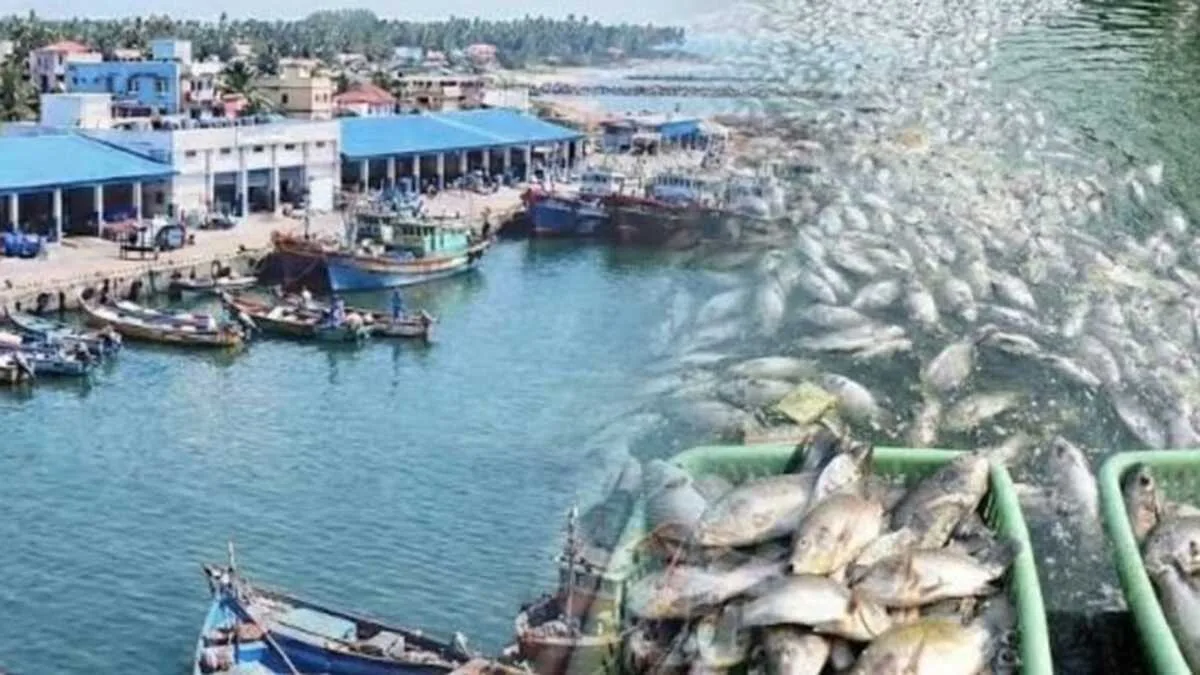
A fish caught is worth little if it spoils before it is sold. Over the last five years, the Department has approved ₹3,741.89 crore for 28 fishing harbour projects, 25 fish landing centres and 23 dredging projects. ₹2,797 crore has gone to cold-chain and marketing infrastructure. As of 11 August 2026, this covered 28,489 fish transportation units, 1,394 live fish vending units, 6,018 fish kiosks, 117 retail markets, 775 cold storages, ice plants and 24 wholesale fish markets.
This is the unglamorous middle of the value chain, and it is where incomes are either protected or lost. Better handling means fewer distress sales, less wastage and a product fit for discerning domestic buyers as well as foreign ones. The same facilities serve inland produce too, giving fish farmers in the interior a route to distant markets that once belonged only to coastal traders.
Fish is among the most affordable sources of animal protein for Indian households, and a cold chain that reaches small towns widens its availability well beyond the coastline. Fisheries in this sense sits at the meeting point of livelihoods, food security and exports, three priorities that rarely align so neatly in a single sector.
The impact is easiest to see at the level of a single enterprise. In Porbandar, Gujarat, Pravinbhai Babulal Masani had spent over two decades in fishing and knew that an ice plant would transform his business, but the capital cost was beyond him. In 2021-22, he received a ₹48 lakh subsidy under PMMSY and set up a 30 MT per day plant. Boats now leave harbour with enough ice to keep their catch fresh; spoilage has fallen, and his family’s earnings have improved. Multiply that story across thousands of harbours and markets, and the aggregate numbers begin to make sense.
Antyodaya on the waterfront
The scheme has a social spine that lies in collective strength. Between 2021-22 and 2025-26, projects worth ₹544.86 crore were approved to establish 2,195 Fish Farmers Producer Organisations (FFPOs), with support for incubation, management costs and equity grants. An individual fisher bargains alone; an FFPO bargains for hundreds, and that shift in negotiating power is the practical meaning of Antyodaya.
Coastal communities, among the most exposed to a changing climate, have received targeted attention. One hundred fishing villages have been identified as Climate Resilient Coastal Fishermen Villages, each backed by ₹2 crore of fully Central funding for resilient infrastructure, livelihoods and post-harvest facilities. The regulatory component adds insurance for vessels and fishers, monitoring and surveillance and stronger safety measures at sea.
A digital identity for the fisher
Perhaps the most far-reaching reform is the least visible. The National Fisheries Digital Platform (NFDP), launched under PM-MKSSY in September 2024, gives fishers and fish farmers work-based digital identities and builds a national stakeholder database. It works as a single window for institutional credit, aquaculture insurance, traceability and performance-linked incentives.
As of 8 September 2026, it had recorded over 37.01 lakh individual registrations, with total registrations crossing 37.23 lakh. For a sector long dominated by informal arrangements, being counted is the first step towards being served.
The platform also supports cooperatives, training and capacity-building, which matters because a digital identity is only as useful as the fisher’s ability to act on it. Credit that once depended on a local moneylender’s goodwill can now follow a documented record of work, and insurance that seemed remote becomes a matter of registration.
PMMSY also aligns India with Sustainable Development Goal 14, Life Below Water, by encouraging cage culture, mariculture, RAS and biofloc over practices that strain natural stocks. The challenge now is to convert approvals into completed, well-run assets and to ensure that traceability and certification keep Indian seafood competitive as global buyers tighten standards.
Equally important is sustaining momentum in regions that joined the journey late, so that growth in the North-East and the hill States matches what the coastal States have already achieved. Each completed harbour, each registered fisher and each functioning producer organisation adds to the sector’s contribution to rural incomes and national value addition and makes the next phase of investment easier to justify.
Six years ago fisheries sat at the margins of economic policy. Today it is a Sunrise Sector with record output, rising exports and a digitally registered workforce. In an Aatmanirbhar Bharat, the waters that the Rigveda hailed as bearers of well-being are once again becoming a source of prosperity for those who have always lived by them.