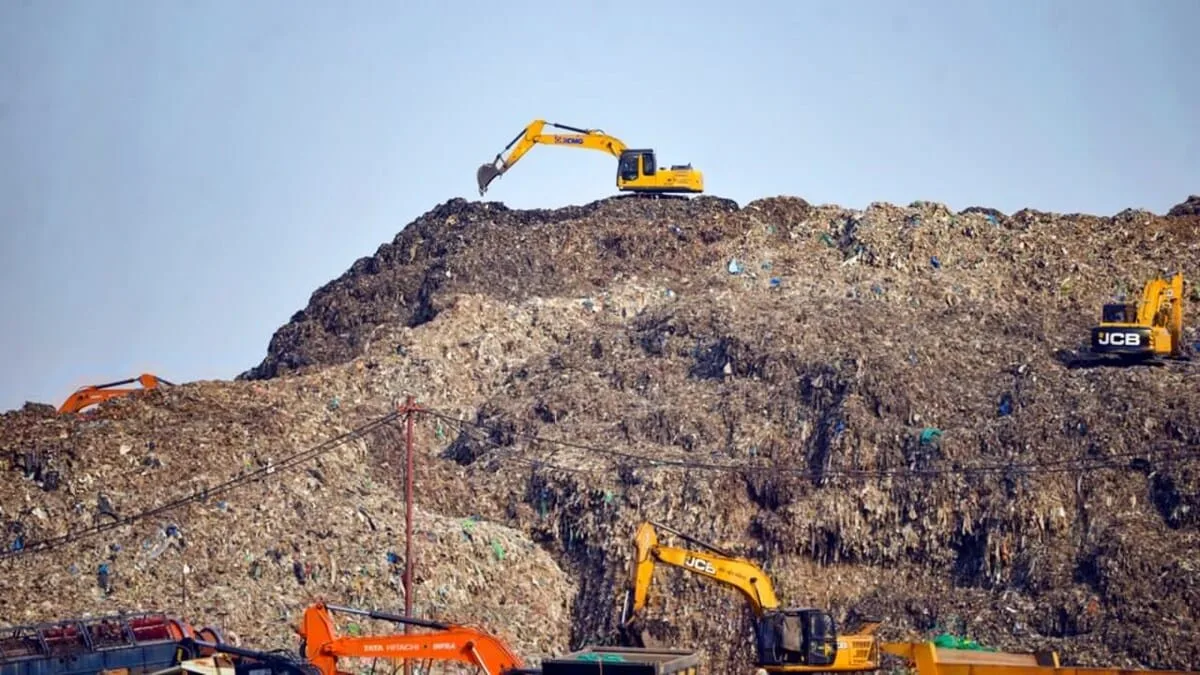
NEW DELHI: Delhi’s long-standing garbage crisis is witnessing a significant shift, with the BJP government accelerating the scientific disposal of legacy waste from the capital’s three major landfill sites, Okhla, Bhalswa and Ghazipur. In the past 18 months, 21.717 million metric tonnes of waste have been disposed of, reclaiming nearly 100 acres of land, according to the Delhi government.
ओखला, भलस्वा और गाजीपुर में 217.17 लाख Metric Ton Legacy Waste का Scientific Disposal कर करीब 100 एकड़ भूमि मुक्त कराई गई है।
अब फोकस सिर्फ पुराने कचरे के निस्तारण तक सीमित नहीं है। रोज़ आने वाले Fresh Waste की Scientific Processing के लिए नई Processing Facilities की क्षमता… pic.twitter.com/ZoZYCXKncd
— Delhi Government (@DelhiGovDigital) October 5, 2026
From decades-old garbage mountains to reclaimed land
For years, Delhi’s skyline has been marked by enormous garbage mounds at Okhla, Bhalswa and Ghazipur. These sites accumulated waste over several decades, becoming a persistent challenge for successive governments and civic authorities.
Delhi’s Economic Survey 2025-26 records that the three dumpsites had a baseline legacy-waste assessment of 203 lakh metric tonnes through a June 2022 drone survey. It also records a substantial acceleration in remediation during FY 2025-26, when 74.11 lakh metric tonnes of legacy waste were remediated between April 2025 and February 2026, the highest annual quantity recorded in the survey data.
The latest figures from the Delhi government indicate that the pace has continued, with 217.17 lakh metric tonnes disposed of across the three landfill sites during the last 18 months and almost 100 acres of land reclaimed.
A problem that outlasted successive governments
The garbage mountains did not emerge overnight. They are the result of years of accumulated municipal waste and the gap between waste generation and scientific processing. When the BJP government assumed office, it placed renewed emphasis on clearing the accumulated waste while simultaneously expanding processing capacity.
The current BJP government has sought to move beyond simply reducing the visible height of the landfill mountains. Its stated approach is to tackle the accumulated legacy waste while ensuring that the fresh waste generated every day does not create another generation of garbage mountains.
During her inspection of the Okhla landfill, Chief Minister Rekha Gupta reviewed both legacy-waste disposal and the capacity of new processing facilities. The government has also laid the foundation for new waste-processing facilities at Okhla, Ghazipur and Singhu, along with a biogas plant at Ghazipur.
The proposed facilities are expected to add 2,900 tonnes per day of fresh-waste processing capacity, 1,400 TPD at Okhla, 800 TPD at Singhola and 700 TPD at Ghazipur. The move is aimed at addressing the gap between the amount of municipal waste Delhi generates and the quantity currently processed.
The political contrast lies in the fact that Delhi’s landfill crisis remained a major civic issue through years of AAP-led governance, while Congress also governed Delhi for 15 years before AAP’s rise. The three landfill sites continued to receive waste and accumulated enormous quantities of legacy waste during the broader period of successive Delhi administrations.
Delhi generates thousands of tonnes of municipal waste every day. If fresh waste is not segregated, processed and scientifically disposed of at sufficient capacity, the reclaimed land could once again become dumping grounds.
The physical scale of the cleanup is perhaps best illustrated by the land being recovered. Nearly 100 acres have been reclaimed across Okhla, Bhalswa and Ghazipur in the latest 18-month period. The reclaimed space can potentially be put to productive use rather than remaining occupied by decades-old garbage. The government has also indicated that portions of the cleared areas are being converted into green spaces, adding an environmental dimension to the reclamation exercise.
Delhi’s landfill crisis is ultimately a story of accumulated waste, delayed solutions and the difficulty of managing a megacity’s ever-growing waste generation. The latest figures, however, show a different pace of execution. More than 217 lakh metric tonnes of waste cleared and nearly 100 acres reclaimed in 18 months mark a substantial phase in Delhi’s long-running battle with its garbage mountains.