



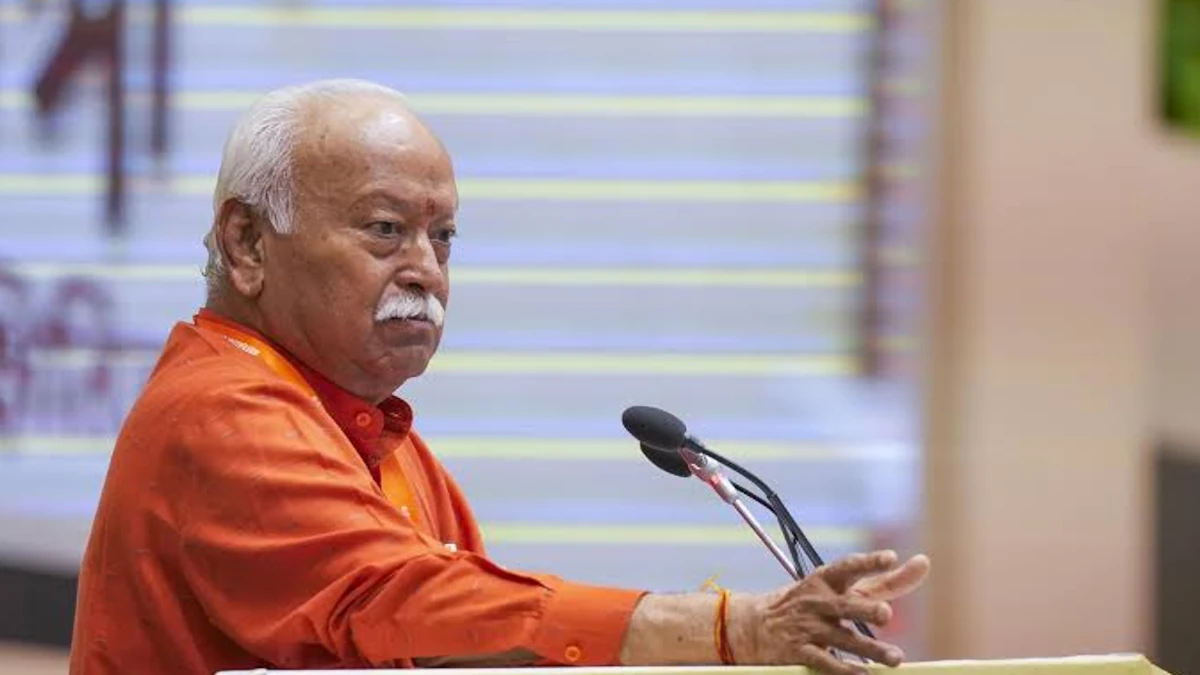
India’s quest for genuine independence must extend beyond political freedom to cultural identity, indigenous traditions and economic self-reliance, according to the ideas articulated by RSS Sarsanghchalak Dr Mohan Bhagwat and Jan Sangh ideologue Pandit Deendayal Upadhyay.
At the heart of this vision lies a clear message: a nation that abandons its own language, traditions, industries and economic capabilities risks becoming dependent on external influences, even after achieving political independence.
Mohan Bhagwat’s emphasis on cultural identity
RSS Sarsanghchalak Dr. Mohan Bhagwat has stressed the importance of Sva-bhasha (one’s own language), Sva-bhusha (traditional attire) and Sva-bodha (self-awareness and cultural identity) in shaping the character of an independent India.
According to this perspective, independence must be reflected in everyday life, beginning at home. Language, clothing, food, devotional practices and architecture should retain a connection with India’s cultural heritage rather than being shaped entirely by imported preferences.
Bhagwat’s emphasis on Sva-bhasha calls for greater use of Indian languages in everyday communication. Even something as routine as signing one’s name in one’s mother tongue can become an expression of cultural confidence and a conscious effort to preserve linguistic identity.
Similarly, Sva-bhusha does not mean rejecting Western clothing. Wearing trousers or other convenient attire is not inherently objectionable, but forgetting traditional garments such as the dhoti would represent a loss of cultural continuity. Traditional clothing, particularly during festivals and special occasions, can help preserve that connection.
The same principle extends to homes and religious practices. The idea of a puja ghar, or dedicated place of worship, reflects the importance of accommodating religious traditions within domestic architecture. The broader argument is that cultural identity should remain an integral part of everyday life rather than being confined to ceremonial occasions.
Beyond cultural pride: Recognising social kinship
Bhagwat’s vision also extends to how Indians perceive their fellow citizens and the places they visit. While international destinations such as Paris and Singapore offer valuable experiences, visiting India’s historical sites, including Kumbhalgarh, and engaging with communities living in slums are equally important.
The underlying message is that cultural awareness must go hand in hand with social responsibility. People living in impoverished neighbourhoods should not be viewed as outsiders but as members of the same larger social family.
This emphasis on apnatva, or a sense of belonging, places social kinship alongside cultural preservation. The objective is not merely to celebrate heritage but to cultivate a stronger sense of shared identity across social and economic divisions.
Deendayal Upadhyay’s warning: Swaraj without Swadeshi is incomplete
The economic dimension of this vision finds a strong parallel in the ideas of Pandit Deendayal Upadhyay, who argued that political independence remains incomplete without a commitment to Swadeshi.
For Upadhyay, self-rule could not deliver its full promise if the national economy continued to depend excessively on foreign goods, capital, technology and economic models. He maintained that strengthening domestic production was essential to building national wealth and safeguarding India’s economic interests.
His criticism focused particularly on the neglect of small-scale and cottage industries. He argued that industrial policies favouring large enterprises at the expense of smaller producers weakened indigenous manufacturing and restricted opportunities for businesses that could operate with modest capital and limited technical resources.
The imbalance in industrial investment, as highlighted in his arguments, illustrated a larger policy failure: the neglect of small producers could undermine employment, local enterprise and the availability of domestically manufactured goods.
Upadhyay also called for policies that would encourage indigenous products, regulate the influx of foreign goods where necessary and ensure that Indian diplomatic establishments supported domestic manufacturers, particularly cottage industries.
He warned that import-export policies, excessive taxation and administrative corruption could further disadvantage Indian businesses. In his view, when policy decisions were vulnerable to external commercial interests, domestic industries risked paying the price.
Foreign dependence is not the same as progress
Upadhyay’s critique of economic dependence went beyond imported consumer products. He cautioned against adopting foreign ideas, systems, production methods, technologies and consumption standards without examining whether they served India’s own needs.
His argument was that development cannot be measured simply by the volume of foreign goods consumed or the extent to which domestic preferences imitate those of other countries.
Instead, national planning should begin with India’s requirements and available resources. Foreign assistance and foreign exchange should be used where genuinely necessary, rather than becoming the default foundation of economic development.
This approach also called for a change in public attitudes towards consumption, travel and resource utilisation. Greater self-reliance, he believed, would reduce unnecessary dependence on foreign currency and encourage the more effective use of domestic resources.
The central principle was straightforward: India should not depend on external resources when it possesses the capacity to meet its needs through its own people, industries and institutions.
Swadeshi as a foundation for national strength
The connection between Dr Bhagwat’s emphasis on cultural identity and Upadhyay’s advocacy of economic self-reliance lies in their shared focus on the idea of Sva one’s own identity, capabilities and civilisational roots.
While Dr Bhagwat’s emphasis centres on language, attire, traditions and social belonging, Upadhyay’s vision focuses on indigenous production, decentralised industries and economic independence. Together, these ideas present Swadeshi as more than a preference for Indian-made products. It is a broader approach that seeks to align cultural confidence with economic capability.