



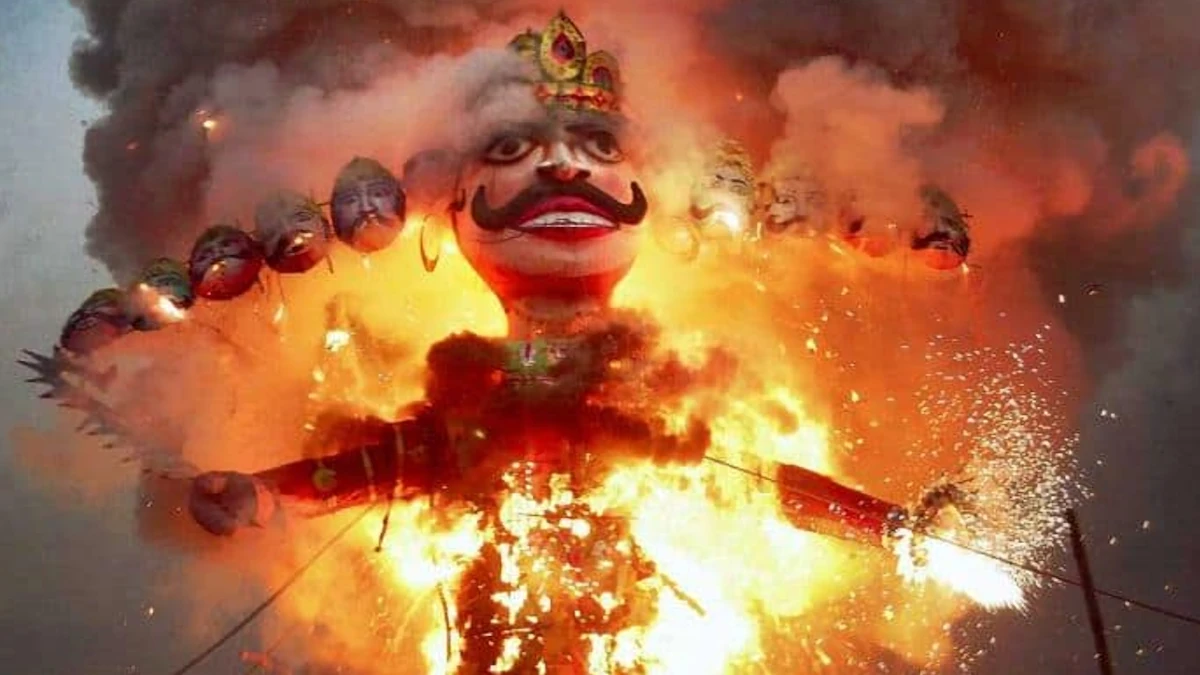
On Vijayadashami, effigies of Ravana, Kumbhakarna, and Meghnad are burned in towns and cities across the country. Amid loud cheers and celebrations, the message of good’s triumph over evil is reiterated year after year. Yet when the noise of the festivities subsides, a question remains: Will we keep burning only the effigy of Ravana, or will we ever resolve to burn the Ravana that resides within us?
This question is not merely related to religious faith or tradition. It concerns our conduct, character, values, and consciousness. Indeed, Vijayadashami is as much an occasion to celebrate victory over external evil as it is an opportunity to look within ourselves and recognise our own weaknesses.
The human being of the twenty-first century is scaling new heights in science, technology, and development. A smartphone that connects the world rests in our hands, our reach extends into space, and technologies such as artificial intelligence are continuously transforming our lives. We have made unprecedented progress in understanding nature, utilising resources, and reshaping the material world. Yet, one fundamental question remains unanswered: Has our inner consciousness evolved at the same pace? Alongside technological advancement, have our thoughts become more liberal, our conduct more compassionate, and our character more firmly rooted in moral principles? As we transform the world around us, have we also tried to dispel the darkness within?
To answer these questions, we must examine both the society around us and our own conduct.
Ravana is not merely a character from the Ramayana; he can also be regarded as a symbol of human weaknesses and uncontrolled impulses. His ten heads may be interpreted as representing evils such as arrogance, anger, greed, attachment, jealousy, deceit, hypocrisy, injustice, uncontrolled desire, and intolerance. Ravana was learned, powerful, and exceptionally capable. Yet his arrogance, uncontrolled desires, and insistence on unrighteousness ultimately led to his downfall. This episode offers an important lesson: knowledge, power, and ability are not enough on their own. They acquire true significance only when guided by wisdom, restraint, justice, and concern for the greater good. Is humanity living up to this ideal today?
Ironically, modern humans constantly strive for knowledge, prestige, wealth, and power. Yet, they often allow the very evils they symbolically burn in the form of Ravana’s effigy every year to flourish within themselves. They celebrate the destruction of evil while continuing to disregard the evils growing within them.
Today, a person who delivers speeches against corruption may not hesitate to accept an improper benefit. Someone who preaches honesty may resort to dishonesty when an opportunity arises. In a society that speaks of respecting women, incidents of humiliation, discrimination, and violence against women continue to surface. Even those who advocate truth and justice sometimes compromise these values when self-interest is at stake. Some who preach morality on social media are equally quick to spread falsehoods, bitterness, and hatred.
This contradiction compels us to reflect: Have we reduced the struggle against evil to a merely symbolic ritual? Have we come to believe that burning Ravana’s effigy fulfils our responsibility, even as we continue to keep the same evils alive in our own conduct?
Dussehra reminds us that however powerful injustice and unrighteousness may appear, the courage to stand for truth and righteousness ultimately makes the difference. But this message becomes meaningful only when it is reflected in our daily lives. If, after burning Ravana, our arrogance remains unchanged, deceit and dishonesty continue to shape our behaviour, and our insensitivity to others’ rights persists, then we must seriously reconsider the true purpose of our celebration.
The problem isn’t burning Ravana’s effigy. The problem is that we often keep the very traits he symbolises alive within ourselves. Burning the external Ravana is easy because he stands before us as an effigy. Burning the Ravana within is difficult because each of his ten heads may be connected to some aspect of our own personality. Recognising him takes courage, acknowledging him demands honesty, and overcoming him requires constant self-discipline.
It is easy to identify others’ faults, but difficult to acknowledge our own shortcomings. We often call our anger self-respect, our arrogance dignity, our greed necessity, and our selfishness pragmatism. We find it easier to defend our misconduct than to admit our mistakes, which requires inner strength. In this way, instead of overcoming our weaknesses, we begin to justify them.
True self-reflection begins when a person finds the courage to question oneself rather than constantly questioning others. Does my behaviour cause unnecessary pain to anyone? Do I disregard another person’s rights for my own benefit? Do I misuse my position, wealth, or influence? Do I extend the same respect and fair treatment to others that I expect for myself? And, most importantly, do I practise in my private life the moral values that I publicly profess to support?
The answers to these questions reveal an individual’s true character. A person’s morality cannot be judged merely by their thoughts, speeches, or public image. It is revealed through behaviour, decisions, and actions, especially when nobody is watching.
Evil is not confined to major crimes or grave acts of immorality. Insulting someone in need, exploiting the weak, envying another person’s success, spreading false rumours, using abusive language, damaging public property, or remaining silent in the face of injustice out of self-interest also weakens our social character. When such tendencies are accepted as normal behaviour, they gradually become part of the collective consciousness of society.
A society’s moral decline does not begin only when serious crimes are committed. It also begins when people accept small acts of dishonesty as commonplace, grow indifferent to injustice, and compromise their principles for personal gain. Therefore, recognising the Ravana within us means not only confronting major evils but also controlling the small weaknesses that gradually corrupt our personality and social life.
Positive social change cannot be achieved through laws, speeches, and campaigns alone. These matter, but their success also depends on changes in individual attitudes and conduct. If everyone remains honest in fulfilling their responsibilities, respects others’ rights alongside their own, puts collective welfare above personal interests, and stands up for the truth, many positive changes in society become possible. Values instilled within the family, moral awareness in education, transparency in public life, and sensitivity in social interactions are all foundational pillars of the transformation we expect from our society.
This does not mean our traditions are meaningless or that burning Ravana’s effigy has no significance. Festivals are important expressions of our cultural consciousness, collective memory, and social unity. The only requirement is that the outward form of a celebration remain connected to its inner message. Burning Ravana’s effigy should inspire us to stand against unrighteousness, resist injustice, overcome the evils within ourselves, and uphold the truth. If this tradition becomes confined to fireworks, entertainment, and formal observance, we risk losing an important dimension of its deeper moral message.
The ideals Bhagwan Ram represents are equally relevant in this context. Commitment to righteousness, duty, self-restraint, truth, and justice remain as essential today as ever. The true meaning of remembering Bhagwan Rama’s ideals lies not merely in chanting his name but in making room for those values in our own conduct. If we wish to see truth prevail, we must be truthful ourselves. If we envision a just society, we must practise justice in our own dealings. If we expect others to uphold dignity and restraint, we must show these qualities in our own behaviour.
The true message of Vijayadashami lies in this very process of self-transformation. The festival encourages us to look within before listing other people’s faults. It reminds us that life’s hardest struggle is often not against an external enemy but against our own weaknesses, desires, and ego. Victory in this struggle does not require grand ceremonies; it requires small, sincere, and sustained efforts.
On this Vijayadashami, let us resolve to give up at least one bad habit, correct one personal failing, oppose an act of injustice, and help someone in need. Let us cultivate honesty in our conduct, openness in our thoughts, and compassion in our relationships. If we do so, the message of Vijayadashami will no longer remain a celebration confined to a single day; it will become a guiding principle that shapes the course of our lives.
This Vijayadashami, we must ask ourselves one essential question: Will we remain mere spectators watching Ravana’s effigy burn, or will we become seekers who recognise the evils within ourselves and strive to overcome them?
Ultimately, the question is not when Ravana will be burned again next year. The real question is when we will resolve to eliminate the arrogance, greed, deceit, injustice, and insensitivity within ourselves. The day we genuinely stand up against the evils within us will be the day Vijayadashami acquires its true meaning in our lives.