



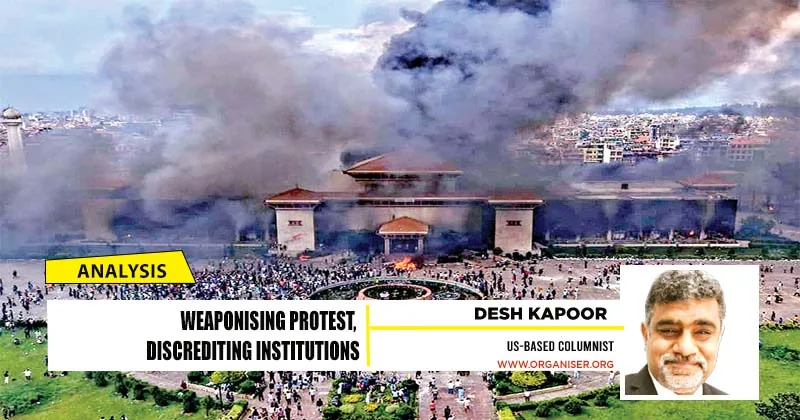
Listen long enough to the current round of protest commentary, and you will hear one sentence over and over. “The institutions are being broken. The Election Commission is captured. The courts have folded. Parliament does what it is told.”
Ask when this happened, and the activist had a politically convenient benchmark: 2014. The year a certain dispensation lost control over deciding India’s destiny. At that time, an arbitrary body called the National Advisory Council, made up of unelected activists, sat above elected representatives. The slogans beg the question. Which decision showed it and compared with what? Nobody says. The charges, fashioned into pithy slogans, are meant to be repeated, and they work only if no one asks for the yardstick. The same people who say the institutions have failed also tell us what should replace them. The street. We will look at that prescription, at the history it quietly relies on, and at the strange similarity of these movements across many countries.
Discrediting Institution
The accusation needs a past in which these institutions were independent. Without that, “weakened” means nothing. So look at the past. MS Gill was Chief Election Commissioner from 1996 to 2001. He then joined the Congress, sat in the Rajya Sabha from 2004 to 2016, and became a Union Minister. TN Seshan, the CEC people remember as fearless, contested the 1999 Gandhinagar seat against LK Advani on a Congress ticket. None of this proves either man was compromised while managing elections. It does, however, show that the wall between the Commission and party politics was never solid before 2014.
The judiciary has a harder chapter. In ADM Jabalpur (1976), four Supreme Court judges accepted that habeas corpus could be suspended during the Emergency. Justice HR Khanna dissented alone. Of the majority, AN Ray was already Chief Justice, and MH Beg, YV Chandrachud, and PN Bhagwati each later held the office. The court passed over Khanna when Beg became Chief Justice in 1977. The court failed the Indian citizens at the exact moment it was needed to protect them from suspension of the constitutional rights.
Then there is Baharul Islam. Rajya Sabha in 1962 and 1968. Gauhati High Court in 1972, rising to Chief Justice. Retired in March 1980, appointed to the Supreme Court that December. Resigned in January 1983, and by June he was back in the Rajya Sabha as a Congress (I) member. Politics, bench, politics. No one asked what qualified the man to those chairs in the highest courts of the land? Other than his politics. We of course cannot equate the two eras. However, these cases do kill the starting point of those slogans. A commentator who says “institutions have declined” has to show what changed. Which safeguard weakened, which power was abused, which ruling shows dependence?He then has to line that up against earlier decades.
Skip that work and “collapse” becomes a verdict that arrives before the trial. Unfortunately, democracy has ceased to be about process and representation and become about results. As long as they bring the people that fit one’s ideological prejudices, democracy remains intact. Should it bring someone these moral busybodies dislike, democracy comes crashing.
Remedy on Offer
Some advocates say it plainly. On July 22, Yogendra Yadav told BBC Hindi: “From now, Indian democracy will not be run from Parliament, but from the streets. It will not be decided by elections, but by resistance. What you saw on July 20 was just a trailer.”
Protest is a core democratic right. Nobody has to win a seat to criticise a Government. Marches expose injustice, give neglected groups a platform and force officials to answer. Yadav, however, was claiming more than that. He was saying resistance should decide outcomes in place of elections. That is a claim to authority, and authority invites questions. Who picks the leaders? Who pays? How are decisions made, and what happens to members who disagree? Who can remove the people speaking in the movement’s name? What stops its demands from growing, and who answers when something goes wrong? Established institutions do fail. But their duties are written down, so their failures can be measured. A movement with no written duties can claim power and dodge blame at once. Crowds also prove to be smaller than they seem. A big, loud, persistent protest tells you many people are angry. It does not mean the whole electorate agrees, that the allegations are true, or that the demanded remedy would serve the public.And a contradiction sits at the centre of the argument. Critics claim they fear the “tyranny of the masses,” then hand the decision to a mass in the square. Protesters are a mass too. Their organisers are often tighter, better disciplined and better able to impose costs than the much larger public that stayed home. When the ability to disrupt starts to count as a claim to govern, the citizen who votes and goes back to work carries less weight than the group that can shut the city down.
What Former Judges Articulated
On October 7, forty-two former judges signed an open letter. They opened by saying they hold no brief for any political party. Then they gave their reason for speaking: silence is no longer a neutral choice.The letter is worth reading because it doesn’t give constitutional bodies a free pass. It asks the Election Commission to stay transparent and to answer legitimate concerns. It separates criticism from denigration, and it objects to officials being called thieves and puppets without proof. It asks parties to contest elections and not delegitimise them. It tells the media that a headline is not evidence and that repetition does not make an allegation true.
On the Special Intensive Revision (SIR) of electoral rolls, the signatories point to Article 324 and Section 21(3) of the Representation of the People Act, 1950. Revising the rolls is part of the Commission’s legal job. A revision can be politically contested and still be lawful. A clean roll must protect every eligible voter, which is what critics are right to watch.
The line that stays with you is this one: “When the ballot loses meaning, the street gains it.” Tell people long enough that their vote counts for nothing and some of them will believe it. You can weaken a democracy without cancelling a single election.
Meanwhile the matter is before the Supreme Court. Parliament meets. The next election will come on schedule. When every door is open, a movement that says none of them works owes us an answer about what result it would accept from any of them.
One Script, many Countries
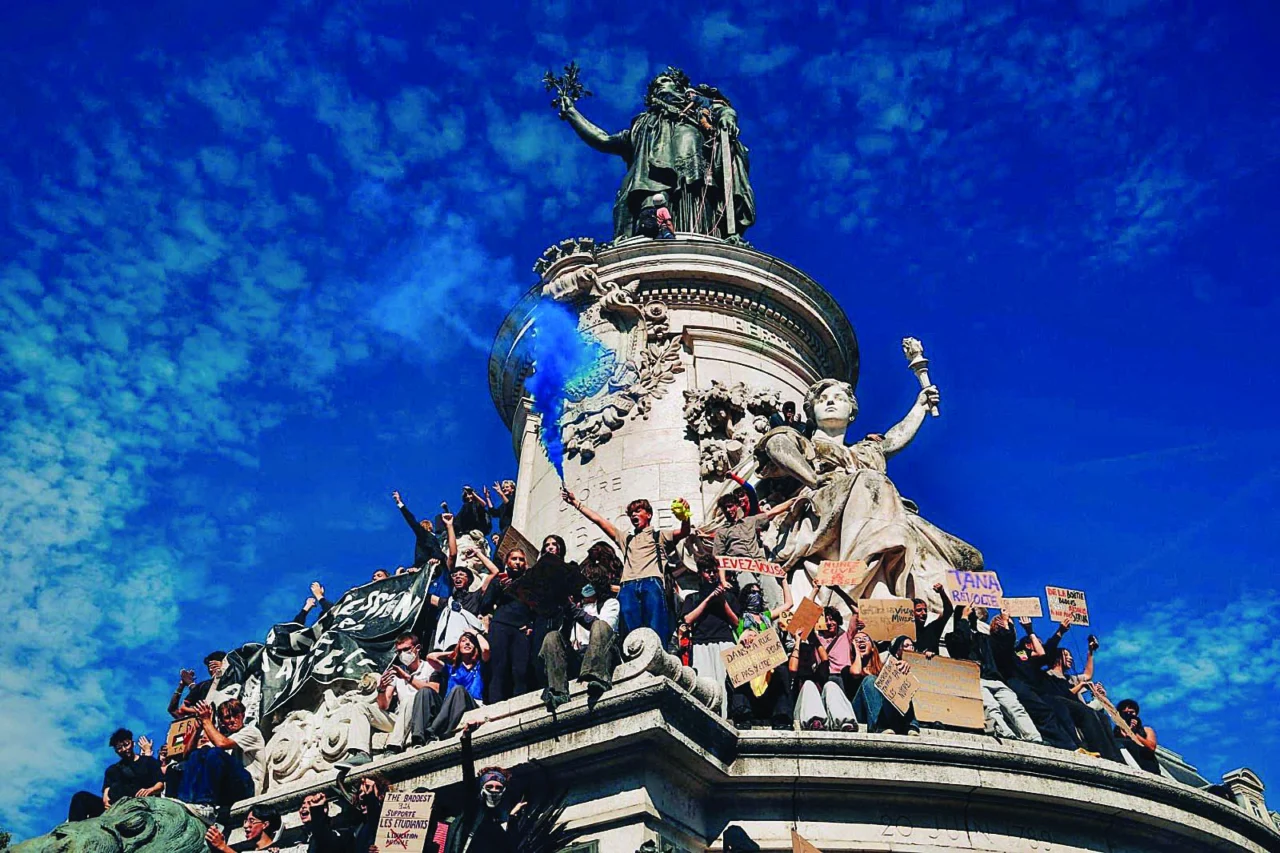
Similar agitations have shown up in a string of countries over the past two years. The features repeat: a single emotional frame, a ready-made symbol, a charge that the system is rigged, and a demand that jumps from reform to removal.
Nepal & Madagascar: Protests on Divergent Issues
The outcomes differ, and they should not be blurred. In Nepal, protesters carried it in September 2025 during an uprising over a social media ban, corruption and privilege. PM KP Sharma Oli resigned on September 9, and an interim Government took over. In Madagascar, protests that began over water and power shortages grew into demands that President Andry Rajoelina go. He was removed, and the military took over in October 2025. One was a Government falling to the street. The other was a coup.
Madagascar carries the sharper lesson. Gen Z representatives later complained that the new Prime Minister was appointed without transparency or consultation. The young people who built the pressure did not control what came after. A movement can bring down a Government and still not own the result. Now the limits. A flag at a protest shows an association. It does not show cause, or that everyone carrying it wanted the same thing, or that one organisation steered its spread. We won’t say that all the movements had a central power structure because they shared a symbol. However, tools that cross between legitimate protests and regime-change efforts often use one’s legitimacy to blur the other’s.
How Agreement gets Built
If direct proof of orchestration is rare, what can an honest analyst do? Describe the mechanisms and check whether they are present.
Buck Sexton’s Manufacturing Delusion (2026) is one framework for doing that. Sexton, a former CIA officer, lists eight tactics he says controlling regimes have used: conditioning, menticide, brainwashing, weaponized law, forced phobia, isolation, identity construction and propaganda.
Although written for American readers from an openly conservative position, while targeting the American left – it provides a useful framework and repeated process. One can use it for that vocabulary and understand how the “method behind the madness”.
The Outside Voices
The domestic argument now has foreign listeners. After police detained protest leaders in Delhi on October 10, the UN human rights office said it was concerned about mass detentions and called on the authorities to respect the right of peaceful assembly. It added that anyone arbitrarily detained should be released.
Bharat’s Response in Geneva
India’s mission in Geneva answered the same day. It said the Constitution guarantees peaceful assembly, subject to reasonable restrictions for public order, that the authorities act under law, and that the courts remain open to anyone with a grievance. It called the UN office’s concerns misplaced and an interference in internal affairs, and said the office should give comparable attention to large protests elsewhere.
One-sided – from the side of the protestors – testimonies and concerns being repeated by international bodies that are largely ineffective in resolving issues and global media where headlines on India’s events read like a well-oiled orchestra churning out music from the same chart, do betray something deeper and more troubling than statements of independent reporting and concern.Intriguingly, Serbia’s former President Aleksandar Vučić said in a broadcast on October 5 that forces are working to hold back India’s rise by undermining Prime Minister Modi’s mandate.
Name the Yardstick
So let us go back to the slogans that everyone, from uninformed protestors (many have been recorded sharing opinions that betray their ignorance) to the United Nations to National and Global reporters and analysts, keeps regurgitating almost on cue. The demand from these actors is specific and short. Before you declare an institution broken, say how you have measured.