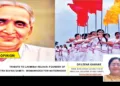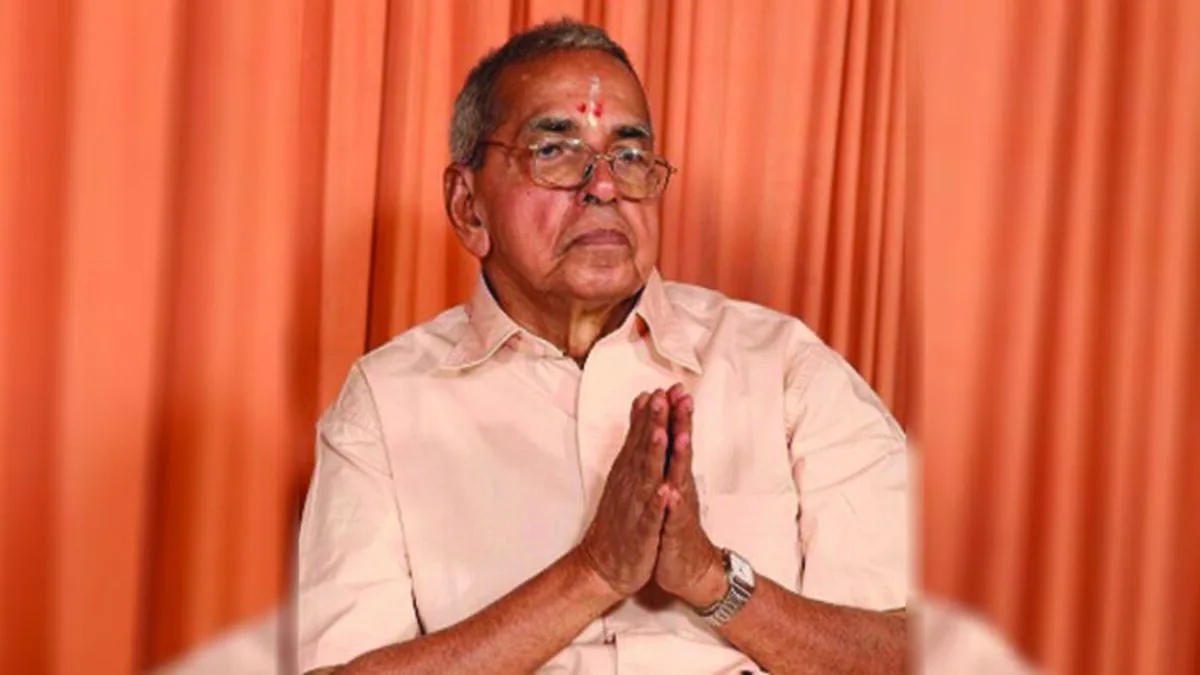
KOCHI: Senior RSS pracharak and veteran cultural activist M.A. Krishnan, popularly known as ‘M.A. Sir’, passed away at the age of 97 at Amrita Hospital in Ernakulam while undergoing treatment.
M.A. Sir was widely associated with the development of several cultural and child-focused initiatives in Keralam, including Bala Gokulam and Tapasya Kala Sahitya Vedi. He also conceived and guided initiatives such as Amritabharathi, Bala Samskara Kendram, Bala Sahithi Prakashan, International Sri Krishna Kendram and Saurakshika, a movement focused on child rights protection.
Early life and association with RSS
Born in 1929 in Ivarkala village of Kollam, M.A. Krishnan completed his Master’s degree in Logic from Sanskrit College, Thiruvananthapuram. He subsequently joined the teaching profession at Vazhoor High School in Kottayam.
During this period, he came under the influence of the teachings of Sree Vidyananda Tirthapada Swami of Vazhoor Theerthapadashram. He also came into contact with Swami Agamananda and was deeply influenced by the teachings of Swami Vivekananda.
M.A. Krishnan had joined an RSS shakha in 1947 and later became a full-time pracharak in 1954 after resigning from his teaching position. He went on to work for the Sangh in Kottayam, Ernakulam, Alappuzha and Kollam districts.
Contribution to Kesari and Keralam’s cultural discourse
In 1964, M.A. Krishnan took over as editor of Kesari in Kozhikode. He served as its editor-in-chief until 1990 and played a significant role in expanding the publication’s reach within Malayalam media and the wider cultural sphere of Kerala.
Under his leadership, Kesari evolved from a publication primarily associated with Swayamsevaks into a weekly that addressed a broader cultural readership. The publication carried articles and poems on Kerala’s temples, cultural centres, historical personalities and cultural heritage.
Several prominent historians and writers, including M.G.S. Narayanan and K.K.N. Kurup, contributed to Kesari during this period. The weekly subsequently became part of wider public discussions on Keralam’s cultural and intellectual life.
It was also during M.A. Sir’s tenure that initiatives such as Bala Gokulam and Tapasya gained momentum. Through these efforts, he contributed to a wider cultural and social engagement in Keralam.
Role during the Jana Sangh conference and Thali movement
M.A. Krishnan was also involved in the organisational arrangements surrounding the 1967 Jana Sangh National Conference held in Kozhikode. He reported on the conference for Kesari under the pen name ‘Shakalyan’, under which the column ‘Ithukettelle’ was also introduced. Kesari subsequently brought out a special edition featuring an image of Deendayal Upadhyaya.
In 1968, M.A. Sir was among those associated with the efforts surrounding the Thali worship freedom movement. The campaign centred on the restoration and protection of the historic Thali temple precinct in Kozhikode.
He also interacted with veteran leader V.M. Korath of Mathrubhumi on the temple renovation issue and sought the support of K. Kelappan. Following government intervention and restrictions concerning the site, Kelappan undertook a satyagraha.
A life dedicated to cultural initiatives
Over several decades, M.A. Krishnan remained involved in initiatives spanning culture, literature, education, heritage and child development. He played a guiding role in organisations and movements that sought to connect younger generations with Indian traditions and cultural heritage.
He was particularly associated with introducing children to cultural role models and traditions, including through Bala Gokulam, where Unnikannan was presented as a role model for Malayalam-speaking children.
M.A. Sir’s influence extended beyond his formal roles as an editor or RSS pracharak. Supporters and associates remember him for his ability to bring together writers, historians, cultural activists and social workers around cultural initiatives.
Through his organisational leadership, editorial work and long-term engagement with Kerala’s cultural sphere, M.A. Krishnan left a distinctive mark on the state’s cultural discourse over several decades.