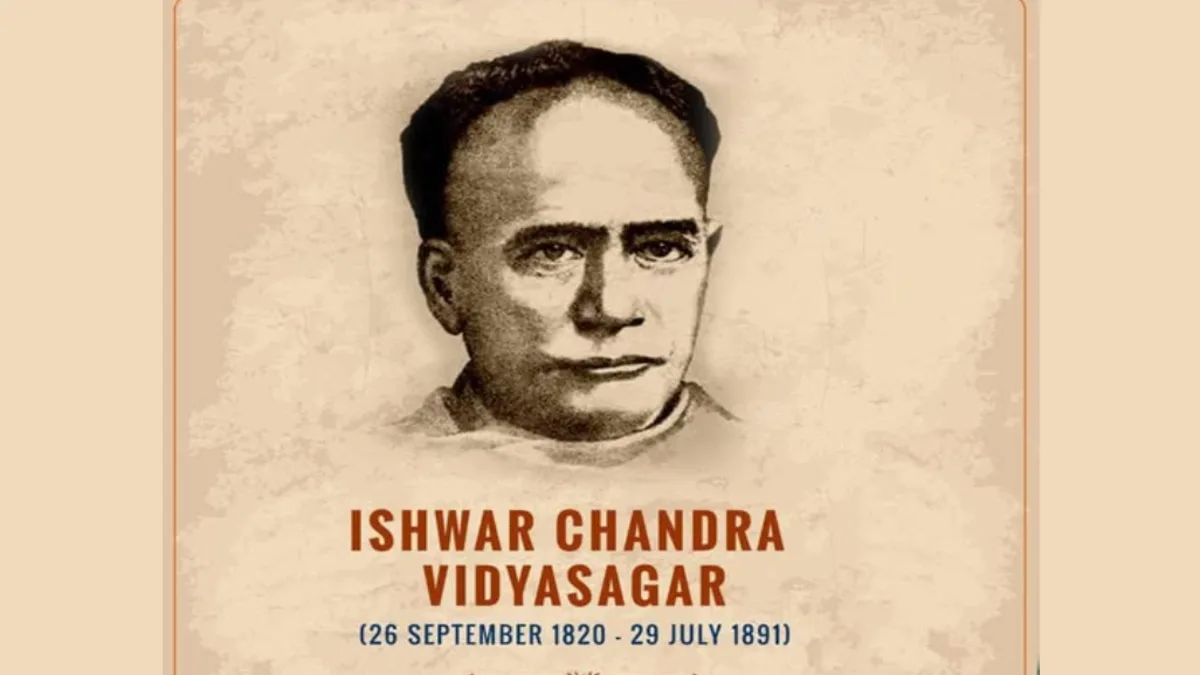
It was a serene late afternoon on August 5, 1882. A divine figure entered the ground-floor reception room of a residence in Badurbagan, Kolkata—Sri Sri Ramakrishna Paramahamsa, accompanied by his devotees. Seated inside was the iconoclastic, sage-like scholar, Pandit Ishwar Chandra Bandyopadhyay, known to the world as ‘Vidyasagar’. Looking at Vidyasagar with a warm smile, Ramakrishna remarked in lucid tones, “Today, at last, after crossing canals, marshes, and rivers, I have reached the ocean (Sagara)!” With modest humour, Vidyasagar replied, “Then you must take back some salt water!” Ramakrishna immediately exclaimed, “Oh no, why salt water? You are not the ocean of ignorance (Avidya); you are the ocean of learning (Vidya) and compassion (Daya)! Your water is sweet!” That historic meeting was not merely an encounter between two eminent souls; it was a profound confluence of Indian spiritual practice and sage-like humanistic karma yoga. Vidyasagar, the ‘Ocean of Compassion’, translated Sri Ramakrishna’s spiritual truth—’Yatra Jiva Tatra Shiva’ (where there is a living being, there is Shiva)—into a practical mission with every drop of his blood.
On the other hand, before the arrogance of colonial oppressors, Vidyasagar stood as a monumental symbol of Indian national self-respect and pride. He did not hesitate for a moment to crush the insolence of Mr. Kerr, the then-English Principal of Hindu College, who had rudely greeted guest Vidyasagar with his shoe-clad feet resting atop the table. A few days later, when Kerr paid a courtesy visit to Vidyasagar’s room at Sanskrit College, Vidyasagar sat in identical fashion with his slipper-clad feet hoisted on the table. When the outraged principal lodged a formal complaint of breach of discipline with the Council, Vidyasagar held his head high and fearlessly retorted: “I assumed this was European etiquette, so I merely followed the path demonstrated by the British guest to welcome him!” The British administration was compelled to express regret and back down. This was Ishwar Chandra Vidyasagar—an undaunted, devoted son who swam across the roaring Damodar River on a stormy Kalbaishakhi night at his mother’s single call; a profound scholar of Sanskrit who nevertheless pioneered modern rationalism and women’s emancipation; and an independent, fiercely spirited Indian in his own right.
Today, as Bengali society bows in solemn reverence at his social and cultural feet, it is essential to look into a bloody and ruthless mirror of history. The man whose heart possessed ‘the tenderness of a Bengali mother’ and whose intellect matched ‘ancient sages’ had to endure fierce physical and mental assaults from fanatic orthodox societal leaders during his lifetime. Yet, the most astounding and tragic irony is that eight decades after his passing, in the late 1960s and 1970s, Vidyasagar’s legacy, ideals, and philosophy faced their most violent, systematic, and organized assault not from religious fundamentalists, but at the hands of the Communist and Naxalite political camps claiming to be ‘progressive’, ‘revolutionary’, and ‘Marxist’.
This article examines how leftist theorists spewed ideological venom against the revered Vidyasagar, how his marble bust was decapitated under political instructions from the journal Deshabrata, how false narratives regarding the 1857 Sepoy Mutiny were concocted to vilify him as an ‘imperialist agent’ and ‘comprador bourgeois’, and how the mainstream CPI(M)-led Left Front government subsequently devalued his historical contributions in academic curricula and textbooks.
Marxist class struggle and the ‘Bourgeois Icon’ label
Rooted behind the anti-Vidyasagar stance of the Communists and Naxalites was an extreme application of orthodox Marxist-Leninist and Maoist dogma. Following the armed peasant uprising in Naxalbari in North Bengal in May 1967, the Communist Party of India (Marxist-Leninist) [CPI(ML)] was formed to propagate its political ideology among urban intellectuals and students. Under the leadership of Charu Majumdar, Kanu Sanyal, and Saroj Dutta, this ultra-left faction unequivocally declared India’s social and cultural heritage to be ‘feudal’, ‘colonial’, and ‘bourgeois’.
The core tenets of this radical ideology asserted that the 19th-century ‘Bengal Renaissance’ was not a genuine social liberation or revolutionary awakening, but merely a compromised, collaborative pact between colonial British rulers and the upper-caste ‘Bhadralok’ elite. According to this theoretical blueprint, because Ishwar Chandra Vidyasagar served under the British Education Department (as Principal of Sanskrit College), petitioned the British government for the enactment of the Widow Remarriage Act, and was influenced by Victorian moralist Samuel Smiles’s philosophy of ‘Self-Help’, ‘Character’, and ‘Thrift’, he was categorized as a ‘comprador bourgeois’ and an ally of colonial capitalism.
Saroj Dutta (writing under the pseudonym ‘Shashanka’), the chief theoretical and cultural spokesperson of the CPI(ML), published a series of articles in the party organ Deshabrata to spread this ideological poison. As documented in his essays “In Support of Statue Smashing” (1970) and “On Vidyasagar” (1970), later compiled in the Saroj Dutta Rachana Sangraha (Vol. 1, 1993, Pranati Prakashani), Dutta argued that as long as Indian youth revered bourgeois ‘icons’ or puppets like Vidyasagar, Rabindranath Tagore, Raja Rammohun Roy, or Mahatma Gandhi, genuine proletarian revolutionary consciousness could never emerge. Charu Majumdar himself, in articles published in Deshabrata and Liberation in August 1970, actively encouraged student groups in their ‘Iconoclastic Movement’ (Murti Bhangar Andolan), hailing it as a manifest expression of ‘class hatred’.
Renowned researcher Sumanta Banerjee, in his historical essay “Mapping a Rugged Terrain: Naxalite Politics and Bengali Culture in the 1970s” (included in Discourses on Naxalite Movement 1967–2009: Insights into Radical Left Politics, edited by Partha Basu, Setu Prakashani, 2010), analyzed in detail how the Naxalite movement made futile attempts to crush the entire Renaissance legacy in the Bengali psyche by labeling it ‘counter-revolutionary’.
Beheading of Vidyasagar’s statue at college square and the trail of destruction
When theoretical hatred translates into extreme street politics, the result is sheer savagery. October 20, 1970 marked the 150th birth anniversary of Ishwar Chandra Vidyasagar. Yet on that historic day, the iconic marble bust of Vidyasagar situated at College Square in the heart of Kolkata came under the brutal hammer blows of Naxal cadres. Installed in 1899 directly behind the historic Sanskrit College, the sculpture was dragged down and decapitated. On the very same day, the statue of Acharya Prafulla Chandra Ray, a world-renowned figure in science, was also smashed to pieces.
This event was not merely an assault on a statue; it was a pre-planned, violent strike against the backbone of Bengali culture. Jawhar Sircar, in his autobiographical memoirs “Those Were Days My Friend” and “Solitary Poor Nasty Brutish and Short 1971 Presidency College and Naxalite Movement,” noted how ultra-left youth, empowered by pipe-guns and crude bombs, rejoiced after severing the head of a revered personality like Vidyasagar. Police guards had to be deployed at educational institutions solely to protect marble statues.
On September 15, 1978, a field report in India Today vividly depicted the Kolkata situation: “In a corner of a park in central Kolkata, the 19th-century Renaissance icon Pandit Ishwar Chandra Vidyasagar gazes with anxious eyes. The head sitting atop his marble bust is now precarious, as Naxalites decapitated it in June 1970. Today, six armed police officers guard the statue day and night with rifles in hand”.
Later, in the international academic journal Society Language and Culture (Vol. 1, Issue 3, 2020), Barnali Paine, quoting Dipesh Chakrabarty in her article “Ishwar Chandra Vidyasagar: The Misunderstood Other,” described how Kolkata citizens shuddered witnessing the decapitation of their cultural icons between June and October 1970. Inside Presidency College, Vidyasagar College, and the internal auditoriums and libraries of Calcutta University, portraits of Vidyasagar, Rabindranath Tagore, and Mahatma Gandhi were torn down and burned, while Mao Zedong’s slogans were painted in red ink across the walls.
Driven by a blind imitation of the Chinese ‘Great Proletarian Cultural Revolution’, supporters of this ‘Statue-Smashing Movement’ (Murti Bhangar Andolan) believed that just as Red Guards in China destroyed the ‘Four Olds’ (Old Ideas, Old Culture, Old Customs, and Old Habits), destroying Vidyasagar’s statues in Bengal was essential to clear the path for revolution.
Attempted character assassination regarding the sepoy mutiny
Naxalites and ultra-left theorists did not stop at smashing Vidyasagar’s statues; they distorted history to engineer a malicious campaign of character assassination against him. A fabricated conspiracy widely circulated in Naxal pamphlets and study circles alleged that during the Sepoy Mutiny of 1857, Vidyasagar handed over the Sanskrit College building to the British colonial army so that imperial soldiers could take shelter there and suppress the sepoys’ rebellion. On the basis of this imaginary charge, Vidyasagar was branded a ‘national traitor’ and a ‘British sycophant’.
An examination of historical documents reveals this allegation to be entirely baseless and a pre-planned falsehood. In a scholarly research paper titled “De-Iconisation of Pandit Ishwar Chandra Vidyasagar,” published in Mainstream Weekly on September 26, 2020, senior researcher Pabitra Kumar Sarkar exposed the absurdity of this concocted accusation. He demonstrated that during the 1857 Sepoy Mutiny, the colonial Military Department forcibly requisitioned the Sanskrit College building by official decree for housing troops. The then-Principal Vidyasagar registered a fierce protest. He was severely angered by the government’s decision, as it gravely disrupted student education. Following this conflict and unresolved differences with Director of Public Instruction W.G. Young, Vidyasagar resigned in November 1858 at the young age of 38, relinquishing a lucrative government salary of approximately 500 rupees per month.
Furthermore, when Kolkata’s Victorian-loyalist elites organized a grand victory banquet to honor the British conquerors after the suppression of the Mutiny, Vidyasagar conspicuously boycotted the event, sending an unambiguous message. Relevant government archives and original copies of the Military Department’s orders confirm to this day that the charge of ‘treason’ leveled against Vidyasagar by ultra-left theorists was nothing short of a dirty, politically motivated character assassination conspiracy. Yet, this very falsehood was utilized to brainwash ultra-left cadres of the time.
Misleading Marxist political readings of social reform and educational policy
To undermine Ishwar Chandra Vidyasagar’s social and educational contributions, leftist academicians and theorists constructed a specialized argument centered on ‘class limitations’. Their assertions included:
First, Vidyasagar’s widow remarriage movement was strictly an internal affair of the upper-caste ‘Bhadralok’ society, claiming that widow remarriage was already prevalent among lower-caste communities and rural peasants, and thus his work could not be termed a social revolution. Second, Vidyasagar cited scriptural authorities (such as the Parashara Samhita) to support widow remarriage, which allegedly proved his reliance on Brahminical religious frameworks and his failure to establish secular rationalism. Third, his educational initiatives did not reach the working masses at the primary level, and he compiled curricula suited only for producing ‘Macaulay’s children’ to serve as British clerks.
Multiple modern researchers have exposed the superficiality and narrowness of such one-sided analysis.
Leftist critics often selectively quote an 1859 letter written by Vidyasagar to Rivers Thompson, Junior Secretary to the Government of Bengal, attempting to portray him as an ‘elitist’ who favored restricting education to upper classes. However, research by Abhishek Choudhury published in the Indian Educational Review Journal (IERJ) demonstrates how Vidyasagar’s complete text was suppressed. Vidyasagar had explicitly written that imparting quality education to the upper classes would produce a cadre of qualified teachers, who would subsequently take the light of education to the masses in rural areas through the Bengali vernacular.
In reality, Vidyasagar not only transformed the Bengali language in 1855 through Barna Parichay and Bodhoday, but also established free primary schools and night schools for children of peasant families in his native village of Birsingha, Medinipur, entirely at his personal expense. He lived among the Santhals for 18 years and established schools for Santhal children—marking the first indigenous tribal education initiative in India. By securing admission rights for Shudras and non-Brahmins at Sanskrit College, he shattered thousands of years of Brahminical monopoly. Yet, Communist theorists suppressed these revolutionary strides, choosing instead to endlessly chant the mantra of ‘class limitations’ against him.
Marxist Historiography and Academic Conspiracy: The ‘False Renaissance’ Theory
If the street movement of statue-smashing represented the violent face of the anti-Vidyasagar crusade, university seminar halls and historical research journals served as its subtle and enduring counterpart. From the 1940s onward, Communist-influenced historians were eager to brand the Bengal Renaissance as a ‘False Renaissance’ or ‘Illusory Renaissance’.
Although Susobhan Sarkar initiated a materialist review of the Renaissance in his Notes on the Bengal Renaissance (1946), later Marxist historians pushed this critique into extreme negativity. In his famous 1977 work Ishwar Chandra Vidyasagar and His Elusive Milestones (published by Riddhi-India, with an extensive introduction by Dipesh Chakrabarty), historian Asok Sen depicted Vidyasagar’s life and work as an elusive milestone defeated by the crisis of the colonial economy. According to Sen, the reforms Vidyasagar envisioned within the colonial framework were historically doomed to failure.
Similarly, prominent Marxist historian Sumit Sarkar, in A Critique of Colonial India (1985, Papyrus) and his essay “Vidyasagar and Brahminical Society” in Writing Social History (Oxford University Press, 1997), characterized Vidyasagar’s reforms as a limited endeavor bound within feudal and colonial constraints.
A most telling example is found in a booklet authored by Provash Ghosh, General Secretary of the Socialist Unity Centre of India (Communist) [SUCI(C)]. In The Pioneer of Indian Renaissance: Ishwar Chandra Vidyasagar – A Marxist Evaluation (2012), Ghosh noted how so-called ‘Marxist scholars’ reduced Vidyasagar to a mere ‘petty-bourgeois reformer’. Renowned literary figure and Marxist sociologist Binoy Ghosh, despite displaying deep respect for Vidyasagar in his four-volume Vidyasagar o Bangali Samaj, referred to the Renaissance as a ‘historical deception’ in his earlier work Banglar Nabajagriti (1948).
During the 34-year rule (1977–2011) of the CPI(M)-led Left Front government in West Bengal, a form of institutional neglect was maintained against Vidyasagar in the academic sphere. In secondary and higher secondary textbooks, Vidyasagar was reduced merely to the ‘author of Barna Parichay’ and a ‘kind social reformer’, while his revolutionary rationalism, anti-British administrative conflicts, and secular ethics were systematically excluded from curricula. Furthermore, when Vidyasagar University was established (under the 1981 Act) with a mandate for non-traditional rural development required by the UGC, Left Front-nominated Vice-Chancellors trapped the mandate in bureaucratic red tape, as documented in the article “Rule Makers, Rule Breakers” in Volume 44 of Frontier magazine.
Naxalite U-Turn, Media Amnesia, and Left Political Hypocrisy
The ultimate political bankruptcy became evident in the subsequent admissions of ultra-left leaders and the hypocrisy of the media. From the 1990s into the early 21st century, several top Naxalite leaders were forced to confess that smashing Vidyasagar’s statues and attacking his heritage had been a historic political blunder.
In a special report titled “Stone Henge” published in The Telegraph on July 5, 2020, journalist Prasun Chaudhury noted that former top Naxalite leader Ashim Chatterjee publicly expressed remorse at a rally, stating: “We failed to recognize the true revolutionary within Vidyasagar. He was the nerve center of the Indian Renaissance and a symbol of internal social struggle”. Another Naxalite leader, Santosh Rana, admitted in an interview with The Times of India that blind dogmatism had prevailed within party leadership, which misconstrued the military requisition of Sanskrit College during the Sepoy Mutiny as ‘pro-British behavior’. Naxalite leader Krishna Bandyopadhyay similarly conceded that the destruction of Vidyasagar’s bust should have been completely avoided.
However, the most sensational drama unfolded in May 2019. On May 14, amidst political violence during the Lok Sabha elections, a marble bust of Vidyasagar was smashed at Vidyasagar College in North Kolkata. This sparked intense political mudslinging between the ruling Trinamool Congress (TMC) and the Bharatiya Janata Party (BJP).
The most astonishing spectacle was watching the CPI(M) and other leftist parties take to the streets in protest, claiming to be the ‘guardians of Vidyasagar’s legacy’. The very political ecosystem that had decapitated Vidyasagar’s bust in 1970 and spent four decades vilifying him as a ‘comprador bourgeois’ transformed overnight into his fervent devotees to safeguard their electoral vote bank!
Left-dominated media outlets broadcast hundreds of hours of television debates and filled newspaper columns expressing outrage over the 2019 incident, yet completely suppressed the history of Naxalite statue-smashing in 1970. Writing in The Statesman in August 2019 under the title “Remembering Ishwar Chandra Vidyasagar,” historian Amiya P. Sen pointedly observed that Bengali memory is strikingly short and selective. Those vocal during the 2019 political skirmish conveniently chose to forget how the decapitation of Vidyasagar’s statue in 1970 had been publicly celebrated as a festival under the theoretical directives of Deshabrata.
The Immortality of Vidyasagar
The prolonged, multi-dimensional assault unleashed on Ishwar Chandra Vidyasagar by the Communist and Naxalite camps—ranging from violent decapitations on the streets to character assassination in party organs and theoretical vilification in university seminars—remains one of the darkest chapters in modern Indian political history. Yet history, in its own natural course, has ground these extremist misadventures into dust.
The marble busts whose heads were severed by Naxal hammers have been reconstructed; the very party organs that branded Vidyasagar an ‘imperialist agent’ belong to a generation of leaders now forced to cling to his memory for political survival. But Vidyasagar’s true monument was never confined to marble statues. His true legacy resides on the pages of Barna Parichay placed in the hands of every Bengali child, in the educational rights secured for thousands of women, in the legal and social dignity granted to widows, and in the grand lessons of iconoclastic rationalism and courage he bequeathed to Indian society.
The political ideology that sought to assassinate his character and destroy his legacy stands isolated today, reduced to a microscopic element of history. In stark contrast, Ishwar Chandra Vidyasagar—described by Michael Madhusudan Dutt as possessing “the wisdom of an ancient sage, the energy of an Englishman, and the heart of a Bengali mother”—remains an unblemished, imperishable, and undefeated sovereign symbol of the Indian Renaissance and humanism.