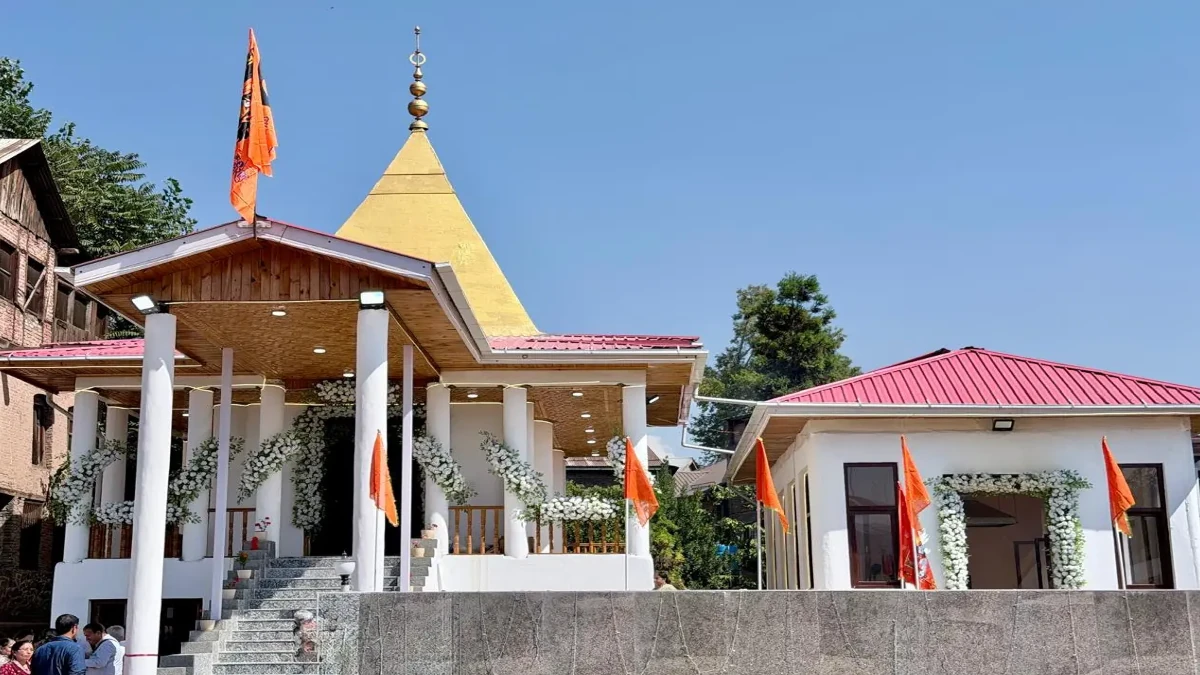
SRINAGAR: The historic Sheetalnath Mandir in Srinagar’s Habba Kadal area has reopened its doors after 36 years, marking the revival of a shrine deeply associated with Kashmiri Hindu heritage and the Valley’s shared cultural traditions.
Mandir bells, Vedic chants and havan rituals filled the restored complex as devotees gathered for prayers. A large number of Kashmiri Pandits, many of whom travelled from different parts of India, attended the reopening. They were also welcomed by local Kashmiri Muslims, highlighting the site’s place in Kashmir’s pluralistic cultural history.
The Mandir had remained closed and neglected for decades after the mass migration of Kashmiri Pandits in 1990. The complex suffered extensive damage, including from arson, during the years of unrest.
The restoration was undertaken by Srinagar Smart City Limited (SSCL) in coordination with the Jammu and Kashmir Department of Culture. Key portions of the complex, including the sanctum sanctorum and havanshala, were structurally rebuilt to make the shrine accessible to devotees once again.
An earlier attempt to conduct prayers at the Mandir was made during Basant Panchami in 2021. However, severe structural damage at the time prevented the shrine from being opened for regular public access.
An ancient shrine of Kashmiri Shaivism
Sheetalnath Mandir holds an important place in the religious history of Kashmir and is associated with Kashmiri Shaivism. The shrine is regarded as one of the ancient Ashta Bhairavs the eight guardian deities traditionally associated with the protection of Srinagar.
Regional traditions also connect the site with sage Kashyapa and the mythology surrounding Satisar, adding to its historical and cultural significance.
Where Hindu and Muslim children studied together
The Sheetalnath complex was more than a place of worship before 1990. It also housed primary and higher secondary schools where Hindu and Muslim children studied together.
The site served as a significant socio-political gathering place in Kashmir during the 20th century. National leaders including Mahatma Gandhi, Jawaharlal Nehru, Indira Gandhi and Atal Bihari Vajpayee are associated with public gatherings held at the location.
Reconnecting displaced families with their heritage
For Kashmiri Pandit families displaced from the Valley, the reopening provides an opportunity to reconnect with a shrine linked to their ancestral and cultural memory.
Officials said the restoration of Sheetalnath is part of a wider effort to preserve historic places of worship across Jammu and Kashmir. The initiative covers Mandirs, Sufi shrines, gurdwaras and mosques that were damaged or neglected during years of unrest.
The reopening of Sheetalnath Mandir therefore marks not only the restoration of an ancient shrine but also the return of a historic cultural space to public life after more than three decades of closure.