Congress wants the Chief Election Commissioner removed. It wants the Special Intensive Revision suspended. Then what is V.D. Satheesan doing in the Chief Minister’s chair?
The question cuts to the heart of Kerala’s politics in October 2026. On 12 October, the Kerala Legislative Assembly, dominated by the Congress-led United Democratic Front, passed a resolution moved by Chief Minister V.D. Satheesan himself. It sought the removal of Chief Election Commissioner Gyanesh Kumar, the restoration of voting rights for those allegedly excluded during the Special Intensive Revision of electoral rolls, and reforms to the process of appointing Election Commissioners. The resolution passed with the support of 137 of the 140 members; the three BJP MLAs opposed it. It was described as historic—the first of its kind by any state assembly.
Yet the same electoral process now under fire had delivered Satheesan his office only months earlier. The Special Intensive Revision in Kerala ran as part of a national exercise, with the enumeration phase from early November to early December 2025. The final electoral rolls were published in February 2026, showing a reduction of roughly 8.57 lakh names from about 2.78 crore to 2.69 crore. Kerala’s Assembly election followed on 9 April 2026—the first after the SIR. Turnout reached 79.53 percent, the highest since 1987. Results declared on 4 May saw the UDF win 102 of 140 seats; the Congress alone took 63. V.D. Satheesan became Chief Minister.
Congress leaders had not always viewed the revision with hostility. Thiruvananthapuram MP Shashi Tharoor, speaking at the Stanford India Conference in May 2026, said he had “no problem with deleting spurious, absent, migrated voters” and added that in Kerala “I suspect the Congress benefited from the deletions because the CPM was long a past master of double enrolment, triple enrolment, quadruple enrolment… That used to happen. And so they were eliminated by the SIR.” Other Congress voices, including references to MLAs noting the removal of fake voters, aligned with the view that a cleaner roll had aided the UDF. Satheesan himself had, at different points, indicated that no legitimate voter in Kerala had been denied the franchise due to the exercise and that names were removed for reasons of absence, death or migration.
“All elections were illegal” – Mallikarjun Kharge
That earlier comfort has evaporated. Now the same party that governs Kerala on the revised rolls attacks the revision in Delhi and demands the Commissioner’s head. Congress president Mallikarjun Kharge has gone further still, declaring that “all elections were illegal,” that every Chief Minister is illegitimate, and that the Lok Sabha and state Assemblies should be dissolved for fresh ballot-paper polls. The statement lands with particular force in Thiruvananthapuram, where the very Assembly now sitting was elected after the SIR. The BJP has seized the contradiction with both hands. General secretary M.T. Ramesh and the state leadership have announced a statewide agitation. Their demand is blunt: if the electoral process is illegitimate, Satheesan must resign, and so must every legislator elected under those rolls. The party calls the demand logical, not theatrical, and promises to press it inside the Assembly and on the streets of every district.
Their argument is straightforward: if the SIR and the Election Commission are illegitimate, then the election conducted on those rolls, the mandate, the Cabinet and the Chief Minister’s chair are tainted. If Congress believes the process is flawed, every legislator elected under it—including those of the Congress, the Left and the Muslim League—should resign. The BJP frames the demand as a logical consequence rather than a political stunt and has pledged to raise it both inside the Assembly and on the streets.
Same Barricades, Different Rules: Congress’s Selective Outrage on Police Action
Congress presents its Delhi protests as peaceful dissent crushed by an authoritarian state. The police record describes a different sequence.
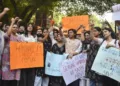
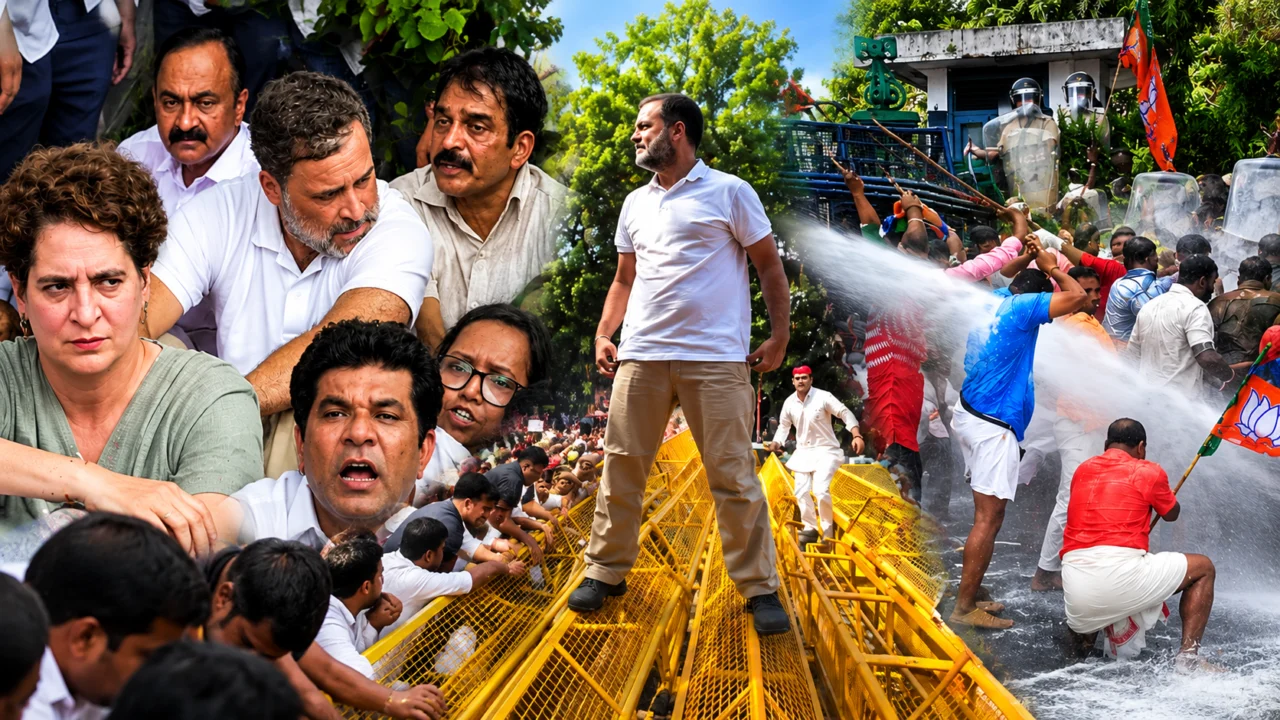
On 6 October 2026, INDIA bloc MPs, led by Rahul Gandhi, set out from Parliament toward the Election Commission headquarters demanding Gyanesh Kumar’s resignation. Delhi Police stated that no permission had been sought or granted from the DCP’s office for the march. The procession was halted near the NITI Aayog office. Rahul Gandhi and Trinamool Congress MP Abhishek Banerjee were seen climbing police barricades. Leaders then entered the Akashvani Bhawan premises through the reception gate despite being stopped. They staged an eight-hour sit-in. Police reported that two guards were injured during attempts by MPs and supporters to force entry. Approximately 260 people were detained after the sit-in.
The following day brought further confrontation. Delhi Police registered FIRs against Rahul Gandhi and Priyanka Gandhi Vadra for allegedly assaulting police personnel and obstructing government work. Ninety-one people were detained during the protest. Rahul Gandhi remarked that he already had 45 FIRs against him and called them a “badge of honour,” adding that he wanted the number to reach 100. Under ordinary circumstances, an MP climbing barricades and entering a government building after permission has been refused would invite police response. The action followed due process once the protest crossed into unauthorised entry and alleged obstruction.
The double standard becomes clearer when set against events in Kerala. When BJP workers attempted to climb barricades or force their way during protests near the Secretariat or other official sites, Congress leaders and the state administration described the police response as the maintenance of law and order. The same principle—that a protest which crosses barricades and breaches entry rules invites police action—applies regardless of which party organises it. Congress demands consistency only when it suits its narrative.
Congress vs the Constitutional Establishment
The Kerala Pradesh Congress Committee (KPCC) sparked a political controversy after its official X handle published a post demanding the resignation of Chief Justice of India (CJI) Surya Kant.
Amid protests in Delhi demanding the resignation of Chief Election Commissioner Gyanesh Kumar, the CJI observed that law and order issues regarding the protests fell outside his domain. In response, the ‘Congress Keralam’ X handle posted: “Dear Surya Kant, if law and order is not your domain, resign now. We will find your replacement who can handle it.” The post expressed anger over the CJI’s decision not to meet INDIA bloc leaders, citing legal and procedural constraints.
The remarks drew strong condemnation from the Supreme Court Bar Association (SCBA), which stated that the comments belittled the judiciary and interfered with the administration of justice. Union Minister Kiren Rijiju also slammed the Congress, accusing the party of trying to destroy independent constitutional institutions. Following the uproar, the post was quickly deleted. KPCC President Sunny Joseph issued a statement clarifying that the post was published without the knowledge, consent, or consultation of the leadership.
Both the state leadership and national Congress spokespersons, including Pawan Khera, distanced themselves from the remarks. The Supreme Court has issued a notice to the KPCC over the controversial post on X targeting the CJI.
The confrontation extended to the judiciary. Rahul Gandhi and Congress president Mallikarjun Kharge wrote to Chief Justice of India Surya Kant seeking an appointment to submit a memorandum on the SIR, the Election Commission, alleged arbitrary arrests, metro closures and train cancellations. The CJI declined. In his letter he noted that the issues were already sub judice before the Supreme Court. Convening a meeting to discuss pending cases would contravene the principle of separation of powers, an intrinsic part of the Constitution’s basic structure, and would be incompatible with judicial propriety and ethics. He advised that anyone—citizen or parliamentarian—could approach the court through the established legal process by filing a petition. Related SIR matters were listed for hearing, with the bench headed by the CJI himself. The BJP welcomed the stance, arguing that the judiciary must remain above day-to-day political contests.
Across these episodes a single pattern emerges. A party that governs Kerala on the strength of an election held after the Special Intensive Revision now seeks to dismantle that revision and remove the Commissioner who oversaw it. Protests that breach police barricades in Delhi are framed as democratic resistance; similar breaches by political opponents in Kerala are treated as disorder requiring firm response. Appeals that bypass ordinary judicial process are preferred to the filing of petitions. The demand for institutional integrity sits uneasily beside the selective application of rules.